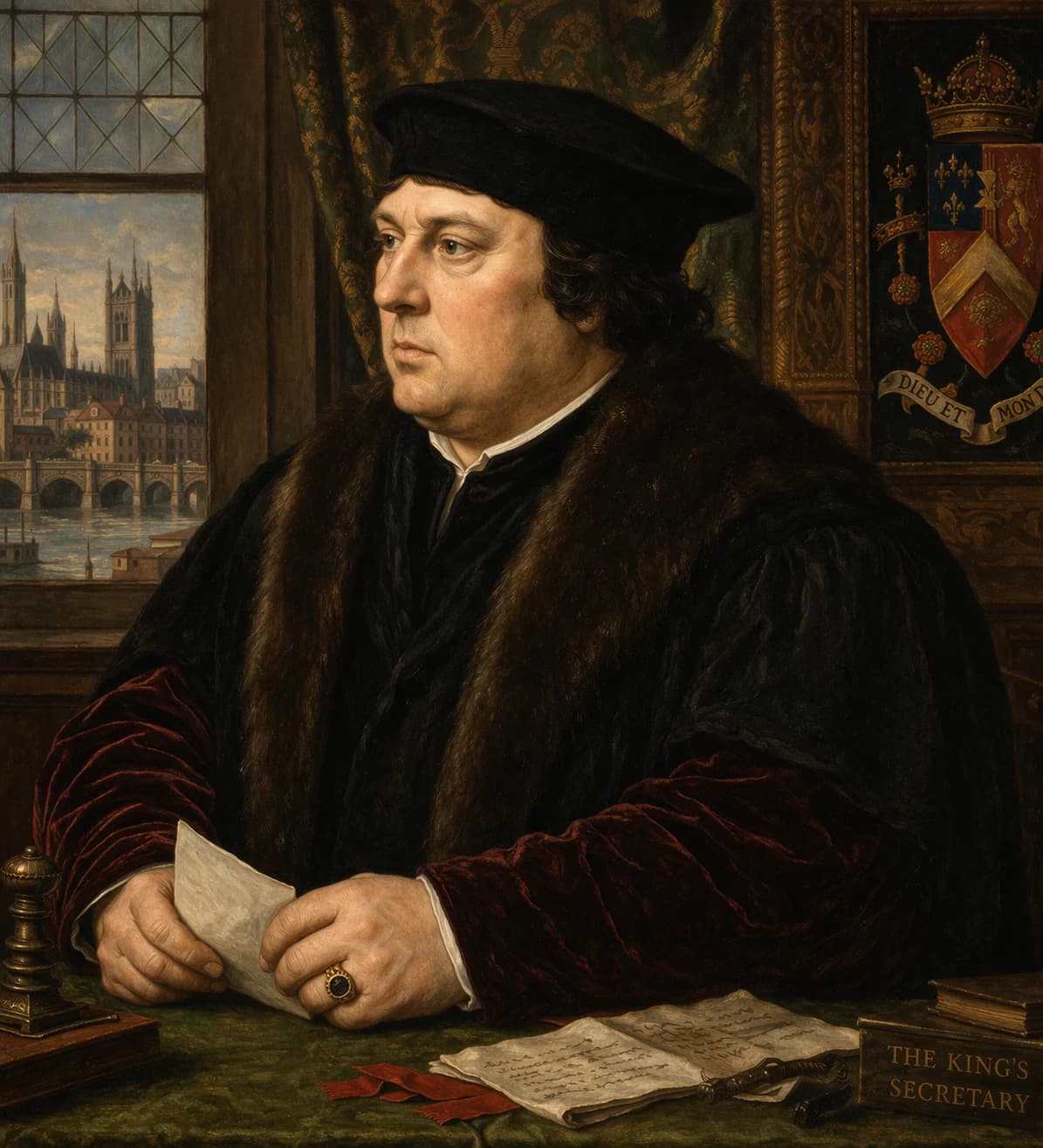
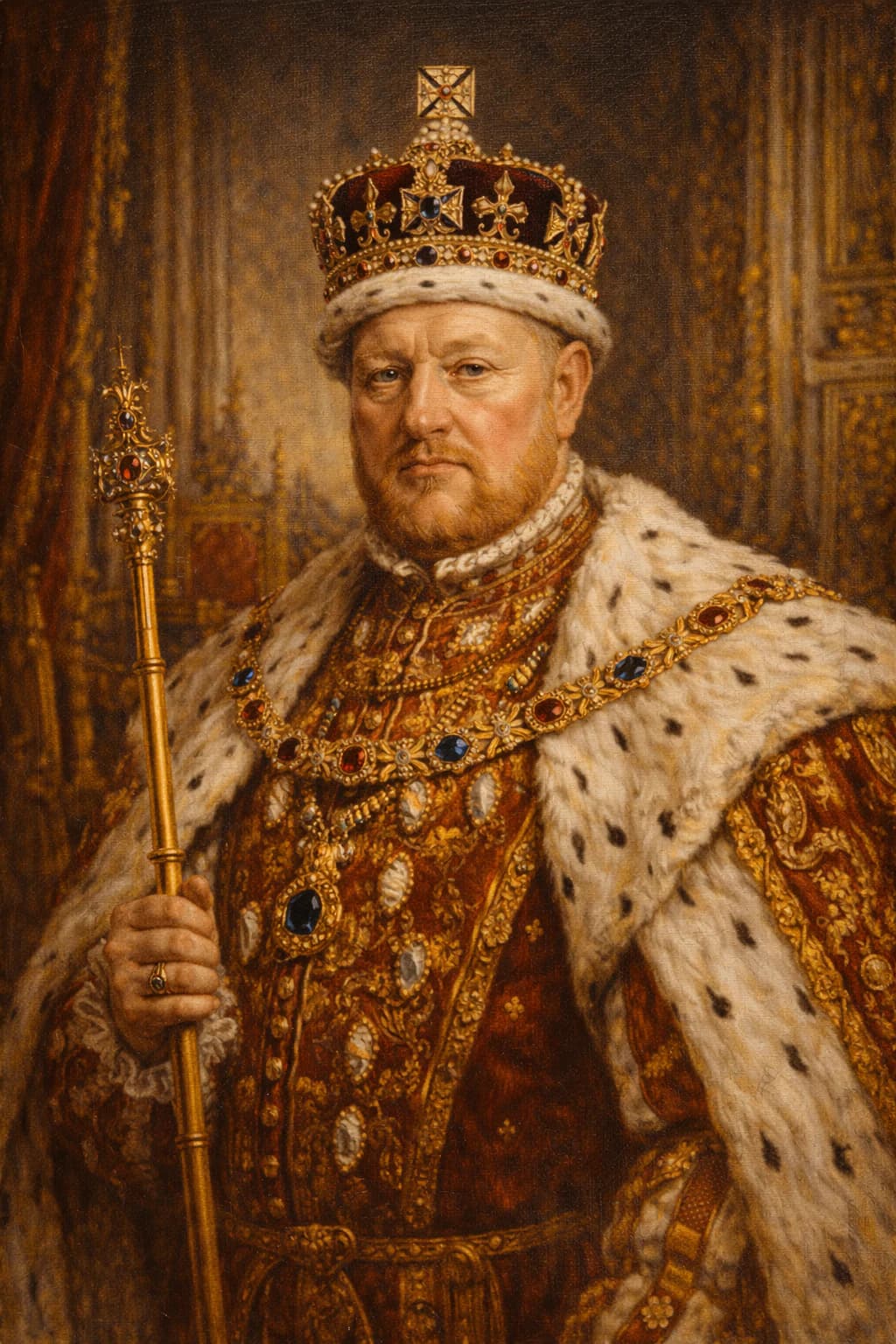
Complete chronology
Full overview and deeper context for every journey step.
1485
Humble beginnings
Cromwell's origins were unusually modest for a man who later dominated Henry VIII's government. His father, Walter, was associated with trades including blacksmithing, brewing and fuller work, and the family had a rough reputation in local records. Later enemies used this background to sneer at Cromwell as an upstart. Yet that outsider status helps explain his strengths. He did not inherit a place in the political nation; he learned to make himself useful. His early life taught adaptability, calculation and emotional toughness. In a court obsessed with blood, lineage and honour, Cromwell built power from skill, information and results.
His lack of privilege became a strength, forcing him to master systems others simply inherited.
1500–1515
European experience
Cromwell's years on the continent gave him a range rare among English administrators. The details are sometimes difficult to pin down, but he appears to have moved through merchant, banking and military worlds in Italy and northern Europe. He learned languages, financial practice, legal habits and the mechanics of international networks. This experience mattered later because Cromwell did not see government as sacred mystery. He saw systems: records, courts, revenues, statutes, agents, inspections and enforcement. Where older aristocrats thought in terms of honour and household influence, Cromwell often thought in terms of machinery. That made him formidable in a monarchy ready to expand its reach.
Travel turned him from a local survivor into a strategist who understood wider systems of power.
1520s
Legal and political entry
Cromwell returned to England with practical skills and used them aggressively. He worked in law, trade and money, becoming the kind of figure powerful people used when a dispute needed managing or a transaction needed making secure. He entered Parliament and developed contacts across church, court and city. His rise was not glamorous at first. It was built through documents, negotiations, debts, favours and the ability to understand what a client actually needed. This was the foundation of his later political style. Cromwell did not merely advise; he delivered. In Henry VIII's court, that capacity could make a man indispensable until the day it made him dangerous.
He rose not through display, but by becoming indispensable to those who held power.
1520–1529
Service to Wolsey
Wolsey was the greatest minister of early Tudor England, and service in his household gave Cromwell a masterclass in power. He saw how patronage, church wealth, royal favour and legal authority could be coordinated by one commanding servant of the crown. He also saw how fast it could collapse. Wolsey fell because he could not secure Henry VIII's annulment from Catherine of Aragon. Many clients would have been destroyed with their patron, but Cromwell defended Wolsey in Parliament and then repositioned himself with remarkable skill. His survival impressed observers. It showed loyalty without political suicide, and it brought him to Henry's attention at exactly the moment the king needed new solutions.
His greatest early test was not success, but surviving the fall of a powerful patron.
1530–1534
Rise under the king
Cromwell's genius was to see that Henry's 'great matter' could become a revolution in jurisdiction. If Rome would not grant the annulment, England could redefine where final authority lay. Cromwell helped use Parliament to make the break legal, public and enforceable. The king would not merely get a new marriage; he would become Supreme Head of the Church of England. Cromwell rose through offices including Master Secretary, Vicegerent in Spirituals and Lord Privy Seal, accumulating authority at extraordinary speed. His power remained dependent on Henry, but he changed the framework in which Henry ruled.
He understood that proximity to power required constant usefulness, not loyalty alone.
1534
Break with Rome
The break with Rome was not a single declaration but a sequence of acts, oaths and enforcement mechanisms. Cromwell helped drive legislation restricting appeals to Rome, controlling clerical revenues, defining succession and requiring recognition of royal supremacy. Parliament became central to the process, giving the revolution a statutory form that outlasted individual proclamations. Cromwell's methods were ruthless when necessary: refusal could mean imprisonment or death, as Thomas More and John Fisher discovered. He was not simply a bureaucrat. He was the architect of a new obedience, using law to bind conscience, church and political loyalty to the Tudor crown.
He turned a personal royal problem into a permanent shift in national power.
1536–1540
Dissolution of monasteries
The dissolution of the monasteries was one of the most dramatic social and economic transformations of Tudor England. Cromwell's visitors investigated religious houses, reporting corruption, superstition and disorder in ways that justified closure. Smaller houses were suppressed first, then larger ones followed. The crown gained enormous wealth, but much land was sold or granted to nobles and gentry, creating new interests tied to the Reformation settlement. The policy destroyed centres of prayer, charity, employment, education and local memory. It also provoked resistance, especially the Pilgrimage of Grace in 1536. Cromwell's achievement was administrative and revolutionary: he made centuries-old institutions disappear through inspection, statute and pressure.
He replaced centuries-old institutions with a system centered entirely on royal authority.
1540
Fall from favor
Cromwell's fall came from the same source as his rise: Henry VIII's needs. Seeking a Protestant alliance, Cromwell helped arrange Henry's marriage to Anne of Cleves. The king disliked Anne almost immediately, and the marriage became a humiliation. Conservative rivals, including the Duke of Norfolk, exploited the moment. Cromwell was accused of treason and heresy, condemned by act of attainder without a full trial and executed on 28 July 1540. Henry later regretted the loss of so effective a servant, but regret came too late. Cromwell's fate showed the terror of Tudor service: a minister could remake the kingdom and still die when the king's desire turned.
His fate showed that in absolute systems, success offers no shield against sudden reversal.
Post 1540
Enduring legacy
Cromwell remains one of the most controversial figures of Tudor history. To admirers, he was a modernising statesman who strengthened the crown, elevated statute, promoted English scripture and built a more disciplined state. To critics, he was a ruthless instrument of tyranny who destroyed religious communities, enriched the powerful and enforced obedience with fear. Both views contain truth. His reforms expanded Parliament's role even as they served royal autocracy. His religious policies advanced Protestant change while depending on coercion. His administrative methods made government more capable and more intrusive. Cromwell matters because he turned Henry VIII's personal crisis into a constitutional and religious transformation from which England never fully returned.
His influence endured not through memory, but through systems that continued to operate.