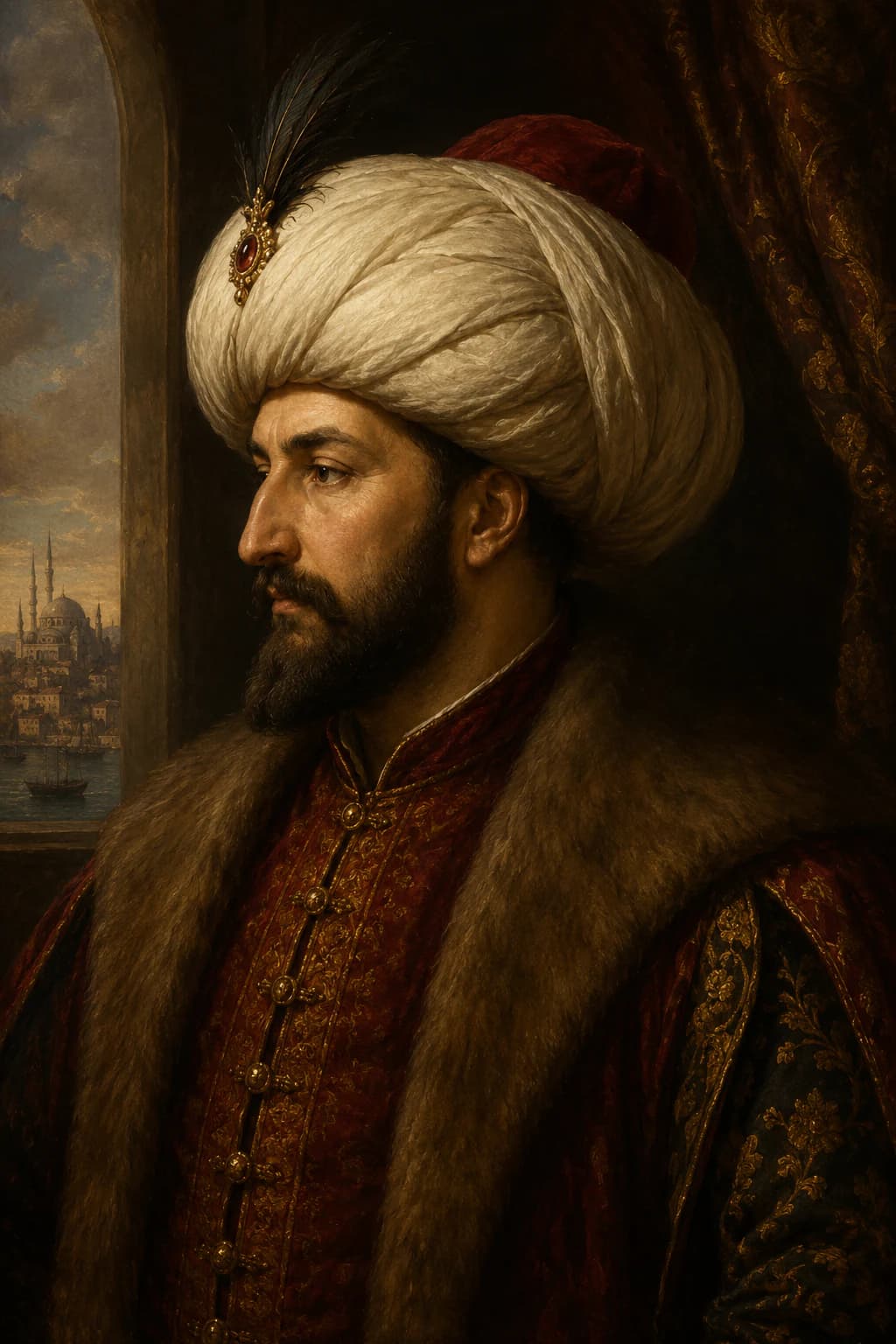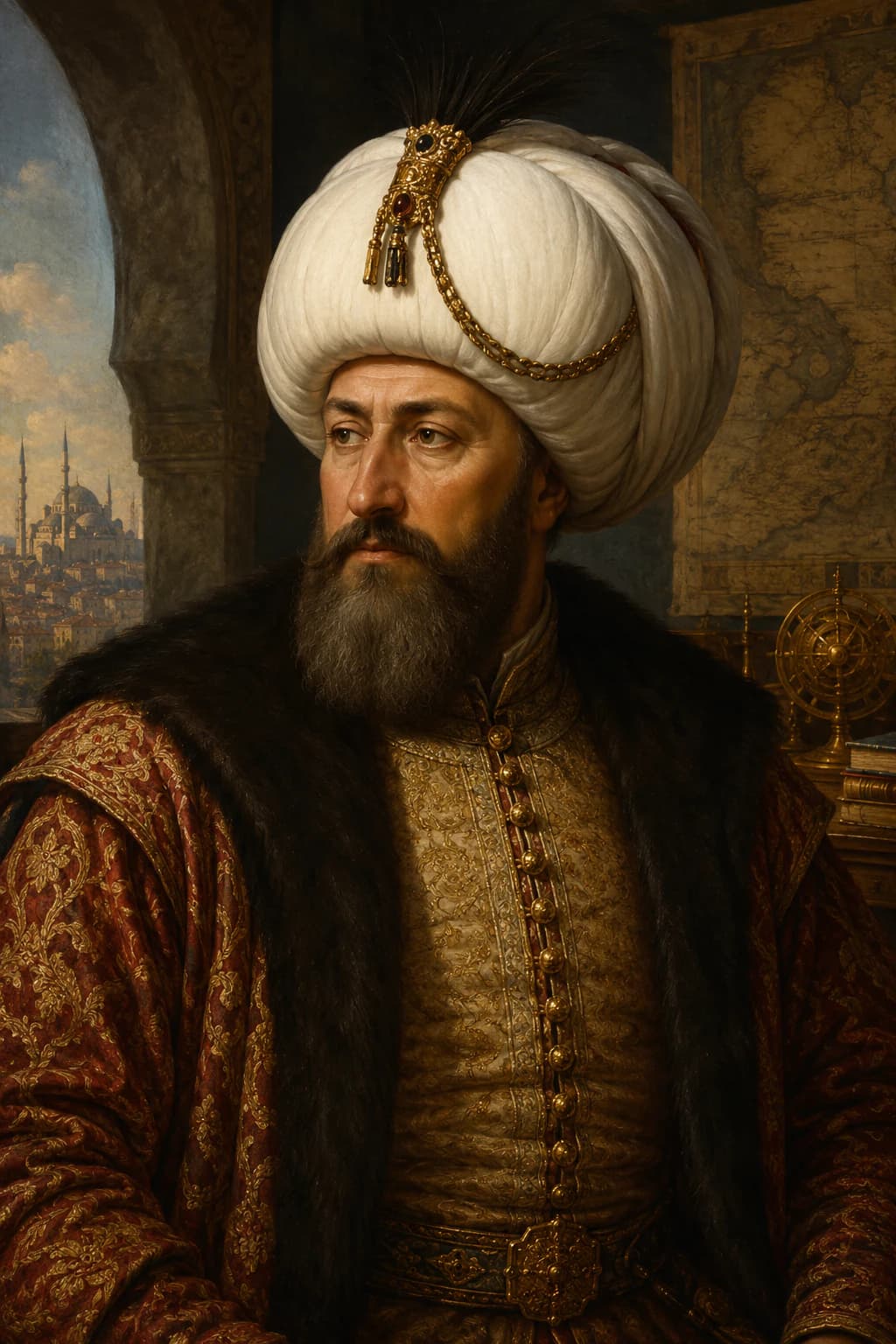
Complete chronology
Full overview and deeper context for every journey step.
1494
Imperial heir
Suleiman I was born in 1494, probably at Trabzon, where his father Selim served as governor before becoming sultan. His mother was Hafsa Sultan. As an Ottoman prince, Suleiman received training in administration, warfare, Islamic learning and courtly culture. He governed provinces before taking the throne, learning how power worked beyond the palace. His father Selim I dramatically expanded the empire by conquering Syria, Egypt and the holy cities of Mecca and Medina through control of the Mamluk realm. When Suleiman inherited power in 1520, he received an empire richer, larger and more prestigious than ever before.
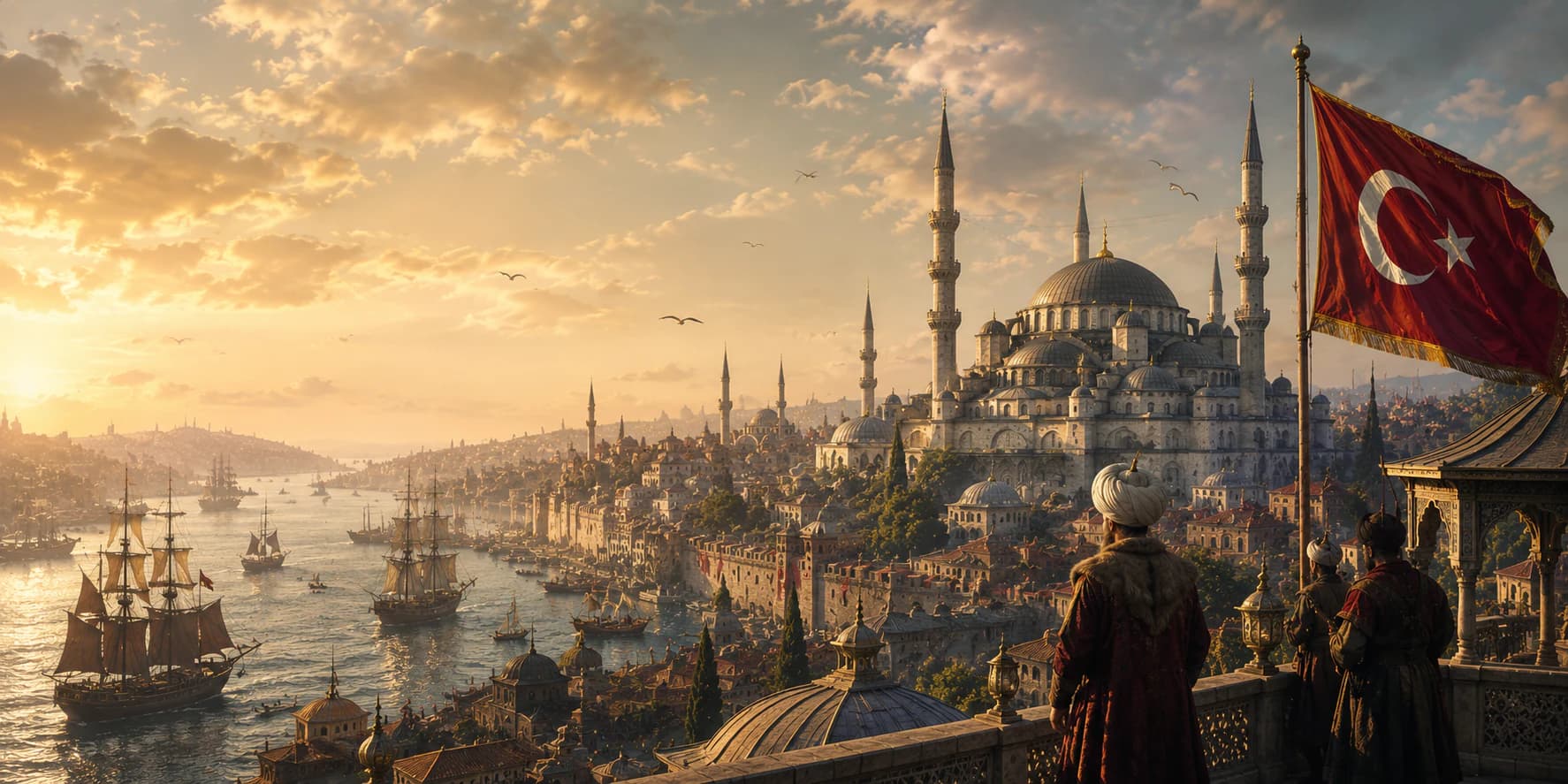
He began where many conquerors hoped to finish: at the head of a vast and confident empire.
1520
Accession
Suleiman came to the throne in 1520 after Selim I's death. European observers sometimes underestimated the young ruler, but he soon demonstrated political confidence and military ambition. He inherited experienced officials, formidable janissaries, a sophisticated fiscal system and an empire positioned between Europe, the Mediterranean and the Islamic world. His reign would be unusually long, allowing him to imprint his personality on Ottoman institutions and culture. Known in Europe as the Magnificent and in Ottoman tradition as Kanuni, the Lawgiver, he became the ruler most associated with the empire's classical age.
His accession did not interrupt Ottoman expansion; it gave that expansion its most famous ruler.
1521-1522
Belgrade and Rhodes
Suleiman's first major campaigns targeted strategic obstacles that had frustrated earlier Ottoman rulers. In 1521, he captured Belgrade, a fortress controlling routes into Hungary and central Europe. In 1522, after a major siege, he took Rhodes from the Knights Hospitaller, removing a Christian military order from a key eastern Mediterranean base. These victories announced that Suleiman would be an active campaigner, not a palace-bound inheritor. They also strengthened Ottoman mobility by land and sea, giving the empire stronger positions from which to pressure both Habsburg Europe and Mediterranean rivals.
His opening campaigns cleared gateways for the wider ambitions of the reign.
1526
Mohacs
The Battle of Mohacs in 1526 was one of Suleiman's most consequential victories. Ottoman forces destroyed the army of King Louis II of Hungary, who died during the rout. The defeat shattered the medieval Kingdom of Hungary and opened a long struggle over central Europe between the Ottomans and the Habsburgs. Suleiman did not simply annex all Hungary at once; the aftermath produced contested claims, client kingship and frontier war. Yet Mohacs changed the strategic map. The Ottoman Empire became a direct force in the politics of Vienna, Prague and the Habsburg monarchy.
Mohacs turned Ottoman power into a central European reality.
1529
Vienna
In 1529, Suleiman marched on Vienna, the Habsburg capital in Austria. The campaign followed the contest over Hungary and aimed to pressure Ferdinand of Habsburg. Bad weather, long supply lines, strong defences and the lateness of the season all worked against the Ottoman army. The siege failed, but it still carried enormous psychological force. Vienna became a symbol in European memory of resistance to Ottoman expansion, while for the Ottomans the campaign showed the logistical limits of projecting power deep into central Europe. Suleiman remained formidable, but distance mattered.
Vienna showed both the reach of Ottoman ambition and the limits imposed by geography and supply.
1530s
Mediterranean power
Suleiman's empire was not only a land power. In the Mediterranean, Ottoman strength expanded under the admiral Hayreddin Barbarossa, who brought North African corsair power into closer imperial service. The Ottoman fleet challenged Habsburg and Venetian interests, supported Muslim polities and projected power across sea lanes. The victory at Preveza in 1538 helped confirm Ottoman naval dominance in the eastern Mediterranean. Suleiman's alliance with Francis I of France against the Habsburgs also showed the diplomatic flexibility of the age: religious divisions mattered, but strategic rivalry could override them.
Ottoman greatness under Suleiman moved by ship as well as by army.
1530s-1550s
The Lawgiver
In Ottoman memory, Suleiman's title Kanuni, the Lawgiver, points to one of the central achievements of his reign. He did not replace Islamic law, but he organised and issued sultanic regulations, or kanun, that addressed taxation, landholding, criminal practice and administration across a vast empire. The goal was not abstract reform for its own sake. Law helped stabilise revenue, discipline officials and present the sultan as guardian of justice. His reign also flourished culturally, especially through architecture under Mimar Sinan, whose mosques gave imperial authority a monumental form in stone.
Suleiman's power endured because it was written into law and built into cities.
1530s-1560s
Hurrem and succession
Suleiman's household politics were unusually important. His consort and later legal wife Hurrem Sultan rose to extraordinary influence, breaking older expectations about the role of a concubine mother in the imperial family. The succession question became dangerous, especially around Prince Mustafa, Suleiman's popular eldest son by Mahidevran. In 1553, Mustafa was executed on Suleiman's order during campaign, after accusations of treason. The decision remains one of the darkest episodes of the reign. It protected Suleiman's authority in the moment, but it damaged his image and intensified later debates about palace politics, dynastic fear and the human cost of absolute rule.
At the height of empire, the most dangerous battlefield could still be the royal family.
1566
Szigetvar
In 1566, the aged Suleiman led one final campaign into Hungary against the fortress of Szigetvar, defended by Nikola Subic Zrinski. The siege was costly and symbolic. Suleiman died in his tent before the fortress finally fell, and his death was initially concealed to preserve army discipline. His son Selim II succeeded him. The scene captured the contradictions of the reign: magnificence and exhaustion, conquest and mortality, imperial theatre and practical command. Suleiman had ruled for forty-six years, longer than almost any Ottoman sultan, and his death marked the end of an era.
He died as he had ruled: on campaign, with the empire still moving behind him.
After 1566
Imperial legacy
Suleiman the Magnificent remains the most internationally famous Ottoman sultan after Mehmed the Conqueror. His reign stretched Ottoman authority across Hungary, Iraq, the Red Sea world and the Mediterranean, while his court projected refinement, legality and universal monarchy. Historians no longer treat the decades after him as simple decline, but his reign did mark a summit of confidence and visibility. He mattered because he combined conquest, administration, diplomacy, legal order and cultural patronage on a scale few rulers matched. To ask why Suleiman was important is to ask how the Ottoman Empire became a world power with a language of rule as impressive as its armies.
His legacy is not only that the empire grew, but that it learned how to look and act like a universal power.