Complete chronology
Full overview and deeper context for every journey step.
c. 470 BCE
Athenian Origins
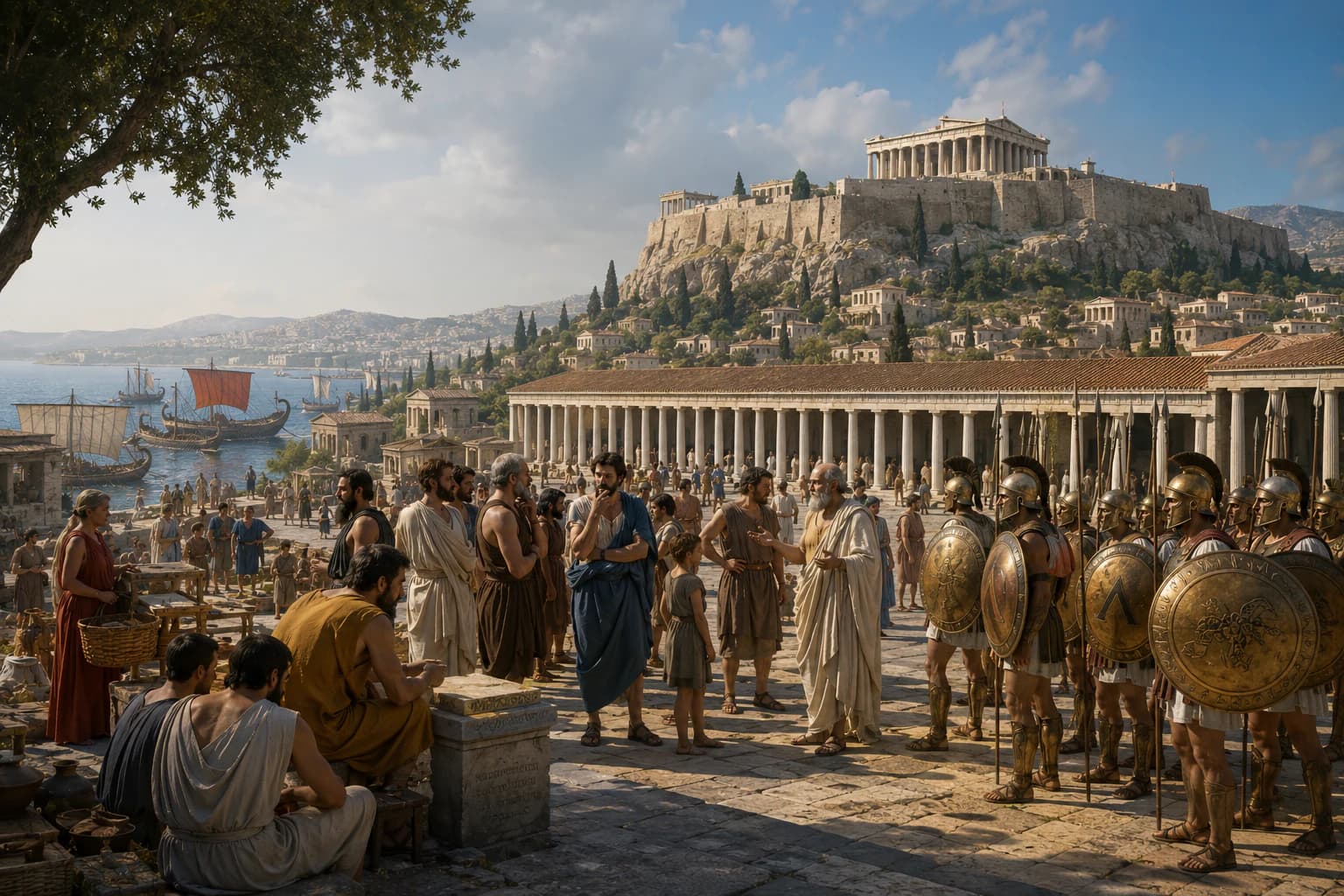
Socrates grew up in a city unlike almost any other in the Greek world. Athens was expanding its naval power, experimenting with citizen democracy and turning public speech into a civic art. The law courts, assembly, theatre and marketplace all trained Athenians to argue about justice, honour, courage and the good of the city. Socrates did not come from the highest aristocracy. Ancient tradition names his father as Sophroniscus, a stonemason or sculptor, and his mother as Phaenarete, a midwife. Whether every detail is recoverable or not, the picture matters: Socrates was not a remote professor but an Athenian citizen formed by the noise of public life. His philosophy would keep that civic texture. He asked questions in streets and workshops, not in a private school.
His philosophy began in the public life of Athens, where argument was both a habit and a danger.
early adulthood
Citizen and soldier
Socrates' life was not spent safely outside the demands of his city. He served in the Peloponnesian War, with ancient sources placing him at campaigns such as Potidaea, Delium and Amphipolis. Plato and others remembered his endurance, physical toughness and calm under pressure, qualities that complicate the image of Socrates as merely a talker. He also served in civic office when required, including a famous episode during the trial of the generals after Arginusae, when he resisted an illegal collective proceeding. These details reveal a thinker whose ideas about virtue were tested by public duty. He asked what courage, justice and obedience meant because he lived in a city where those words had consequences.
Socrates' questions about virtue carried weight because he had faced danger, duty and public pressure himself.
mid life
Method of Questioning
Socrates did not build a doctrine in the usual sense. He became famous for a method. Someone would claim to know what justice, piety, courage or wisdom meant; Socrates would ask for a definition; the answer would be tested through examples; and the speaker would often discover that confidence had outrun understanding. This style, later associated with the Socratic method, was not simple negativity. Socrates believed that moral seriousness required intellectual honesty. To discover that one did not know was not failure but a beginning. His conversations also shifted Greek thought toward ethics: not only what the cosmos is made of, but how a human being should live.
He made ignorance visible so that genuine inquiry could begin.
mid life
Public Engagement
Socrates' public presence made him magnetic and irritating in equal measure. Unlike paid sophists, he insisted that he did not sell wisdom, and unlike conventional teachers, he left no manual. His classroom was Athens itself. He spoke with ambitious young men such as Alcibiades and Critias, with craftsmen whose practical knowledge he respected, and with politicians whose claims to wisdom he distrusted. This openness gave philosophy a democratic setting, but it also made his influence hard to control. To admirers, he liberated minds from lazy opinion. To enemies, he encouraged clever young men to sneer at fathers, generals and laws. The same method that made him important also made him vulnerable.
A public philosophy reaches more people, but it also creates public enemies.
later years
Challenging Authority
The Athens that tried Socrates was not the confident city of Pericles. It had lost the Peloponnesian War to Sparta, endured plague, watched its empire collapse and survived the brutal rule of the Thirty Tyrants. Some of Socrates' former associates had dark reputations: Alcibiades had betrayed or embarrassed Athens more than once, and Critias became one of the Thirty. Socrates was not responsible for their actions, and ancient sources present him as resisting injustice under both democracy and oligarchy. But in a wounded city, association mattered. His refusal to flatter public opinion, his habit of exposing ignorance and his unconventional religious language made him look dangerous to those who wanted civic confidence restored.
Socrates became controversial because private inquiry collided with a city's political trauma.
399 BCE
Trial and Accusation
The formal charges against Socrates accused him of not recognizing the gods of the city, introducing new divine things and corrupting the youth. The religious language should not be dismissed as a disguise, because Greek civic religion was bound tightly to public order. Yet the trial also carried political memory. Socrates had spent decades making prominent men look foolish, and some of the young men drawn to him had become notorious. His accusers, including Meletus, Anytus and Lycon, presented him as a threat to Athens' moral fabric. The case therefore asked a larger question: could a democracy tolerate a citizen who treated majority confidence as something to be cross-examined?
The trial turned philosophical irritation into a legal judgment about civic danger.
399 BCE
Defense in Court
Socrates' defence, preserved most famously by Plato, is part history and part literary-philosophical portrait. Even allowing for Plato's shaping hand, the central stance is striking. Socrates did not present himself as harmless. He argued that his questioning was a divine mission, a gadfly sent to stir a sluggish horse. He denied teaching for payment and insisted that he exposed false wisdom because the oracle at Delphi had forced him to examine what wisdom meant. His tone was courageous but also provocative. By refusing the usual displays of remorse or supplication, he defended his integrity while making acquittal harder. He would not purchase life at the cost of becoming someone else.
His defence made survival secondary to the consistency of his life.
399 BCE
Sentence and Death
After conviction, Socrates was sentenced to death. Plato's Crito presents friends urging escape, but Socrates argues that he cannot answer injustice with lawbreaking after a lifetime lived under the city's laws. The argument remains debated: was he honouring law, submitting to a flawed verdict, or staging a final lesson in philosophical integrity? Whatever the interpretation, his death in 399 BC became one of the most charged scenes in intellectual history. In the Phaedo, Plato depicts him calmly discussing the soul before drinking hemlock. The literary polish is obvious, but the symbolic force endured: Socrates turned execution into a final examination of fear, justice and the good life.
His death made philosophy look less like speculation and more like a way of living.
after 399 BCE
Philosophical Legacy
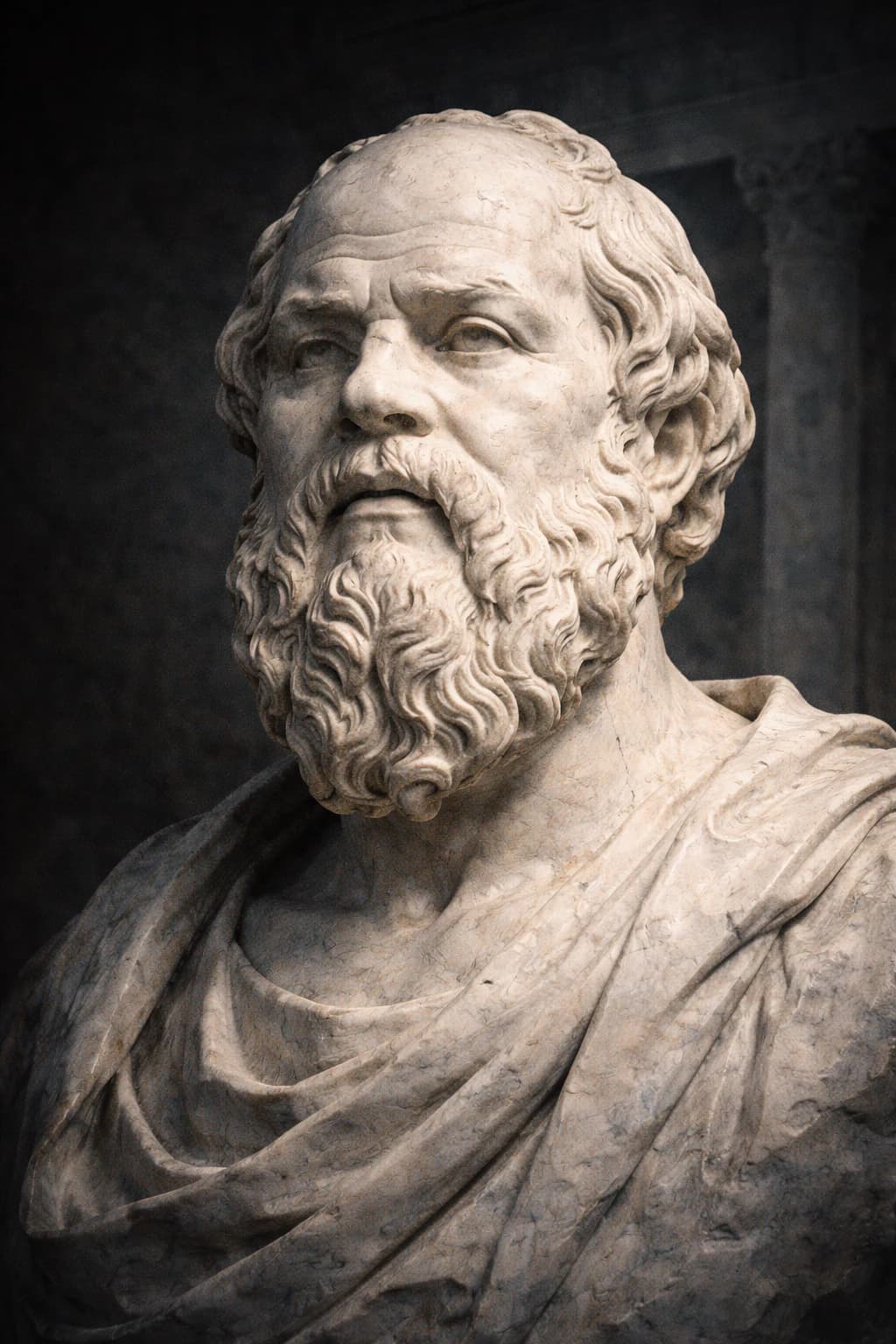
The historical Socrates is difficult to recover because he wrote nothing. We meet him through others: Plato's searching dialogues, Xenophon's more practical reminiscences, Aristophanes' comic caricature and later traditions shaped by admiration or argument. That uncertainty is part of his importance. Socrates became not only a man but a problem: how should knowledge be tested, what is virtue, can democracy punish truth-telling, and is an unexamined life worth living? Plato turned his teacher's method into a philosophical world. Aristotle inherited a tradition transformed by Socratic questions. Later religious thinkers, sceptics, humanists and political dissidents found in him a model of conscience under pressure. Socrates matters because he made thinking accountable to life.
His greatest legacy is not a doctrine but a demanding habit of examination.