Complete chronology
Full overview and deeper context for every journey step.
c. 1540
Early Seafaring Life
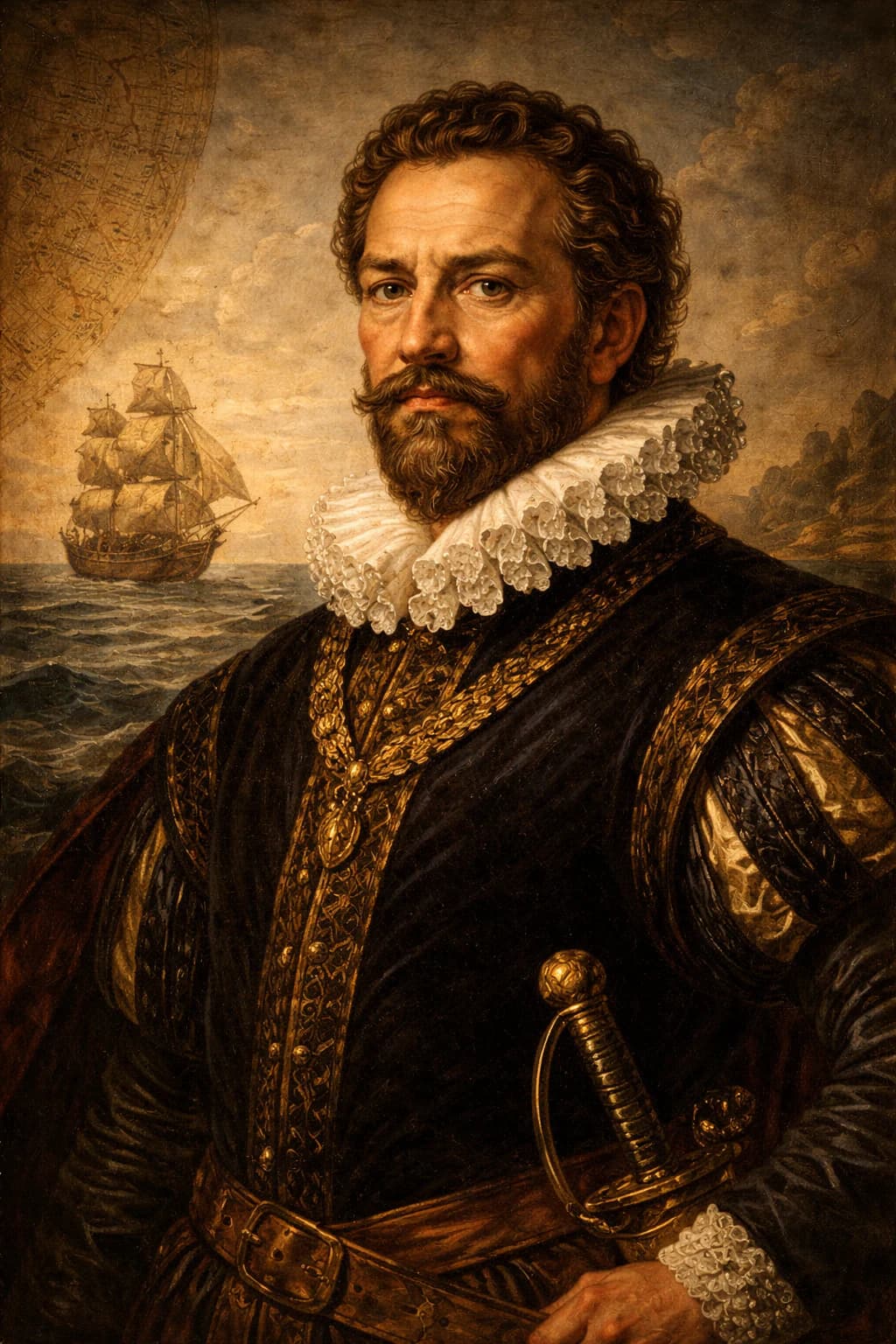
Drake's early life is partly shadowed by later legend, but the broad setting is clear. He came from England's West Country, a region tied to fishing, coastal trade, Atlantic ventures, and Protestant suspicion of Catholic Spain. He was related to the Hawkins family, whose commercial and slaving voyages exposed him to the brutal realities of the expanding Atlantic economy. Drake learned seamanship not in classrooms but on decks, in ports, and through risk. That mattered. Elizabethan England had limited formal naval power compared with Spain, so men who understood ships, weather, profit, and violence became strategically valuable.
Early immersion in a demanding environment can quickly build both skill and ambition.
1560s
First Expeditions
In the 1560s Drake joined voyages associated with John Hawkins, including expeditions bound up with the slave trade and illicit commerce in Spanish America. These ventures were profitable, violent, and morally ugly, and they should not be softened into simple adventure. The 1568 clash at San Juan de Ulua, where Spanish forces attacked English ships after a tense agreement collapsed, became central to Drake's memory of Spain. Whether he understood it as betrayal, warfare, or commercial rivalry, the experience sharpened a lasting hostility. From then on, Drake's career moved toward a pattern: strike Spanish wealth where it was vulnerable and turn private revenge into national service.
Experience in high-risk environments often builds both confidence and tactical awareness.
1570s
Privateering Career
Privateering gave Elizabethan England a useful ambiguity. Drake could raid Spanish ports and shipping with royal encouragement, investors could share the profits, and the queen could deny full responsibility when diplomacy required it. His attacks on the Spanish Main made him notorious. To English Protestants, he looked like the daring edge of a small kingdom resisting Catholic empire. To Spanish officials, he was a pirate whose violence threatened lives, property, and imperial order. Both readings contain truth. Drake's importance lies partly in that blur: he stood where commerce, religion, state power, personal ambition, and maritime warfare overlapped.
State-supported risk-taking can accelerate both personal success and national rivalry.
1577-1580
Voyage Around the World
Drake's voyage around the world was exploration, intelligence-gathering, raiding expedition, and investment scheme at once. Leaving England in 1577, he passed through the Strait of Magellan, entered the Pacific, and struck Spanish settlements and ships along a coast where Spain had not expected English attack. The capture of the treasure ship Nuestra Senora de la Concepcion, often called the Cacafuego, made the voyage spectacularly profitable. Drake then crossed the Pacific and returned via the Indian Ocean and the Cape of Good Hope. The achievement expanded English geographical knowledge, proved long-range naval reach, and announced that Spain's oceanic empire was not untouchable.
Pushing beyond known limits can redefine what is considered possible.
1581
Royal Recognition
Drake's knighthood was a carefully staged political act. Elizabeth I benefited from his treasure and from the strategic pressure he placed on Spain, but open endorsement risked worsening relations with Philip II. By knighting him aboard the Golden Hind, she turned maritime plunder into national prestige. The gesture told English audiences that Drake's violence could be interpreted as service to the realm. It also told Spain that England was becoming bolder. The ceremony did not settle the moral question of Drake's actions; it showed how power could transform an outlaw in one empire into a decorated hero in another.
Recognition from authority can legitimize actions that are otherwise contested.
1580s
Naval Leadership
Drake's most effective naval talent was offensive disruption. In 1587 he attacked Cadiz and destroyed or captured ships and supplies being prepared for Spain's invasion fleet, an exploit remembered as singeing the King of Spain's beard. The phrase is colourful, but the strategic point was serious: time mattered. England needed months to prepare ships, crews, coastal defences, and command arrangements. Drake's raid did not end the Spanish threat, but it damaged logistics and delayed the Armada. His career shows that early modern naval war was often decided before the grand battle, through supply, weather, intelligence, and the ability to unsettle an enemy's timetable.
Experience gained in smaller operations can translate into leadership in larger conflicts.
1588
Conflict with Spain
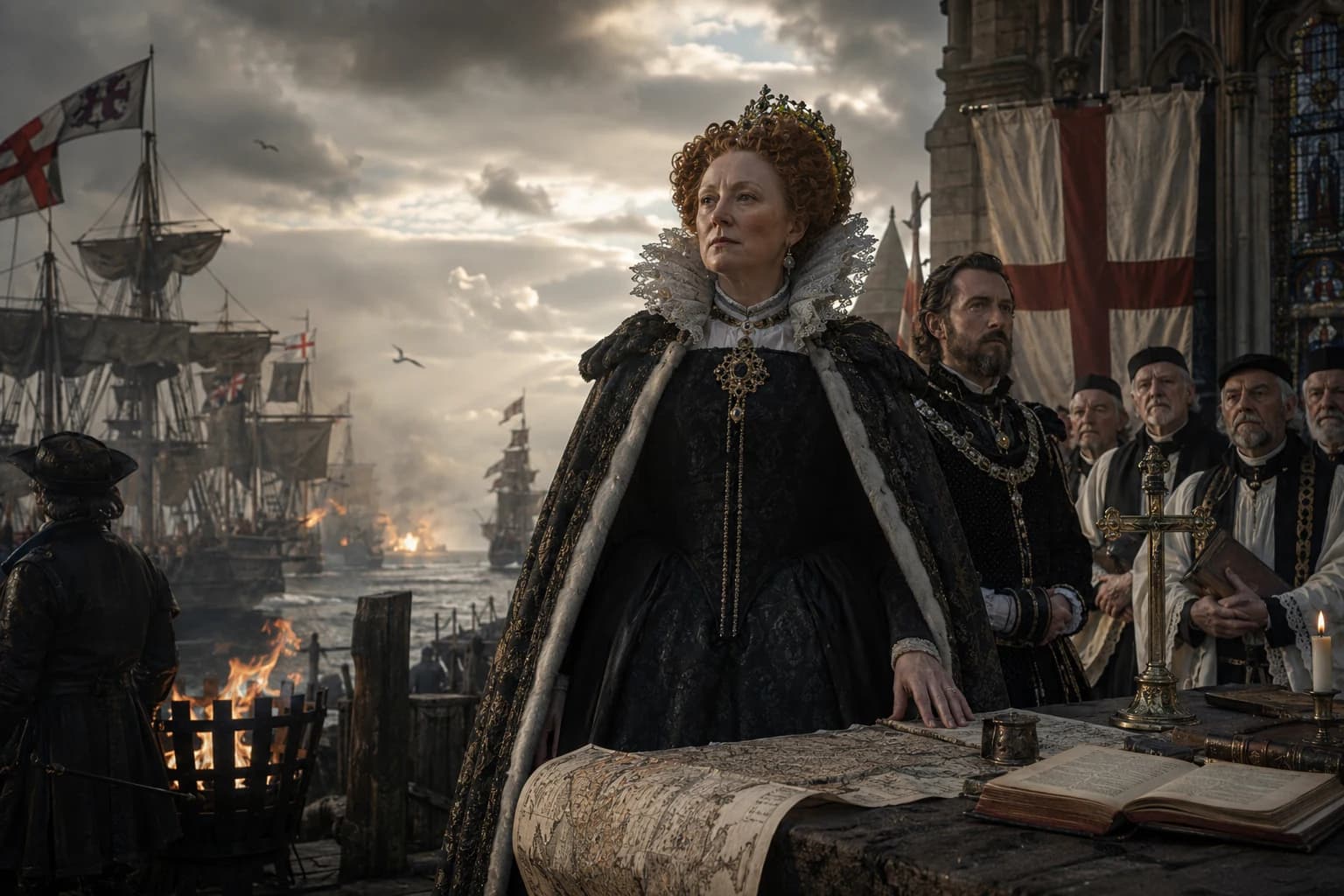
Drake was not the sole hero of the Armada, and the English victory was not his alone. Lord Howard of Effingham commanded the fleet, while many captains, sailors, gunners, shipwrights, and coastal communities played essential roles. Drake's experience mattered because the English strategy relied on manoeuvre, long-range gunnery, and refusing the close grappling battle Spain preferred. Fireships at Calais helped break the Armada's formation, and storms later completed the disaster as the Spanish fleet struggled around Scotland and Ireland. The campaign became a Protestant national myth, but beneath the myth was a real shift: England had survived invasion and gained confidence at sea.
Strategic use of skill and coordination can overcome even larger opposing forces.
1590s
Later Expeditions
After 1588, Drake's reputation remained immense, but success became harder. The 1589 English Armada against Iberia failed badly, exposing the limits of English organisation when operating on a large scale. Later ventures in the Caribbean produced disappointment rather than glory. Spain adapted, fortifications improved, disease struck crews, and the balance between daring and overreach became less favourable. Drake remained courageous, but courage could not overcome every logistical and strategic problem. His decline is important because it strips away the legend just enough to reveal the historical man: formidable, experienced, ambitious, and fallible.
Sustaining success becomes harder as conditions change and opposition adapts.
after 1596
Legacy at Sea
Drake died of disease during an unsuccessful expedition against Spanish America and was buried at sea near Portobelo. His afterlife has been unusually contested. In English memory he became the bold Elizabethan seafarer who circled the globe, helped defeat the Armada, and opened horizons for later maritime expansion. In Spanish memory he remained a corsair and pirate. In modern history he also belongs to the violent Atlantic world that included raiding, forced labour, and the slave trade. To ask why Francis Drake was important is not to choose between hero and villain as if history were a courtroom with one verdict. It is to see how early English empire grew through courage, theft, faith, profit, and war.
Historical figures can embody both achievement and controversy, shaping how they are remembered.