Complete chronology
Full overview and deeper context for every journey step.
1916
Modest beginnings
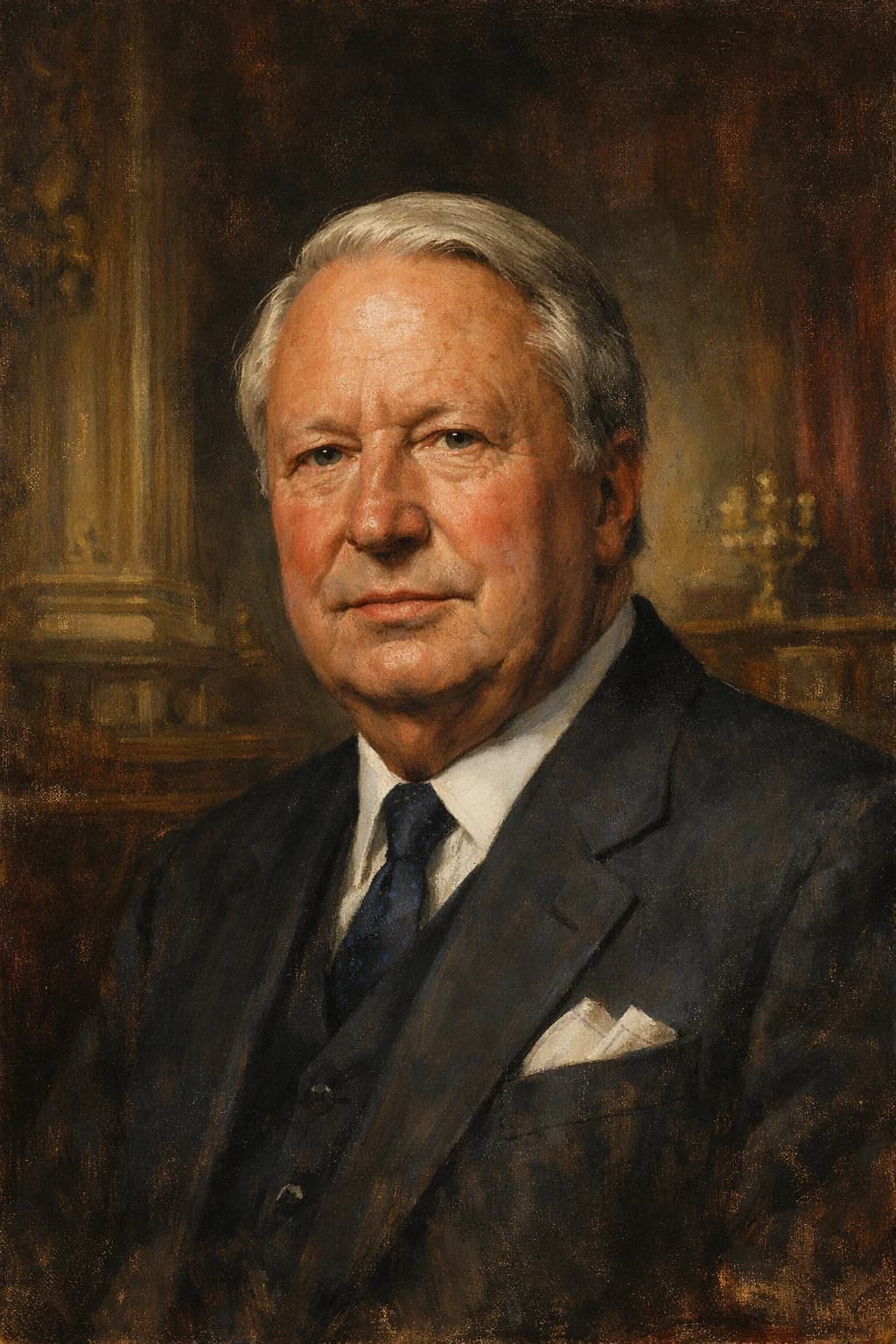
Edward Heath's importance begins with social movement. He was not born into the old Conservative establishment, but into a lower-middle-class household that valued work, music, discipline, and education. Winning a place at Chatham House Grammar School and then Balliol College, Oxford, gave him access to elite networks without making him feel fully at home in them. That outsider quality never entirely left him. It fed his seriousness, his impatience with clubby politics, and his belief that Britain had to modernise if it was to avoid genteel decline.
His outsider status in elite politics shaped both his determination and his distance from colleagues.
1930s
Oxford and formation
The 1930s gave Heath his political compass. As an Oxford student politician he watched Europe move toward catastrophe and became hostile to appeasement of fascist powers. He visited Nazi Germany and Republican Spain, experiences that strengthened his belief that nationalism and isolation could become deadly. For Heath, European cooperation was never merely a trade arrangement. It was a lesson drawn from war's approach: states that treated each other only as rivals could destroy themselves. That conviction would later make him unusually committed, and unusually stubborn, on Britain's European future.
His belief in cooperation over confrontation took root long before he entered national politics.
1939–1945
War service
Heath's war service was substantial rather than decorative. He served in the Royal Artillery, took part in the Normandy campaign, and gained experience of command, logistics, and continental warfare. The war confirmed what the 1930s had taught him: Britain's security could not be separated from Europe's political order. It also reinforced his managerial style. Heath admired planning, competence, and institutional seriousness. He was not a natural populist and rarely pretended to be one. His authority came from preparation and command rather than warmth.
War confirmed his conviction that political fragmentation could lead to disaster.
1950
Entry to Parliament
Heath entered Parliament during the postwar settlement, when Conservatives had to adapt to the welfare state, decolonisation, and Labour's new social reforms. His early rise came through organisation. As Chief Whip under Anthony Eden he mastered party management, discipline, and the unglamorous arithmetic of parliamentary power. This work suited his temperament. He valued order and loyalty, but it also encouraged a command style that later colleagues could find rigid. By the early 1960s, as Lord Privy Seal, he led Britain's first attempt to join the European Economic Community, blocked by Charles de Gaulle in 1963.
He advanced not through charisma, but through competence and persistence.
1965
Rise to leadership
Heath's leadership marked a change in Conservative politics. The old magic circle of aristocratic succession had been weakened, and MPs now chose their leader by ballot. Heath defeated Reginald Maudling and presented himself as a moderniser: technically competent, socially mobile, and committed to economic efficiency. Yet his leadership exposed a problem that never disappeared. He could analyse Britain's weaknesses, but he struggled to make voters feel emotionally included in his answer. His reserve was dignified to admirers and cold to critics. In a television age, that mattered.
His leadership symbolised change within the party, even as his style remained cautious.
1970
Becoming prime minister
The 1970 election brought Heath to power against expectations. He entered Downing Street determined to shift Britain away from what Conservatives saw as corporatist stagnation: government bargaining with unions, propping up weak industries, and managing decline through compromise. His early programme sought market discipline and industrial reform. But the realities of office were harsher than the manifesto. Rising unemployment, pressure on major firms, and union confrontation forced retreats, including the rescue of Rolls-Royce. Heath's government began as a project of firmness and became a lesson in how difficult it was to govern Britain's troubled economy.
His victory gave him opportunity, but also exposed the limits of control in a turbulent economy.
1973
Europe achieved
Britain's entry into the European Economic Community was Heath's defining achievement. After earlier French vetoes, he negotiated membership and carried the legislation through Parliament despite opposition inside both major parties. For Heath, joining Europe was about economic scale, political influence, and a postwar settlement that would bind former rivals together. Critics saw a loss of sovereignty and a decision made without sufficient popular consent, though a referendum in 1975 later endorsed continued membership. The argument did not end. Heath's victory opened a European debate that shaped British politics for half a century and culminated, long after his death, in Brexit.
He prioritised long-term strategic alignment over short-term political comfort.
1973–1974
Strikes and crisis
Heath's premiership collapsed under a combination of domestic and global shocks. The 1973 oil crisis intensified inflation and economic strain. Conflict with the National Union of Mineworkers led to energy shortages and the three-day week, a dramatic symbol of a country rationing electricity and confidence. Heath called the February 1974 election around the question of who governed Britain: elected ministers or union power. Voters did not give him the answer he wanted. The Conservatives won more votes than Labour but fewer seats, and Heath could not form a stable government. Harold Wilson returned to office.
His attempt to assert control instead revealed how constrained leadership could be.
1975–2005
After power
Heath never reconciled himself to Margaret Thatcher's leadership. Her victory in 1975 was personal, ideological, and generational: a rejection of his authority and eventually of much of his economic method. He remained in Parliament until 2001, defending European integration and criticising Conservative Euroscepticism with increasing bitterness. His later reputation is therefore divided. He was the prime minister who achieved EEC entry and represented a serious, internationalist Conservatism. He was also the leader defeated by industrial conflict and unable to command the emotional politics of the 1970s. To ask why Edward Heath was important is to see Britain at a hinge point: postwar consensus failing, Thatcherism not yet born, and Europe becoming the question that would not go away.
Even without power, he refused to compromise on the principles that had defined him.