Complete chronology
Full overview and deeper context for every journey step.
1732-1760s
Early trade
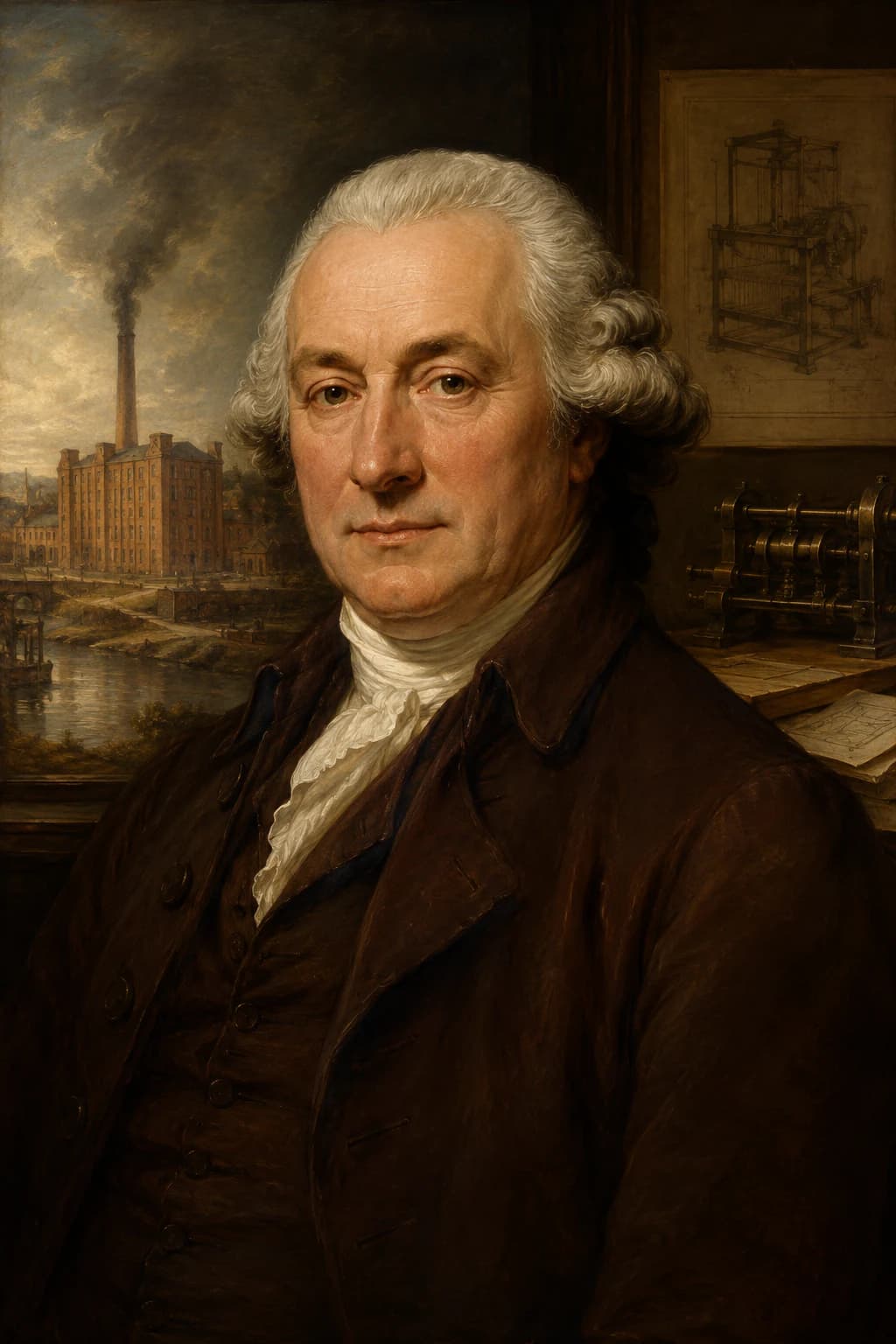
Richard Arkwright was born in Preston, Lancashire, on 23 December 1732, far from the polite world of learned societies and aristocratic patronage. His family background was modest, and his early work belonged to the practical economy of towns rather than universities. He trained as a barber and became involved in wig making, a trade that demanded manual skill, attention to fashion, and a sharp sense of what customers would pay for. That experience did not make him an engineer in the formal sense, but it did give him habits that mattered in the early Industrial Revolution: calculation, salesmanship, mobility, and confidence in ordinary craft knowledge. Arkwright's later success came from seeing invention as a business system. He was not content with a clever machine on its own. He wanted machinery that could be financed, protected, supervised, and made profitable. This is why his origins matter. The Industrial Revolution was not driven only by isolated geniuses discovering new principles. It was also driven by ambitious practical people who could recognise a bottleneck, gather partners, secure money, impose routines, and turn experiment into production.
Industrial change often needed organizers and entrepreneurs as much as inventors.
1769
The water frame
The problem that drew Arkwright into textile machinery was simple to state and difficult to solve: cotton weaving needed more strong yarn than hand spinning could reliably supply. James Hargreaves's spinning jenny increased output, but the yarn it produced was generally better suited to weft than to the stronger warp threads needed for fully cotton cloth. Arkwright's answer was the spinning frame later known as the water frame. Patented in 1769, it used pairs of rollers moving at different speeds to draw out cotton fibres before twisting them into yarn. Powered operation made the process faster and more regular than hand spinning. The machine's history is not clean. John Kay, a clockmaker, worked with Arkwright, and Kay had earlier been connected with Thomas Highs, whose role in the development of roller spinning became part of later patent disputes. It is safest to say that Arkwright patented and commercialised the water frame rather than imagining him as the sole source of every technical idea. His importance lies in what he did next. The water frame was too large and power-hungry to fit easily into domestic work. It needed capital, maintenance, supervision, and a dependable energy source. In other words, the machine pointed toward the factory.
Some inventions change the workplace because their size and power needs demand a new setting.
1771
Cromford Mill
Cromford Mill, begun in Derbyshire in 1771, was Arkwright's great turning point. The site gave him what the water frame required: reliable water power, room for expansion, and a setting where production could be concentrated. This was not merely a workshop with better equipment. Cromford brought raw cotton, powered machinery, workers, supervision, and output into a single coordinated process. The mill helped define what later generations meant by the factory system. Work could be timed, tasks divided, machines arranged in sequence, and labour disciplined around the needs of continuous production. Arkwright also had to solve social problems created by the mill itself. Cromford was not a large industrial city waiting with a ready workforce. Workers had to be recruited, housed, trained, and kept near the machines. Families, including children, became part of the early mill labour system. That reality gives Arkwright's achievement its uncomfortable edge. Cromford was a marvel of industrial organisation, but it also helped create a world in which employers gained new power over time, movement, wages, and daily routine. The factory was efficient because it gathered people and machinery under command. Its success changed the cotton industry and offered a model that others in Britain and beyond would copy.
The factory was not just a building; it was a new way to control production.
1770s-1780s
Factory discipline
During the 1770s and 1780s, Arkwright turned Cromford from an experiment into a business empire. He and his partners expanded production, and his wider interests reached places including Nottingham, Lancashire, Matlock Bath, and, through partnership with David Dale, New Lanark in Scotland. He was aggressive in defending his rights. His 1775 patent attempted to cover a wider set of cotton-preparation and spinning processes, but competitors challenged him in court. In 1785, important parts of his patent protection were overturned, weakening his legal monopoly and exposing the disputed origins of some of the machinery associated with his name. Yet the loss did not erase his position. By then he had already built experience, capital, sites, organisation, and reputation. Arkwright's real strength was not secrecy alone. It was execution. His mills demanded punctuality, repeated tasks, careful maintenance, and managerial oversight. This helped raise output and standardise production, but it also narrowed older forms of independence. Domestic spinners had worked in scattered spaces, often combining production with household rhythms. Factory workers entered a different world, governed by bells, rules, machines, and wages. Arkwright therefore matters not only as an inventor or businessman, but as one of the people who made industrial capitalism feel ordinary.
Higher output often came with tighter control over workers' time.
1792-present
Industrial legacy
Arkwright's later life showed how far industrial wealth could carry a man born outside Britain's traditional elite. He was knighted in 1786 and served as High Sheriff of Derbyshire, signs that manufacturing money was beginning to demand social recognition. He planned Willersley Castle near Cromford, though he did not live to enjoy it fully. He died at Rock House, Cromford, on 3 August 1792, leaving a fortune and a business inheritance that his son Richard Arkwright junior would continue. His reputation has always required balance. Calling him the sole inventor of the water frame oversimplifies a complicated story of mechanics, collaborators, borrowed ideas, patents, and lawsuits. Calling him only a borrower misses the larger historical point. Arkwright's genius was organisational. He made powered cotton spinning commercially durable by combining machinery with buildings, watercourses, labour systems, finance, patent strategy, and relentless management. That combination helped make cotton one of the signature industries of industrial Britain. It also helped create the modern factory as a place of productivity, discipline, opportunity, inequality, and social change. To ask why Richard Arkwright was important is to look beyond one machine. His legacy is the industrial system that formed around it.
A lasting industrial breakthrough can be organizational as well as mechanical.