Complete chronology
Full overview and deeper context for every journey step.
c. 382 BC–365 BC
Hostage in Thebes
Macedonia in Philip's youth was a kingdom on the northern edge of the Greek world, regarded by many southern Greeks as rough, unstable and only partly civilised. Philip was sent to Thebes as a hostage around 368 BC, where he lived in the orbit of Pammenes and the Theban military elite. This was no ordinary exile. Thebes under Epaminondas had shattered Spartan supremacy through tactical innovation, including deeper formations and oblique attack. Philip saw how training, formation, morale and command could change the balance between states. When he later returned to Macedonia, he did not simply copy Thebes. He adapted what he had learned to a kingdom with different resources: cavalry aristocrats, hardy infantry, royal authority and room for professionalisation.
Enforced time in an enemy's or rival's institution can provide an education that no loyal service could offer.
359 BC
Taking the throne
The circumstances of Philip's accession were desperate. His brother Perdiccas III had been killed along with four thousand Macedonian soldiers in a battle against the Illyrians — a defeat that left the kingdom dangerously exposed on its western frontier. In the north, the Paeonians were raiding; in the east, Athens was backing a rival claimant to the Macedonian throne; in the south, the city of Amphipolis remained a contested prize. Philip dealt with each threat in sequence with remarkable speed, using bribery, diplomacy, and military action in combination. He paid off the Paeonians, neutralised the Athenian-backed claimant with negotiations, and defeated the Illyrians decisively. Within a year, the existential threats to Macedonia had been managed. Philip was then free to start building.
The speed with which a new ruler addresses inherited crises defines whether their reign will be remembered for what they built or what they failed to prevent.
359 BC–356 BC
Reforming the army
Philip's military reforms were the most consequential innovations in ancient Greek warfare since the hoplite phalanx itself. He equipped his infantry with the sarissa — a pike of five to seven metres, longer than any previous infantry weapon — allowing the Macedonian phalanx to strike enemy formations before they could close. He professionalised the infantry by requiring year-round training and personal discipline, including prohibitions on carts and the requirement to carry their own equipment on campaign. He developed a coordinated system in which the phalanx fixed enemy formations while the Companion cavalry, led by Philip himself and later Alexander, delivered the decisive blow at a point of weakness. He also developed sophisticated siege engineering capabilities that most Greek cities had never faced. The result was an army that no purely Greek force could defeat in open battle.
Military superiority is rarely permanent, but a systematic and multi-dimensional reform that addresses every dimension of warfare can create an advantage that lasts long enough to change the world.
357 BC–346 BC
Expansion into Thrace and Greece
Philip's expansion was methodical and multi-directional. In the east, he took control of the Pangaion mines, which yielded enough gold to fund his army and his diplomacy — ancient sources credit him with revenues of around a thousand talents annually, a sum that gave him financial resources no Greek city could match. In Greece, the Sacred War — a conflict over control of the sanctuary at Delphi — provided him with the invitation to intervene as the protector of Greek religion against the Phocians, who had seized the sanctuary's treasury. His military intervention won him the Phocians' seat on the Delphic Amphictyony, the council of Greek states that governed the sanctuary, giving him formal institutional standing within the Greek political system.
Financial superiority — the ability to sustain military operations, bribe opponents, and fund diplomatic initiatives simultaneously — is often more decisive than military superiority alone.
338 BC
Battle of Chaeronea
Chaeronea was the battle that settled the question of who would dominate Greece. Athens and Thebes, recognising the threat Philip represented, formed an alliance and fielded their combined forces. Philip's army defeated them decisively. On the Theban side, the Sacred Band — an elite force of one hundred and fifty pairs of lovers, who had been undefeated for nearly forty years — was wiped out almost entirely. Alexander, Philip's eighteen-year-old son, commanded the Companion cavalry that broke the Theban line. The Greek city-states that had defined Greek political life since the archaic period had lost the independence to determine their own foreign policy. Philip was now hegemon of Greece in all but name, and he moved quickly to formalise what force had achieved.
A single battle that breaks the military capacity of all potential opposition simultaneously resolves a political question that decades of diplomacy had left open.
337 BC
League of Corinth
The League of Corinth gave Philip's dominance over Greece an institutional form. Representatives of the Greek states — Sparta notably refusing to participate — agreed to a common peace, prohibited internal wars, and acknowledged Philip as hegemon with the power to call them to military service. The announced purpose was a Persian campaign: retribution for the Persian destruction of Greek temples during Xerxes's invasion in 480, a justification carefully chosen to appeal to Greek memory and pride while providing a concrete military objective. Philip was not merely conquering Greece — he was positioning himself as the champion of a Greek civilisation against a common enemy. The framing was brilliant: it transformed his dominance into a service.
The most durable forms of hegemony are those that present themselves as serving the interests of those being dominated.
336 BC
Assassination at Aegae
The assassination of Philip II at the wedding of his daughter Cleopatra to Alexander of Epirus in 336 BC is one of the most analysed murders in ancient history. The assassin was Pausanias of Orestis, a member of Philip's own bodyguard with a personal grievance — he had reportedly been violently assaulted on the orders of Attalus, a Macedonian noble, and Philip had failed to provide satisfaction. Whether the grievance was the whole story, or whether others — including possibly the young Alexander or his mother Olympias — were involved in encouraging or orchestrating the murder, remains debated. Philip was stabbed as he entered the theatre at Aegae, unarmed and trusting in his own security. He died immediately. He was forty-six years old, at the peak of his power, and about to leave for Persia.
The timing of a great leader's death can determine whether their achievements survive them or depend on successors who happen to be greater still.
336 BC
The inheritance
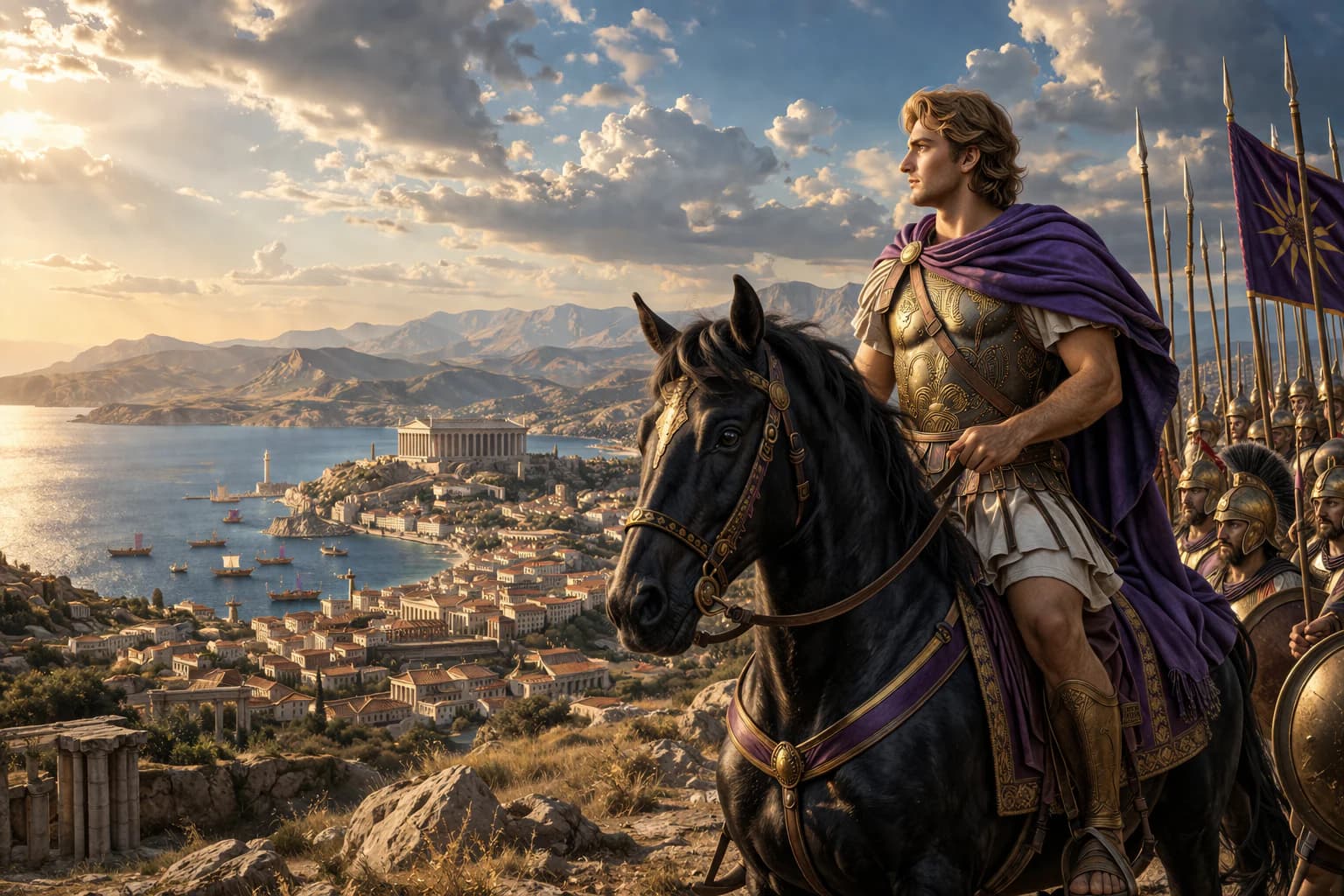
The inheritance Alexander received from Philip was extraordinary. The kingdom was secure, the army was the finest fighting force in the ancient world, Greece was under Macedonian control, and the logistical preparation for a Persian invasion was advanced. Philip had done the hardest work: building the machine from nothing. Alexander would drive it to its limits. That Alexander surpassed his father militarily and in the scale of his conquests has tended to obscure how much of what Alexander achieved depended on what Philip built. Without the sarissa phalanx, the Companion cavalry, the siege train, the Macedonian professional army culture, and the unified base in Greece, Alexander could not have reached India. Philip's contribution to his son's conquests is inseparable from the conquests themselves.
The greatest legacies are sometimes those that enable a successor to go further than the original builder could have imagined.
After 336 BC
The overshadowed giant
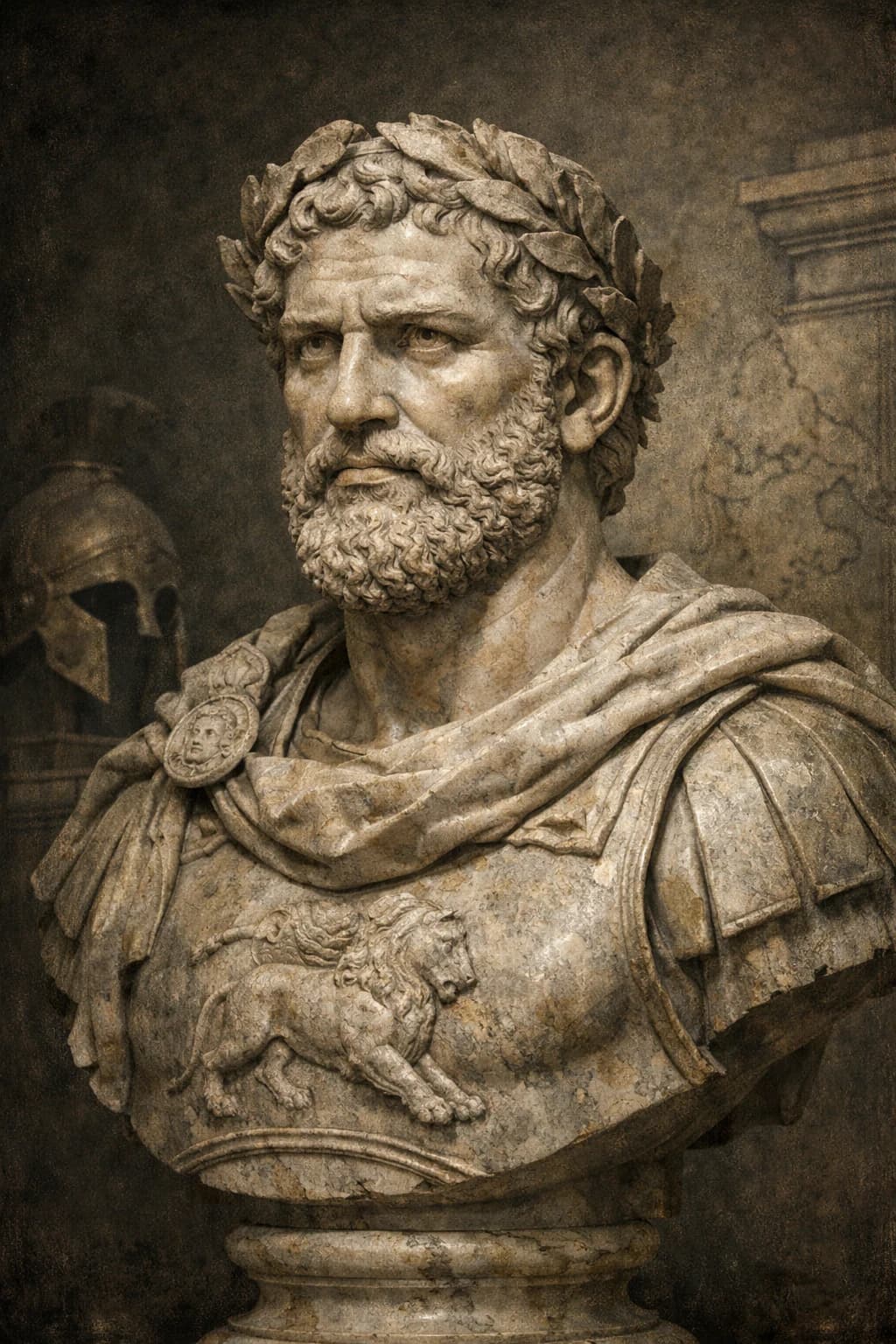
Philip II's historical fate is to stand behind Alexander. Demosthenes' Philippics made him the great enemy of Greek freedom, while Alexander's conquests made him look like a prologue. That is misleading. Philip was one of antiquity's most capable rulers: a military reformer, coalition-builder, diplomat, siege innovator and survivor of repeated crises. He used marriage alliances, bribery, gold, terror, patience and battlefield force with equal fluency. His body bore the cost, including wounds to his eye and leg. The royal tombs at Vergina, though identification remains debated in some details, reveal the splendour and martial culture of Macedonian kingship. Alexander expanded the horizon of conquest beyond anything Philip attempted, but he inherited a secure kingdom, a disciplined army, a Greek alliance and a Persian war already framed. Philip built the launch platform for one of history's most famous explosions of empire.
The builder of a platform is forgotten when someone uses the platform to reach an extraordinary height — but the platform was not built by accident.