Complete chronology
Full overview and deeper context for every journey step.
1559
Born on the frontier
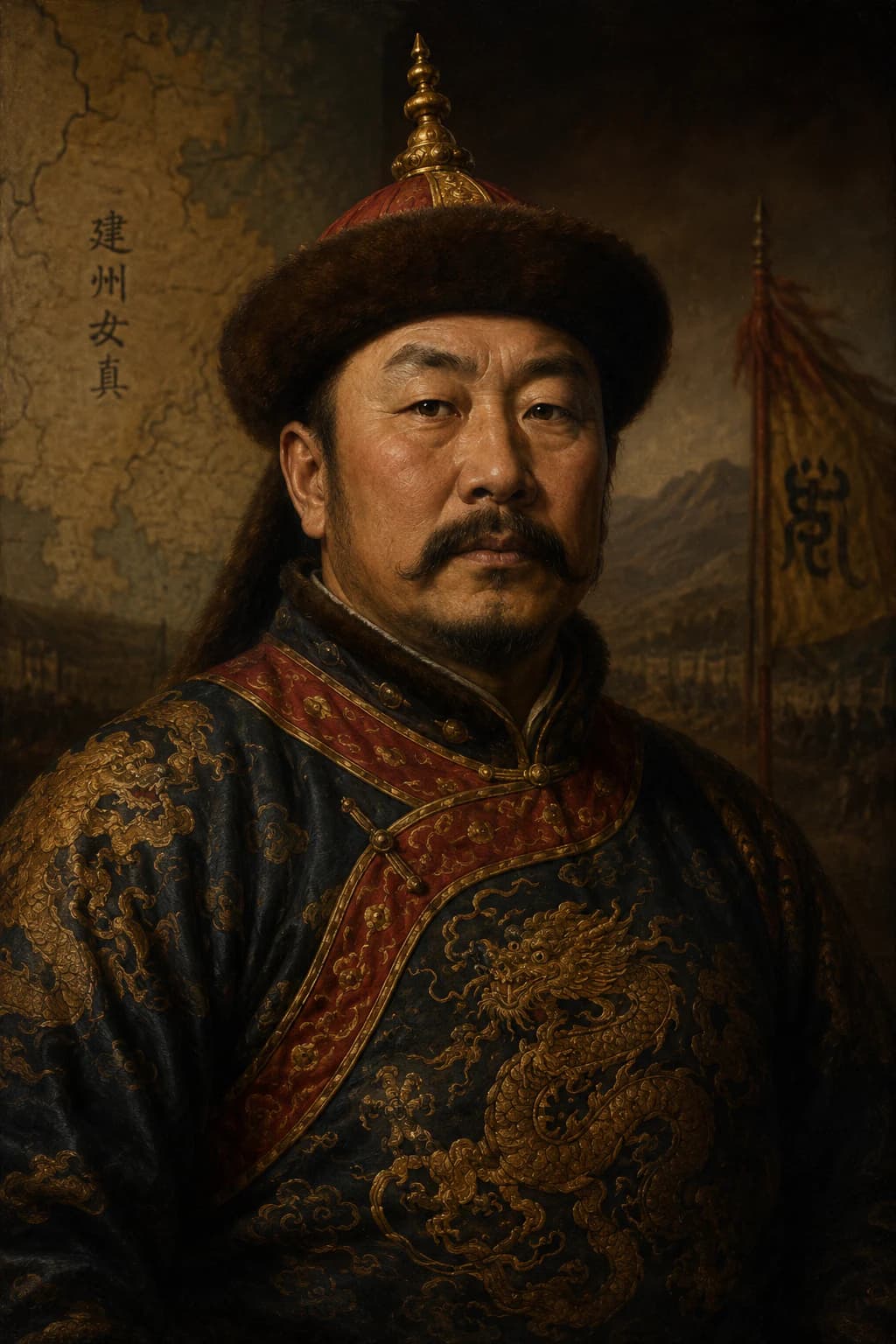
Nurhaci entered a frontier society shaped by forests, rivers, forts, tribute missions, and clan rivalries. The Jurchens were not yet a single nation but a collection of communities linked by language, kinship, hunting, agriculture, and trade with the Ming empire. His family held local status, but that status was fragile. Power depended on followers, military skill, marriage alliances, and the ability to navigate the stronger Ming state to the south. The world that formed him was neither isolated nor simple: it was a borderland where Chinese officials, Mongol groups, Korean interests, and Jurchen leaders all competed for advantage.
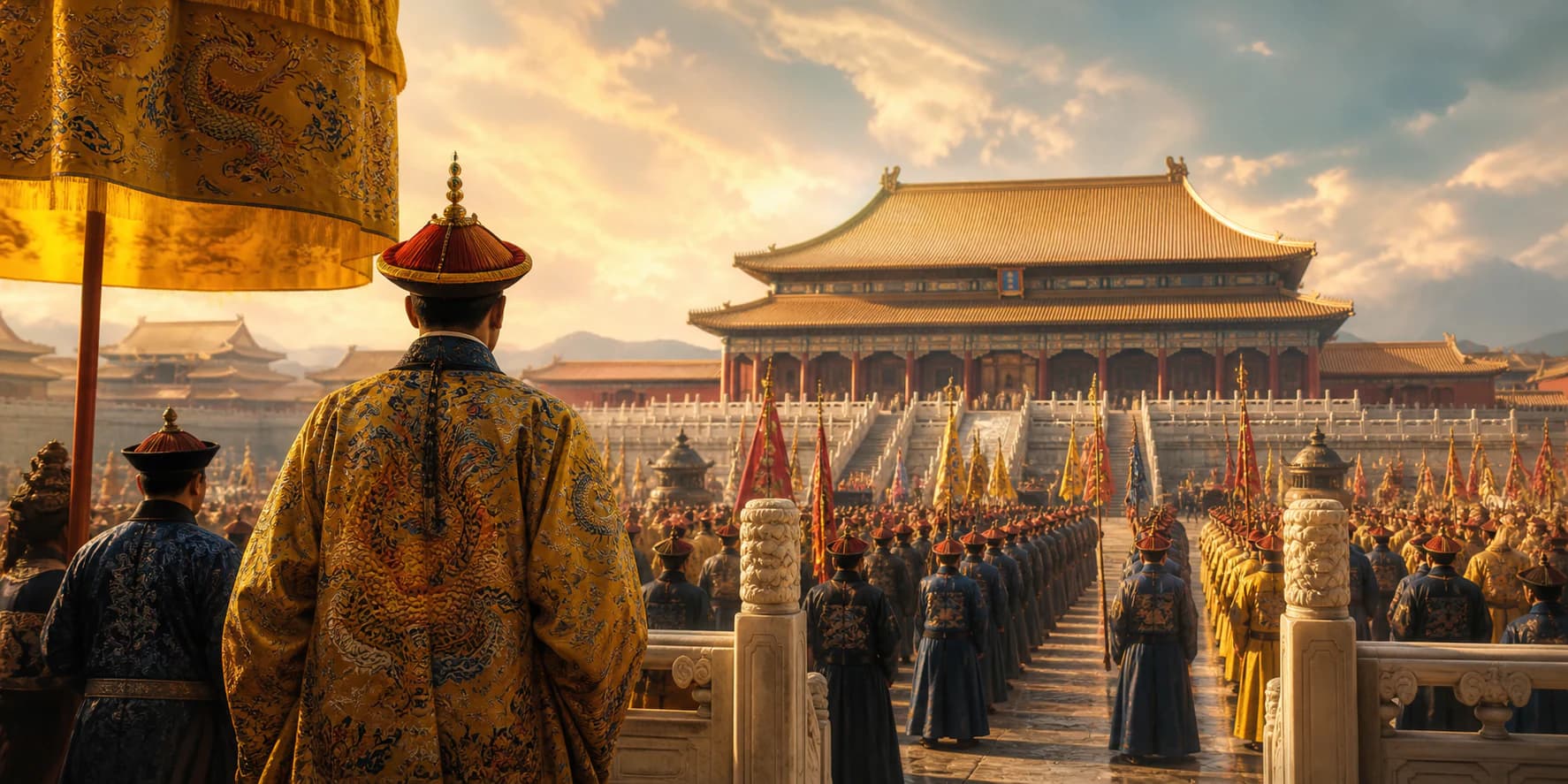
Nurhaci's greatness began in a frontier world where survival required both violence and diplomacy.
1583
A family grievance
In 1583, Nurhaci's father, Taksi, and grandfather, Giocangga, were killed during fighting connected to Ming frontier operations. The incident became central to Nurhaci's political memory. He accepted compensation from the Ming, but he also used grievance as a language of legitimacy, presenting his later campaigns as justice for wrongs suffered by his family and people. This mattered because early power was personal before it was imperial. Nurhaci had to persuade followers that his wars were not merely raids for wealth but part of a larger moral and political cause.
Personal loss became political fuel, giving Nurhaci a story around which followers could gather.
1580s–1600s
Unifying Jurchen clans
Nurhaci's rise was gradual, practical, and relentless. He defeated rival Jurchen leaders, incorporated their warriors, and used marriage alliances to widen his influence. He rewarded loyalty, punished resistance, and transformed scattered clan power into a more durable political structure. His expansion was not a simple national awakening; it was a process of conquest, negotiation, and integration. Groups that entered his orbit could gain security and reward, but they also had to accept his authority. By the early seventeenth century, Nurhaci had become far more than a local chieftain. He had created a new political center in Manchuria.
He built power by converting defeated rivals into the manpower of a future empire.
1601–1615
The Eight Banners
The Eight Banners were Nurhaci's most important institutional achievement. They grouped households and soldiers into banner divisions that served military, administrative, and social purposes at once. The system helped him mobilize forces, distribute rewards, record obligations, and reduce the independence of older clan structures. It also created a shared identity among followers who did not all come from the same lineage. Later Qing rulers expanded the banner system to include Mongol and Chinese banners, but its origin lay in Nurhaci's need to turn frontier warriors into a disciplined, organized ruling force.
The banners made conquest sustainable by turning loyalty into an institution.
1616
Founding Later Jin
Nurhaci's proclamation of the Later Jin dynasty in 1616 signaled a dramatic escalation of ambition. The name recalled the earlier Jurchen Jin dynasty that had ruled north China in the twelfth and thirteenth centuries, linking his new state to a prestigious past. He adopted the reign title Tianming, or Mandate of Heaven, drawing on Chinese political language while ruling a Jurchen-led power. This blend of traditions was characteristic of his success. Nurhaci did not simply imitate Ming models or preserve older Jurchen forms unchanged. He selected from both, creating a state that could speak to steppe, forest, and Chinese imperial worlds.
By founding Later Jin, Nurhaci gave his conquests a dynastic language.
1618–1621
War with the Ming
In 1618, Nurhaci issued his famous grievances against the Ming and moved from frontier rivalry to open war. His forces won a major victory at Sarhu in 1619, defeating Ming armies and their allies through mobility, coordination, and knowledge of terrain. The triumph transformed the balance of power in the northeast. Nurhaci followed it with further advances into Liaodong, capturing strategic cities and drawing more people into his state. These victories did not mean the Ming were doomed immediately, but they proved that Nurhaci's banner forces could defeat one of Asia's great imperial armies.
Sarhu showed that Nurhaci's frontier state had become a serious imperial challenger.
1625
Capital at Mukden
By moving his capital to Mukden in 1625, Nurhaci anchored his regime in a strategic zone between Manchurian homelands and the Chinese world he sought to dominate. The move reflected the changing character of his power. He was no longer only a mobile war leader; he was the ruler of cities, populations, stores, officials, and tax resources. Governing conquered Chinese communities required new administrative skills and new compromises. The future Qing state would depend on this ability to rule across ethnic and cultural boundaries, and Nurhaci's later years began that transition under the pressure of war.
Mukden marked the shift from conquest movement to territorial state.
1626
Defeat at Ningyuan
Nurhaci's career was not an uninterrupted march toward victory. In 1626, his attack on Ningyuan failed against the Ming commander Yuan Chonghuan, whose defense used fortified walls and artillery to blunt banner cavalry. The defeat exposed the limits of Nurhaci's military system when facing well-defended positions and effective firearms. It also showed that the Ming still had capable commanders. Nurhaci withdrew and died later that year. Some accounts connect his death to wounds or illness after the campaign, but what is clear is that he did not live to see Beijing fall or the Qing dynasty rule China proper.
His final campaign revealed that the road to empire still required adaptation.
1626 onward
Legacy of conquest
Nurhaci died in 1626, leaving an expanding but unfinished state. His son Hong Taiji refined the institutions, renamed the Jurchens as Manchus, and proclaimed the Qing dynasty in 1636. The conquest of Beijing came later, in 1644, under the Shunzhi emperor's regime. Yet Nurhaci's role remained foundational. He unified the Jurchens, created the banner system, challenged the Ming, and gave his people a dynastic project. His legacy is best understood not as the founder of a finished empire, but as the architect of the machine that made that empire possible.
Nurhaci did not conquer China, but he built the power that could.