Complete chronology
Full overview and deeper context for every journey step.
-83–-60
Aristocratic youth
Marcus Antonius came from a distinguished plebeian family with real political pedigree. His grandfather had been a famous orator, and his father had held command, but the family fortune and reputation were uneven by the time Antony grew up. Ancient writers, especially those writing under the victorious Augustan order, loved to make his youth a catalogue of debt, drinking and recklessness. Some of that reputation may be deserved; some of it is enemy portraiture. What matters is that Antony entered public life as a nobleman with charm, physical courage and a talent for winning loyalty, but without the careful self-control that made Octavian so dangerous. His gifts were personal and martial before they were administrative.
Early unpredictability can foster both daring and instability in leadership.
-60–-50
Military beginnings
Antony's military career began in the east under Aulus Gabinius, where he gained experience in Syria, Judaea and Egypt. He showed courage, energy and a willingness to operate in the rough world where Roman politics, client kings and military force overlapped. The army suited him. Antony could share hardship, speak plainly to troops and project the confidence soldiers valued in commanders. These qualities later made him invaluable to Julius Caesar in Gaul. Rome's late Republic increasingly rewarded men who could command armed loyalty as well as win votes. Antony understood that world instinctively. His early service made him more than a courtier of Caesar; it gave him a base in the military culture that was remaking Roman power.
Strong connections with followers can become a decisive advantage in times of conflict.
-50–-44
Alliance with Caesar
Antony's alliance with Julius Caesar transformed his career. As tribune of the plebs in 49 BC, he defended Caesar's interests against senatorial opponents and then fled Rome when compromise collapsed. His flight helped Caesar frame the crossing of the Rubicon as a defence of tribunician rights rather than naked rebellion. During the civil war Antony served as a trusted lieutenant, though not always a flawless one. He commanded troops, managed Italy in Caesar's absence and shared in the victory over Pompey's faction. His importance grew because Caesar needed men who combined aristocratic legitimacy with military loyalty. Antony's fate now depended on Caesar's revolution. If Caesar succeeded, Antony would stand near the summit. If Caesar fell, he would be left exposed among enemies.
Aligning with powerful figures can accelerate success but also bind one’s destiny to theirs.
-44
After Caesar’s death
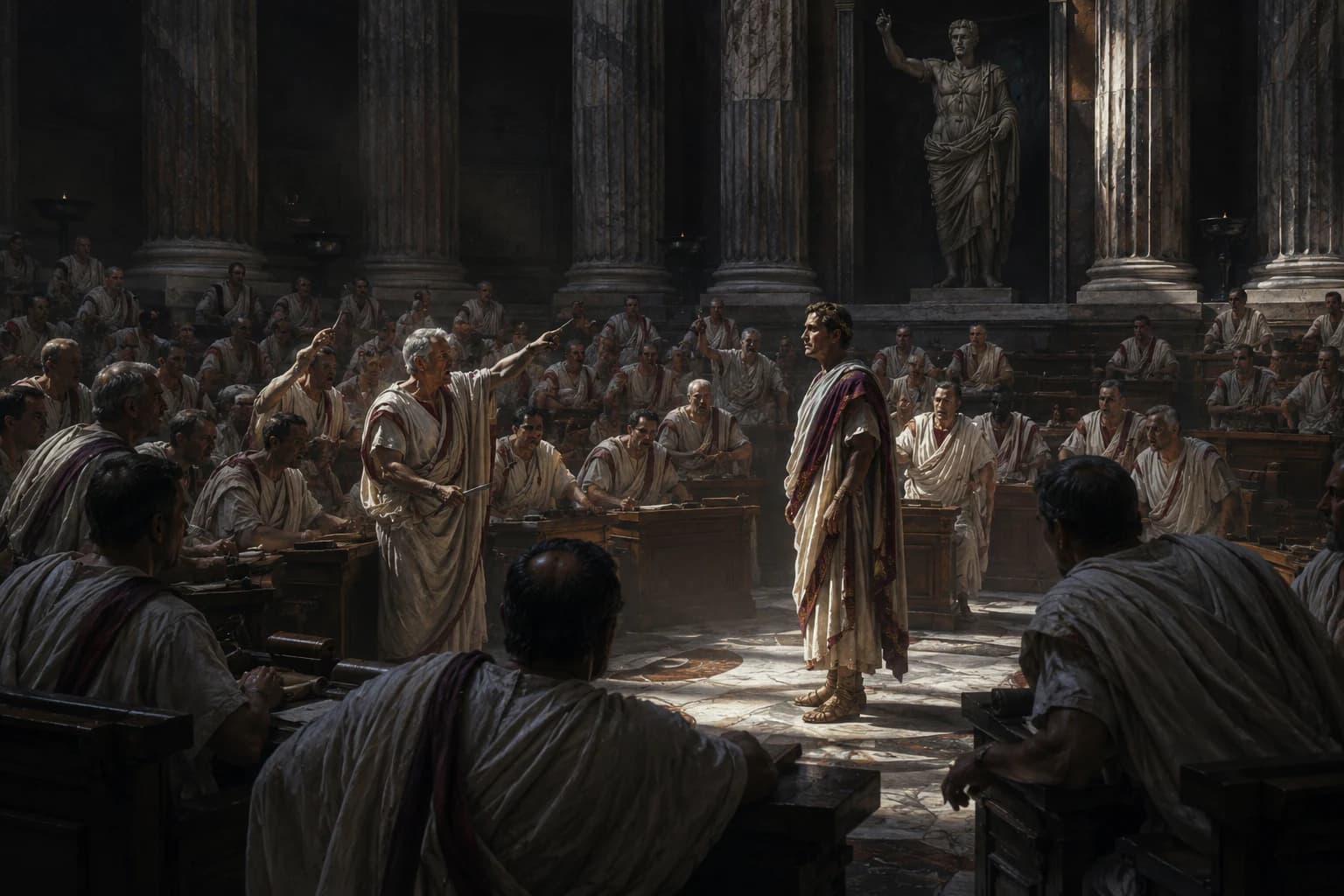
The Ides of March left Antony in a terrifying but fertile position. Caesar was dead, the assassins claimed liberty, and Rome waited to see whether revenge or reconciliation would follow. Antony first negotiated, then outmanoeuvred. At Caesar's funeral he helped turn public feeling against the murderers, while his control of Caesar's will and papers gave him practical leverage over appointments, grants and political promises. He presented himself as guardian of Caesar's memory, but he also sought power for himself. The problem was Octavian. Caesar's adopted heir arrived as an apparently fragile teenager, yet he possessed the one thing Antony could not ignore: Caesar's name. From that moment, the struggle for Caesar's legacy became a duel between experience and inheritance.
Moments of crisis often elevate those ready to act decisively.
-43–-33
Power-sharing rule
The Second Triumvirate was not a private pact pretending to be lawful; it was a legally recognised dictatorship created by Antony, Octavian and Lepidus to reorder the Roman world. Its first acts were brutal. Proscriptions named enemies for execution and confiscation, and Cicero became the most famous victim. The triumvirs then defeated Caesar's assassins Brutus and Cassius at Philippi in 42 BC. Antony played the leading military role in that victory, confirming his status as the strongest commander of the three. Afterward the Roman world was divided. Octavian struggled in the west with veteran settlements and Italian resentment, while Antony took responsibility for the east. The arrangement worked because it postponed the final question: which heir of Caesar's revolution would rule when shared power ceased to be useful?
Shared power can maintain stability, but often contains seeds of future conflict.
-40s–-30s
Eastern focus
Antony's eastern command offered wealth, armies, prestige and danger. He needed to stabilize Roman influence, answer the Parthian threat and maintain alliances across a region where local dynasties mattered. Cleopatra VII was the most important of those rulers. Their meeting at Tarsus in 41 BC later became a story of seduction, but it was also a negotiation between two political survivors. Cleopatra needed Roman protection and territorial recovery; Antony needed money, ships and an eastern base. Their relationship became personal, dynastic and strategic. Antony's Parthian campaign in 36 BC failed badly, weakening his aura of military invincibility. The Donations of Alexandria in 34 BC, which publicly assigned eastern territories to Cleopatra and her children, gave Octavian a perfect weapon: Antony could now be depicted as abandoning Roman interests to an Egyptian queen.
Strategic alliances can strengthen position while altering perception.
-30s
Rivalry for control
By the early 30s BC, the partnership between Antony and Octavian had become impossible. The marriage alliance through Octavian's sister Octavia broke down as Antony remained with Cleopatra. Octavian read Antony's will, or claimed to, before the Senate, using it to suggest that Antony intended to privilege Alexandria over Rome. The official war was declared against Cleopatra, not Antony, a brilliant piece of political framing that turned civil war into a defence of Rome against foreign corruption. The reality was more complicated. Antony retained Roman supporters and commanded formidable resources. Cleopatra was not a mere distraction but a ruler defending Egypt's future. Yet Octavian understood public perception better. Antony entered the final conflict with ships and soldiers, but also with a damaged story about who he was and whom he served.
When power is shared uneasily, rivalry often becomes inevitable.
-30
Defeat and end
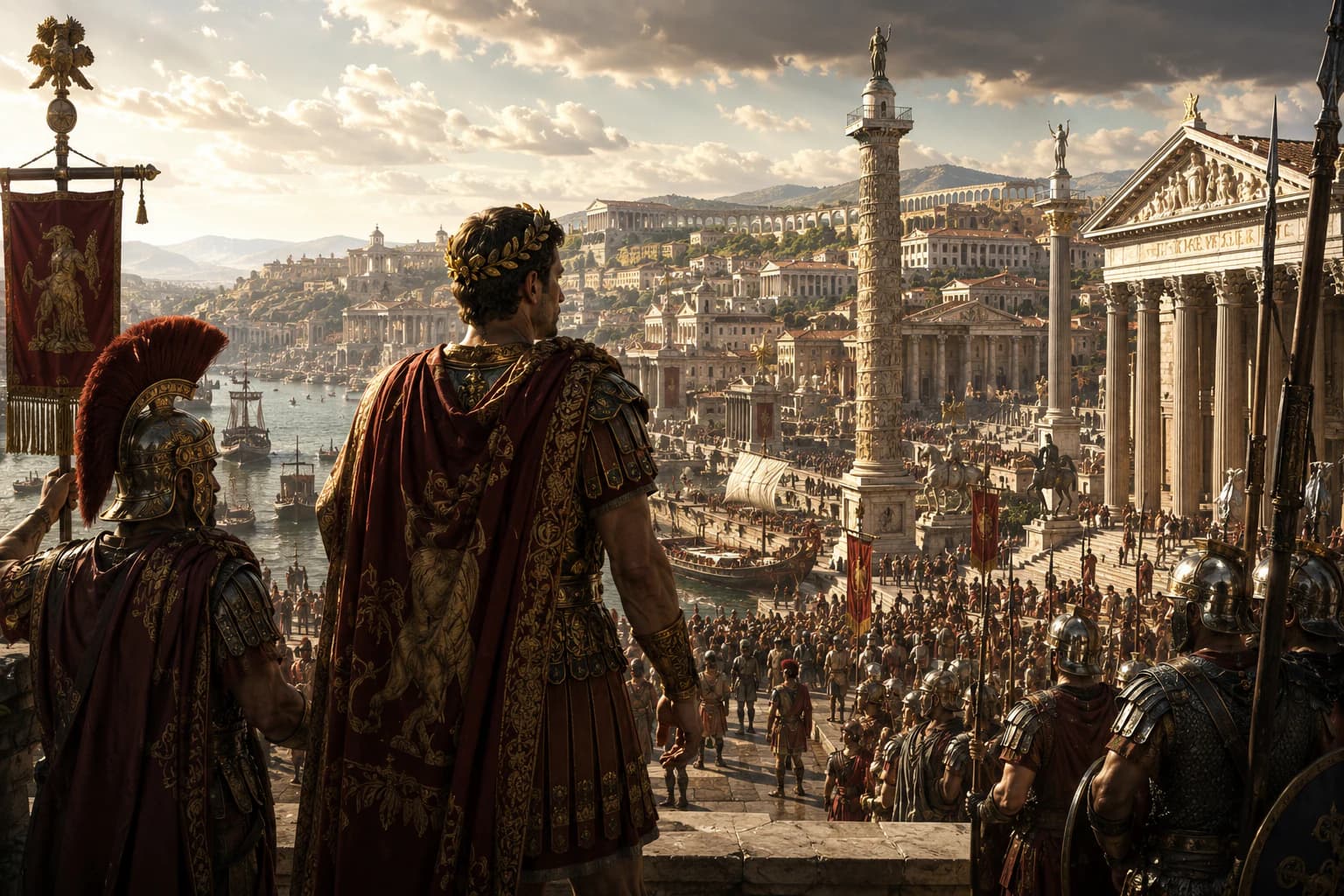
The decisive campaign culminated at Actium in 31 BC, where Octavian's admiral Agrippa outmanoeuvred Antony and Cleopatra's forces. The battle was not a simple romantic flight, as hostile tradition later suggested. Antony's strategic position had already deteriorated through blockade, disease, desertion and supply problems. When the line broke, he and Cleopatra escaped to Egypt, but the war was effectively lost. Octavian invaded the following year. Antony, misled by reports that Cleopatra had died or simply facing the collapse of every political possibility, took his own life. Cleopatra followed soon after. Egypt became a Roman province, and Octavian stood alone. Antony's fall mattered because it ended the last alternative to the Augustan settlement. Rome's future would be written by his enemy.
Defeat at critical moments can bring both personal and systemic transformation.
-30 onward
Historical legacy
Mark Antony is difficult to recover because the winners had every reason to make him look weak, drunken, eastern and enslaved by Cleopatra. Later drama deepened the image of the doomed lover, sometimes at the expense of the politician and general. A better view holds the pieces together. Antony was courageous, charismatic and often effective; he was also impulsive, politically less disciplined than Octavian and vulnerable to strategic overreach. He did not destroy the Republic by himself. He was one of several men operating in a system already broken by militarised politics, inequality, personal armies and the precedent of dictatorship. His importance lies in the fact that he almost became the man to inherit Caesar's world. Because he failed, Octavian could become Augustus, and Rome could call monarchy by another name.
Individual ambition can both shape and be shaped by larger historical transitions.