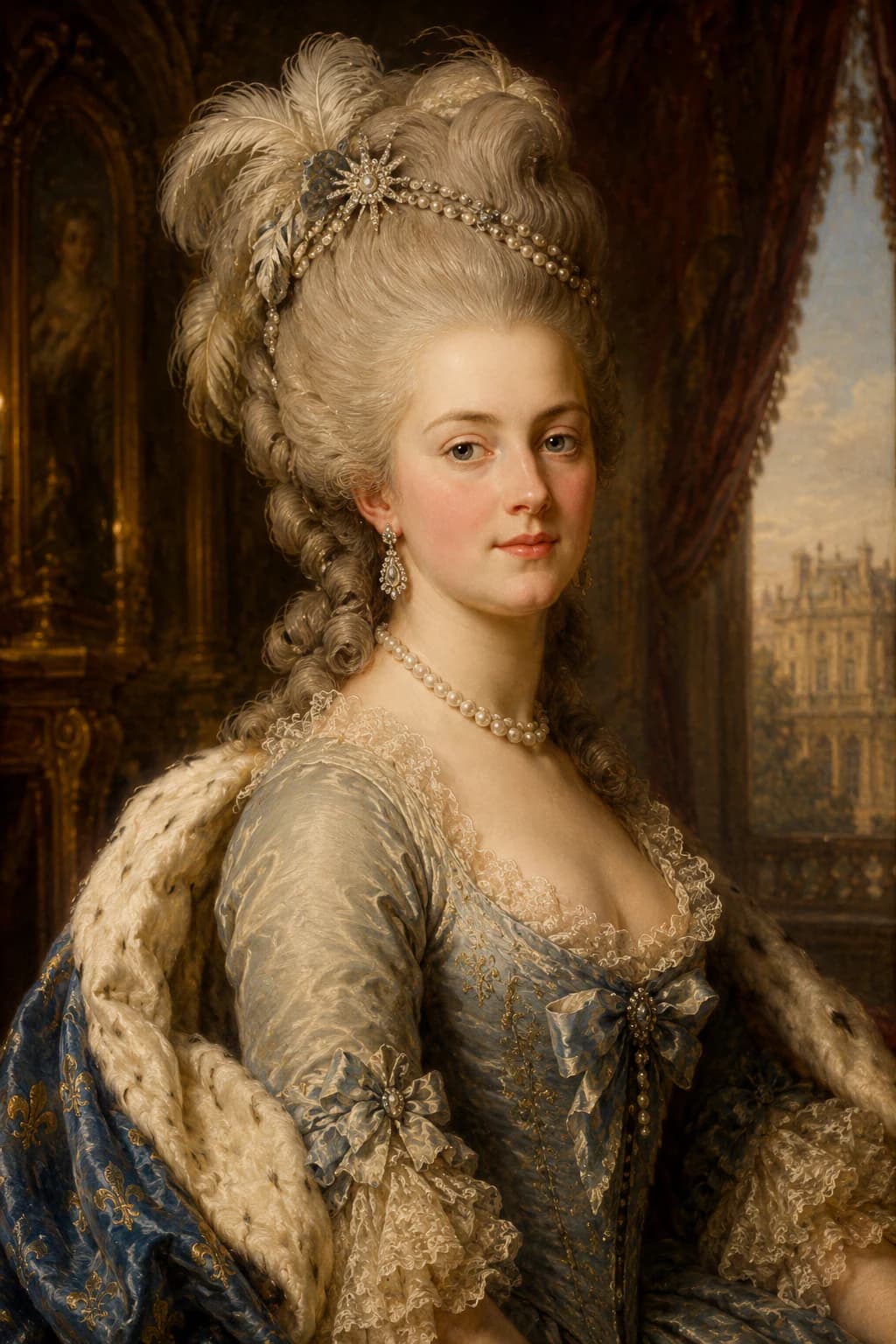
Complete chronology
Full overview and deeper context for every journey step.
1755
Born in Vienna
Marie Antoinette was born Maria Antonia Josepha Johanna in Vienna in 1755, into the Habsburg-Lorraine dynasty. As a daughter of Empress Maria Theresa, she grew up inside one of Europe's most powerful ruling families, where marriage was a tool of statecraft. Her childhood was aristocratic and musical, but her education was uneven compared with the political burden later placed upon her. She was raised to serve dynastic diplomacy, not to survive a revolution. That gap between training and fate shaped much of her life.
She was prepared to be a royal bride, not the focus of a collapsing political order.
1770
French marriage
In 1770, Marie Antoinette crossed into France to marry Louis-Auguste, heir to the Bourbon throne. The marriage was meant to seal the diplomatic reversal that had joined France and Austria after generations of hostility. At Versailles, however, her Austrian identity made her vulnerable from the start. Court factions watched her closely, pamphleteers mocked her, and political enemies found it easy to turn foreignness into suspicion. Her youth and inexperience became part of a larger problem: she was expected to embody French monarchy while never being allowed to seem fully French.
The alliance that made her queen also made her politically suspect.
1774
Queen of France
Marie Antoinette became queen of France in 1774. Versailles offered ceremony, privilege and performance, but also surveillance. Her clothing, friendships, entertainments and spending were turned into political commentary. The queen did spend heavily, especially in her early years, but hostile propaganda exaggerated her influence and turned her into a symbol of royal extravagance. The Petit Trianon, where she sought privacy from court ritual, was portrayed as proof of selfish isolation. In reality, she had limited formal power, but image could matter more than office in a monarchy built on display.
Her reputation became a political battlefield long before she became politically active.
1778-1786
Mother and target
Marie Antoinette's position improved after the birth of children, including Marie Therese, Louis Joseph and Louis Charles. Motherhood helped answer earlier criticism of the royal marriage, which had remained unconsummated for years. Yet her public image did not recover. The Affair of the Diamond Necklace in 1785 damaged her reputation even though she was not guilty of the fraud. The scandal confirmed what many critics already wanted to believe: that the queen was vain, corrupt and detached. The famous phrase about cake was not said by her, but it endured because it matched the caricature her enemies had built.
False stories can survive when they fit a reputation people are ready to believe.
1789
Revolution begins
The Revolution of 1789 transformed Marie Antoinette from unpopular queen into political enemy. The fall of the Bastille, the October Days and the royal family's move from Versailles to Paris placed the monarchy under pressure and surveillance. She feared the erosion of royal authority and distrusted many revolutionary leaders. After the death of the moderate Mirabeau, she increasingly looked to foreign courts, emigres and loyalists for possible rescue. Her political judgement was shaped by danger, grief and distrust, but to revolutionaries those same actions looked like proof of treason.
As pressure mounted, attempts to save the monarchy made suspicion of the monarchy worse.
1791-1792
Flight and imprisonment
Marie Antoinette supported the royal family's attempted escape in June 1791. The failure at Varennes was catastrophic. It convinced many French citizens that the king and queen could not be trusted within a constitutional system. War in 1792 deepened hostility toward her because Austria was now one of revolutionary France's enemies. After the storming of the Tuileries on 10 August 1792, the royal family was imprisoned. The queen who had once moved through Versailles amid ritual and luxury was now held under guard, her identity reduced by revolutionaries to the widow of a fallen tyrant.
Varennes turned her from an unpopular queen into a suspected enemy of the nation.
1793
Trial and execution
After Louis XVI was executed in January 1793, Marie Antoinette remained imprisoned with her children before being moved to the Conciergerie. Her trial in October was political as much as judicial. She faced accusations of treason, conspiracy and moral corruption, including one charge involving her son that horrified even some observers. She defended herself with composure, but the verdict was never seriously in doubt. On 16 October 1793, she was executed by guillotine in Paris. Her death satisfied revolutionary demands for justice against monarchy, but it also helped create a counter-image of royal suffering.
Her execution turned a hated queen into one of the Revolution's most contested symbols.
Long-term
Legacy and myth
Marie Antoinette's legacy is unusually unstable because it sits at the meeting point of fact and fantasy. She was privileged, politically conservative and often poor at reading public opinion. She was also blamed for failures she did not create alone: royal debt, social inequality, diplomatic crisis and the structural weakness of the Bourbon state. Revolutionary propaganda made her a monster of luxury and betrayal; later royalist memory made her a martyr. Modern history must hold both the person and the symbol in view. Her life shows how women near power could be made to carry the sins of an entire regime.
Her importance lies not only in what she did, but in what France chose to see in her.