Complete chronology
Full overview and deeper context for every journey step.
1254–1269
Merchant family origins
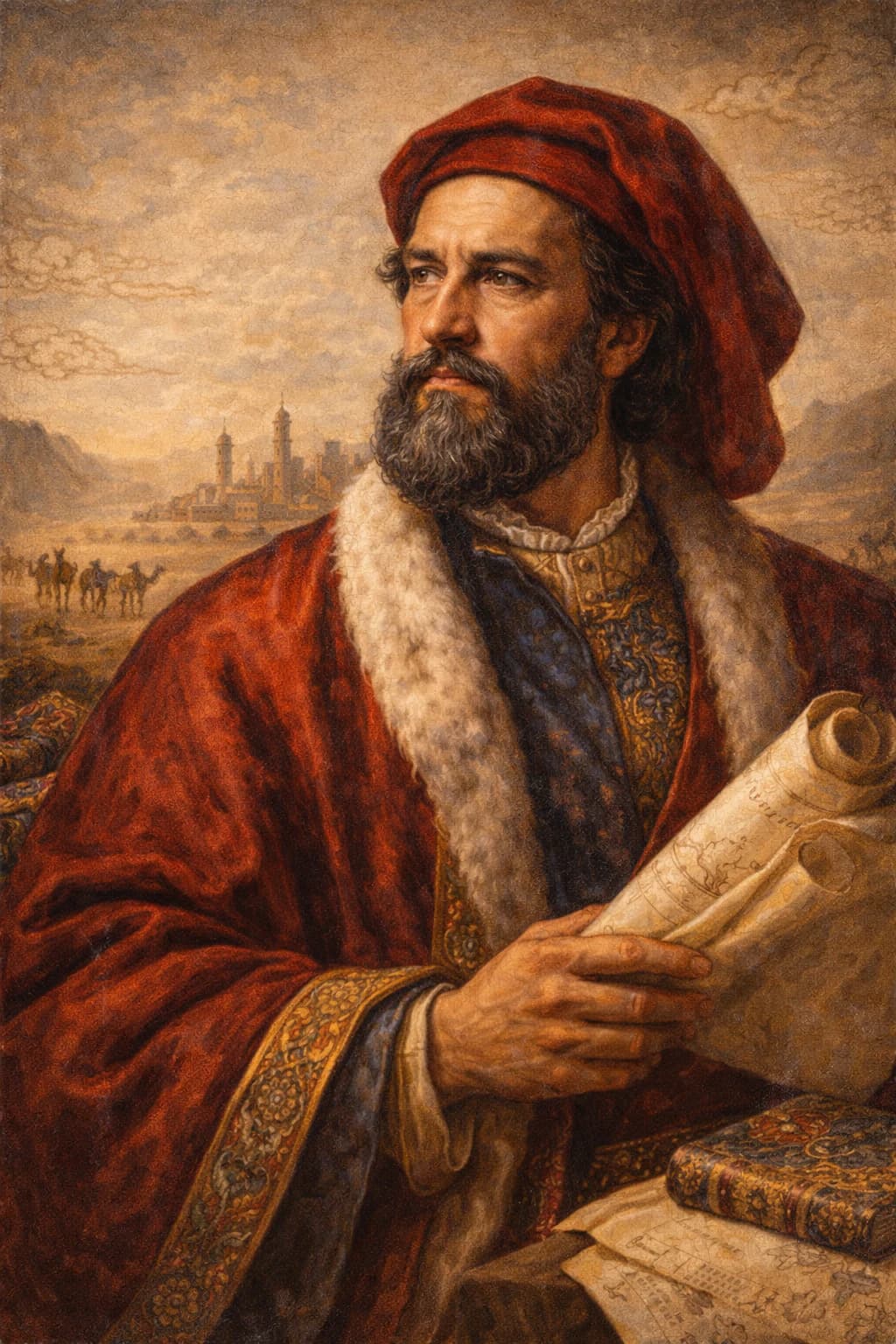
Marco Polo was born in Venice in 1254, at a time when the city lived by maritime trade, credit, risk and information. His father Niccolo and uncle Maffeo were merchants whose business already reached beyond the Mediterranean into the Black Sea and the Mongol-connected trade routes of Eurasia. Marco grew up without his father for much of his childhood, because Niccolo and Maffeo were away in the east. That absence is important. Polo's story began not as a boy's romantic adventure but as a family commercial enterprise shaped by Venice's appetite for goods, contacts and advantage.
Exposure to stories of distant places can inspire a lifetime of exploration.
1271
Journey east begins
In 1271, Marco left Venice with his father and uncle on a journey that would take years. They carried messages and gifts connected with earlier contact between the Polos and Kublai Khan, the Mongol ruler who had become the dominant power across much of Asia. The route was not a single road but a chain of ports, caravan paths, deserts, mountain passes, courts and staging points. Travel depended on political permissions, local guides, money, health and luck. For a young Venetian, the journey was an education in the scale of the thirteenth-century world: Armenian towns, Persian trade, Central Asian distances and Mongol imperial networks.
Stepping into the unknown can transform curiosity into experience.
1270s
Arrival in Asia
The Polos reached Kublai Khan's court in the 1270s, probably around 1275. By then Kublai ruled as Mongol khan and, from 1271, as founder of China's Yuan dynasty. His court was cosmopolitan, administratively complex and far wealthier than many European readers could easily imagine. Polo's later account describes palaces, hunts, postal relays, paper money, coal, cities and rituals of power. Some details remain debated, and his book is not a modern diary. It was shaped by memory, storytelling and Rustichello of Pisa's literary hand. Still, it preserves a genuine European encounter with the Mongol-Yuan world at its height.
Direct exposure to different systems can reshape how one understands the world.
1270s–1290s
Service and travel
Marco Polo claimed to have served Kublai in ways that sent him across parts of the empire. Historians debate the exact nature of that service, because the account is rich in description but thin on verifiable official records. What matters is the range of observation. Polo wrote about northern and southern China, Yunnan, Burma, India, the Indian Ocean, trade goods, taxation, religions, currencies and urban life. He was especially interested in systems that merchants understood: roads, markets, revenue, transport, luxury commodities and state order. His achievement was not that he was the first European to Asia. He was not. It was that he turned travel into a vast comparative description.
Extended exposure to diverse environments builds a deeper and more nuanced perspective.
1290s
Long return journey
The Polos eventually left Kublai's world in the early 1290s, reportedly as escorts connected with a Mongol princess travelling toward Persia. The return by sea through Southeast Asia and the Indian Ocean was dangerous, slow and costly. Many in the party are said to have died before reaching the Persian sphere, a reminder that medieval long-distance travel was never simply picturesque movement across a map. Marco returned to Venice in 1295 after roughly twenty-four years away. He came back not just with memories, but with a merchant's awareness of how large, wealthy and interconnected Asia really was.
Returning from exploration can be as transformative as the journey outward.
1298
Capture and imprisonment
Marco Polo's fame depended on an accident of war. Venice and Genoa were bitter commercial rivals, and in 1298 Polo was captured by the Genoese, traditionally after naval fighting. In prison he met Rustichello of Pisa, a writer associated with romance literature. Polo dictated or recounted his travels; Rustichello shaped them into a lively Franco-Italian prose work. That collaboration complicates every reading of the book. It is both testimony and crafted narrative, merchant information and marvel literature. Yet without captivity, the story might never have become a text with European reach.
Unplanned moments can become the turning point that preserves a legacy.
1290s–1300s
Publication of travels
The book known as Il Milione or The Travels of Marco Polo circulated widely in manuscript and later print. Medieval readers did not all treat it as straightforward fact. Some were dazzled; others suspected exaggeration. That mixed reception is part of its importance. Polo described a world that challenged European assumptions: paper currency backed by state authority, cities of immense scale, imperial postal networks, spices, jewels, religions and trading systems far beyond Latin Christendom. The book did not single-handedly launch European exploration, but it helped make Asia imaginable as a place of wealth, power and reachable routes.
Stories of distant worlds can reshape how societies imagine their possibilities.
1300s–1324
Later life
After his release, Polo lived in Venice as a merchant, husband and father, not as a professional explorer in the modern sense. He married Donata Badoer and had daughters, managed property and business, and remained part of Venetian society until his death in 1324. The famous deathbed story that he refused to retract his 'marvels' is difficult to verify, but it captures a real tension around his reputation. His account sounded too extravagant to some listeners because European horizons were narrower than the world he described. Polo's later life reminds us that the traveller became legendary only because the merchant returned home and the story kept moving.
A life of experience can continue to influence others long after the journey ends.
1324 onward
Enduring legacy
Marco Polo's legacy is not that every line of his book can be accepted without question. It cannot. He omitted things modern readers expect, such as the Great Wall in its later form, and some routes and offices remain disputed. His importance lies in the scale and influence of the account. It brought the Mongol and Asian worlds into European reading culture with unusual richness, offering geography, commerce, wonder and political observation together. Later travellers, mapmakers and explorers drew energy from the possibilities it suggested. To ask why Marco Polo was important is to see how a merchant narrative became a bridge between experience, imagination and global history.
Knowledge shared across cultures can open paths for future exploration.