Complete chronology
Full overview and deeper context for every journey step.
-259–-247
Birth in turmoil
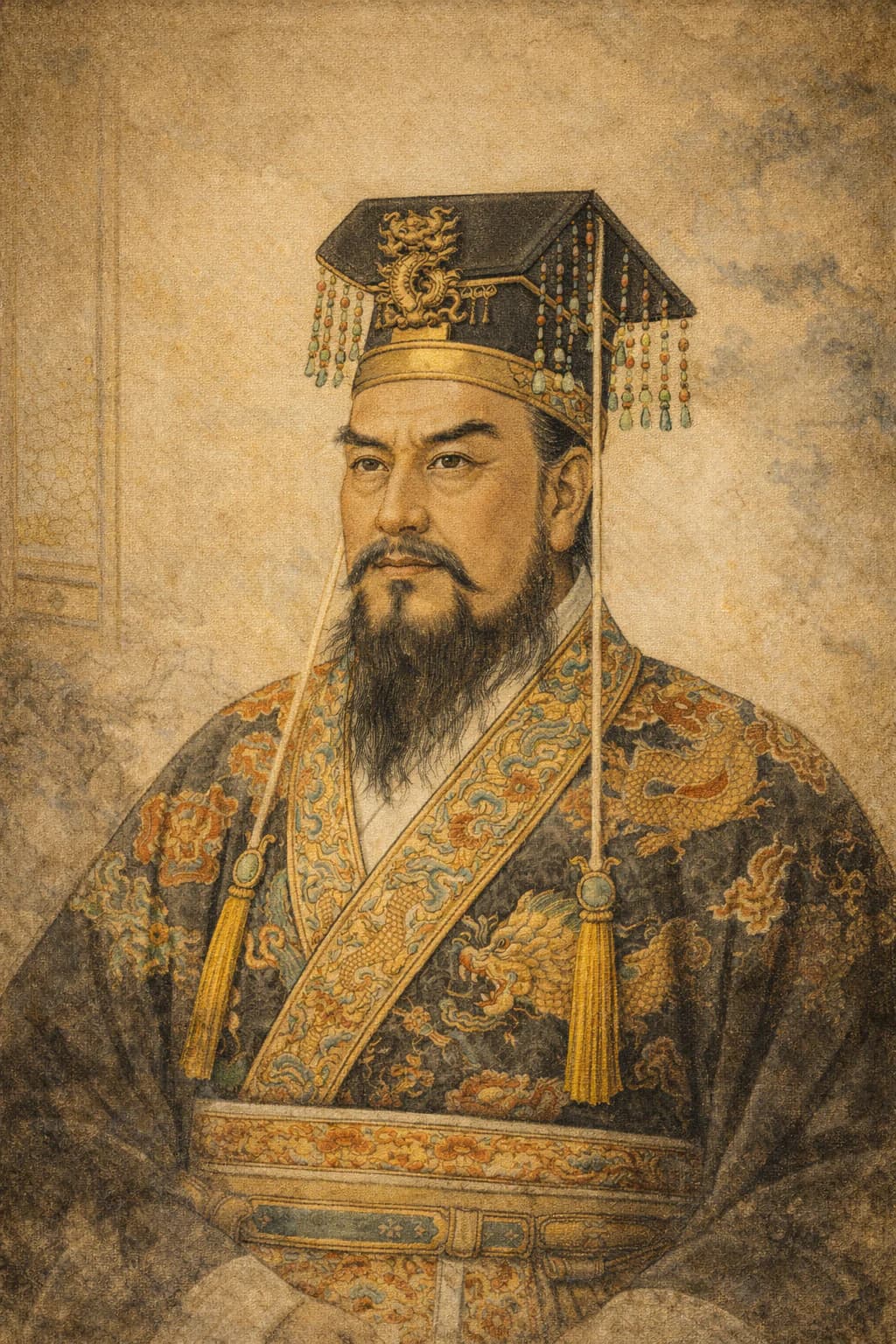
King Zheng's birth belonged to one of the most violent and creative periods in ancient Chinese history. The old Zhou order had fractured, and the major states competed through military reform, bureaucracy, diplomacy, agriculture, fortification and ruthless legal codes. Zheng was born in Handan, the capital of Zhao, while his father was a Qin royal hostage there. Later stories about his parentage and the role of the merchant-politician Lu Buwei are politically charged and cannot be treated as simple fact. What is secure is the instability around him. Zheng entered life as a child of hostage politics, dynastic calculation and interstate rivalry. His later obsession with control was not an abstract preference. It grew in a world where weakness could erase a state.
Leaders formed in unstable times often seek to eliminate uncertainty through control.
-247
Becoming king
When Zheng became king in 247 BC, Qin was already the most formidable of the Warring States. Its strength came from earlier reforms associated with Shang Yang: merit-based military rewards, centralized administration, harsh laws, land registration, agricultural mobilization and a disciplined war machine. The young king initially depended on senior figures, especially Lu Buwei, and on the court networks surrounding his mother, Queen Dowager Zhao. This regency period gave Qin continuity but also danger. A child king could become a pawn if he failed to master the men who governed in his name. Zheng's path to greatness began with internal survival: before he could conquer China, he had to become ruler in fact, not only in title.
Early exposure to power structures can prepare a leader to eventually command them directly.
-238–-230
Consolidating control
Zheng's personal rule began with court struggle. A rebellion connected with Lao Ai, a favorite of the queen dowager, was suppressed in 238 BC, and Lu Buwei later fell from power. These episodes are surrounded by hostile historical storytelling, but their political meaning is clear: Zheng removed alternative centers of influence. He then relied on ministers such as Li Si, a brilliant Legalist statesman, to sharpen Qin administration. Qin's strength was not only battlefield ferocity. It lay in record-keeping, roads, commanderies, law, taxation, weapons production and the ability to reward soldiers for measurable results. Zheng inherited this machine, secured control of it, and used it with exceptional focus.
Strong internal control is often a prerequisite for external expansion.
-230–-221
Campaigns of conquest
The unification campaigns were systematic. Han fell in 230 BC, Zhao in 228, Wei in 225, Chu after fierce resistance in 223, Yan in 222, and Qi in 221. Qin used overwhelming military pressure, strategic sequencing, bribery, espionage, engineering and the weaknesses of rivals who struggled to cooperate against the greatest threat. Chu, with its size and resources, proved especially difficult, but Qin's final victory showed the depth of its mobilizing power. Zheng's achievement was not a lucky sweep by a single general. It was the final act of a long transformation in which Qin had become the most efficient conquest state in the Chinese world. By 221 BC, the political map had changed from many competing kings to one ruler over all under heaven.
Systematic persistence can achieve what isolated victories cannot.
-221
First emperor
Zheng's new title was a constitutional revolution in miniature. By calling himself Shi Huangdi, the First Emperor, he announced that the old Warring States order was over and that his descendants should rule in an unbroken imperial sequence. He divided conquered territories into commanderies and counties rather than restoring hereditary kingdoms, placing officials under central appointment. This decision mattered enormously. It made the empire a bureaucratic structure, not a loose federation of aristocratic domains. Later dynasties would criticize Qin cruelty, but they inherited the imperial idea Qin made real: one ruler, centralized administration, standardized systems, and the claim that political unity was the proper condition of China.
Redefining authority can be as important as achieving it.
-221–-215
Standardization reforms
Conquest alone could not hold the new empire together. Qin therefore attacked variation itself. The standardization of script allowed officials across regions to communicate through a shared written form even when speech differed. Standard weights, measures and coinage improved taxation, trade and command. Road and axle standards helped movement across the empire. Legal uniformity made the state more predictable, though often brutally so. These reforms were not gentle cultural blending. They were instruments of control imposed by a victorious state. Yet their long-term importance is immense. Qin's dynasty collapsed quickly, but later Chinese governments retained the assumption that unity required common administrative standards.
Unity is strengthened when systems are aligned as well as territories.
-220–-210
Massive projects
Qin state power transformed landscapes. Roads radiated from the capital region. Frontier walls built by earlier states were linked and extended against northern threats, forming precursors to later Great Wall systems. Palaces and the emperor's mausoleum near modern Xi'an consumed extraordinary labor. The Terracotta Army, discovered in the twentieth century, gives physical scale to Qin imperial imagination: soldiers, horses, chariots, officials and entertainers arranged to serve the emperor beyond death. These projects display administrative genius and coercive violence at the same time. They connected and defended the empire, but they also burdened laborers, soldiers and families. Qin greatness was inseparable from extraction.
Physical infrastructure can make political authority visible and enduring.
-215–-210
Later rule and control
The later First Emperor was haunted by the problem that faces all founders: how to make a new order permanent. Traditional accounts describe book burnings, the execution or burial of scholars, harsh punishments, massive labor demands and the suppression of dissenting teachings. Some details are debated, and Han dynasty historians had reasons to darken Qin's reputation, but the broader pattern of ideological control fits the regime's Legalist character. Qin Shi Huang also sought immortality, sending expeditions in search of elixirs and becoming increasingly concerned with death. The irony is sharp. The ruler who created the first unified empire could not control succession, mortality or resentment. His strongest methods created obedience, but not loyalty deep enough to save his dynasty.
Maintaining control over a large system often requires trade-offs between stability and flexibility.
-210 onward
Legacy of unification
Qin Shi Huang died in 210 BC while traveling, and the succession was manipulated by powerful court figures including Zhao Gao and Li Si. Rebellion soon spread, and the Qin dynasty fell in 206 BC. Measured by dynastic survival, his project failed almost immediately. Measured by historical consequence, it remade East Asia. The Han dynasty that followed rejected Qin's most hated excesses but kept much of the imperial framework: centralized rule, commanderies, bureaucracy, standardized administration, and the ideal of a unified realm. Qin Shi Huang's legacy is therefore double-edged. He ended the Warring States and founded imperial China, but he did so through methods so severe that his own house could not endure them. Few rulers have failed so quickly and lasted so long.
Foundational changes can outlast the systems that first implement them.