Complete chronology
Full overview and deeper context for every journey step.
1984
Hidden heir
Kim Jong Un is generally believed to have been born on 8 January 1984, though North Korea has long obscured details about the ruling family's private life. He was the son of Kim Jong Il and Ko Yong Hui, and reportedly spent part of his youth in Switzerland under an assumed identity. Those fragments of education abroad have often drawn attention, but they should not be overstated. Kim returned to a political culture built around secrecy, hierarchy, and absolute loyalty. His early life mattered less as a normal biography than as preparation for succession inside a family-state where bloodline was the supreme credential.
His obscurity before succession was not accidental; secrecy is part of how North Korea protects and mythologises power.
2010-2011
Rapid succession
Kim Jong Un's public rise was compressed. In 2010 he received senior military and party titles, signalling that he had been chosen over other possible family members. When Kim Jong Il died in December 2011, the transition moved rapidly. Outside observers questioned whether such a young leader could control the party, army, and security services. North Korea answered through choreography: mourning rituals, titles, military imagery, and elite declarations of loyalty. The state presented continuity as certainty. Behind the scenes, however, Kim Jong Un still had to prove that he could command older officials who had served his father and grandfather.
His succession looked ceremonial, but its success depended on making powerful elites accept a young heir as unavoidable.
2013-2017
Purges and control
Kim Jong Un moved decisively to show that inheritance did not mean weakness. In 2013, his uncle Jang Song Thaek, once considered one of the regime's most influential figures, was purged and executed. In 2017, Kim's half-brother Kim Jong Nam was assassinated in Malaysia in an attack widely attributed to North Korean agents. These events sent unmistakable messages to elites: family connection did not guarantee safety, and alternative centres of loyalty would not be tolerated. Kim also rotated military and party figures, balancing promotion with fear. His consolidation blended dynastic symbolism with ruthless institutional control.
He secured power by proving that even the most protected figures could be removed.
2013-2017
Nuclear drive
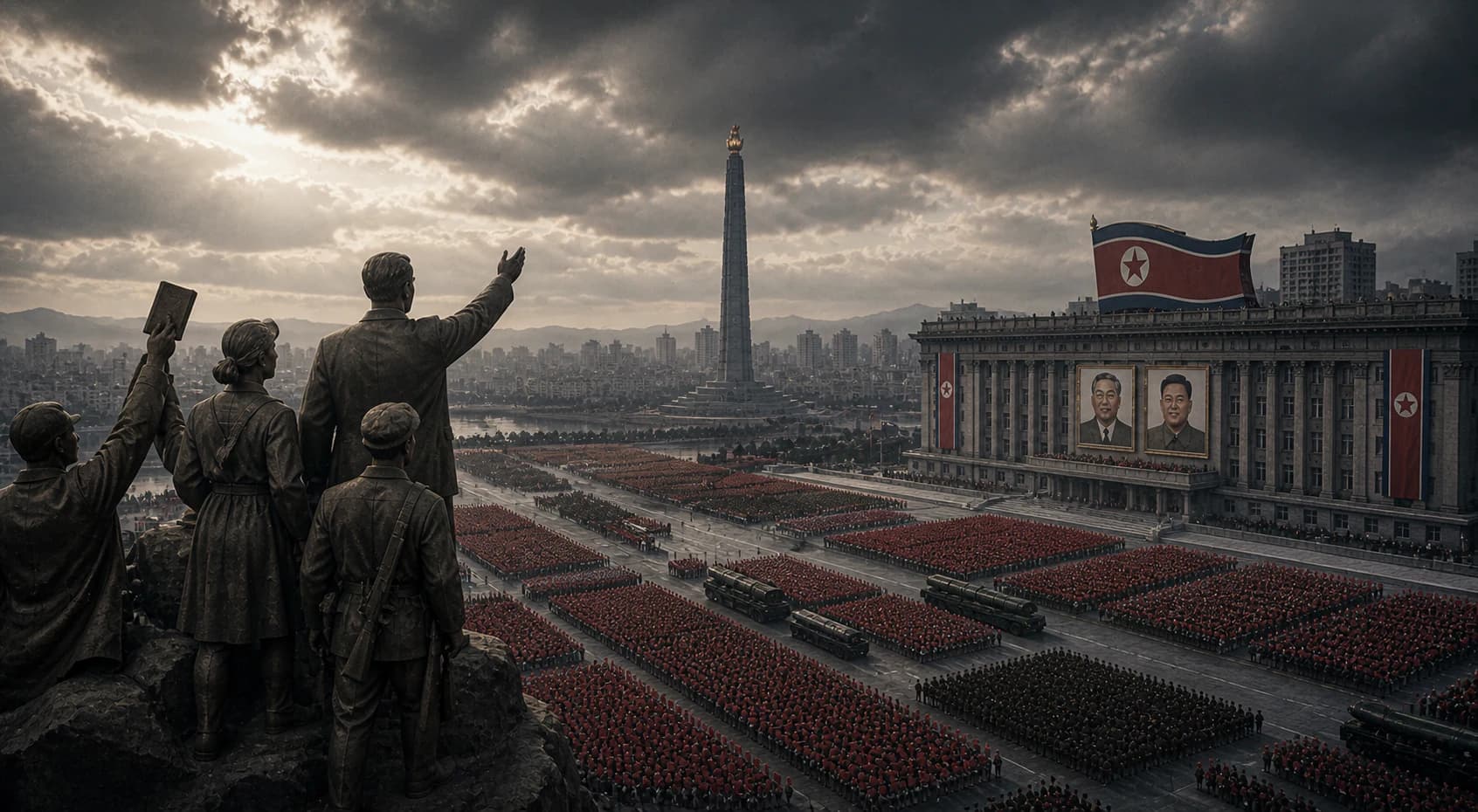
Kim Jong Un pursued the byungjin line, seeking economic development alongside nuclear weapons, though security priorities dominated. Under his rule, North Korea conducted further nuclear tests and rapid missile development, including intercontinental ballistic missile launches. The programme was not only military; it was political theatre, domestic legitimacy, and diplomatic leverage. Nuclear capability told citizens that sacrifice had produced strength, warned enemies that regime change would be costly, and forced outside powers to deal with Pyongyang at the highest level. By the late 2010s, North Korea had changed the strategic conversation in East Asia.
Kim made nuclear weapons the core proof that a small, isolated state could force global attention.
2018-2019
Summit diplomacy
After years of threats and tests, Kim Jong Un turned to summit diplomacy. In 2018 he met South Korean president Moon Jae-in and later U.S. president Donald Trump in Singapore, the first meeting between a sitting U.S. president and a North Korean leader. Further meetings followed, including Hanoi in 2019, where talks collapsed over sanctions relief and denuclearisation terms. Kim also restored visible diplomacy with China and Russia. The summits did not produce lasting disarmament, but they served Kim's purposes. They presented him as a world statesman, weakened assumptions that North Korea could be isolated into surrender, and preserved nuclear leverage while exploring sanctions relief.
His diplomacy was not a retreat from nuclear strategy; it was another way to exploit it.
2010s-2020s
Repression and economy
Kim Jong Un's rule has included visible construction, elite development projects, and tactical tolerance of market activity where it helps the state function. Yet the political structure remains deeply repressive. The regime controls movement, information, speech, religion, and organised dissent, while prison camps and collective punishment remain central human rights concerns. Sanctions, pandemic border closures, climate shocks, and policy choices have placed further strain on food security and trade. Kim's leadership has therefore mixed modern imagery with old coercive foundations. The skyline may change, but the state still depends on surveillance, fear, and ideological enclosure.
His regime has modernised some surfaces of power while preserving the coercive core of the North Korean system.
2022-2026
Russia alignment
Russia's full-scale invasion of Ukraine opened new space for North Korean strategy. Pyongyang moved closer to Moscow, with reports of North Korean munitions, missiles, and troops supporting Russia, and with Russia offering diplomatic cover, technology, food, energy, or other assistance in return. This alignment strengthened Kim's ability to resist U.S.-led pressure and linked the Korean Peninsula more directly to wider geopolitical confrontation. North Korea was no longer merely a regional nuclear problem. Under Kim, it became part of a broader axis of sanctioned states seeking leverage against the Western-led order.
His Russia policy shows how North Korea converts isolation into partnership when larger powers need what it can provide.
Present
Ongoing rule
Kim Jong Un continues to hold North Korea's highest political authority as leader of the Workers' Party of Korea and president of the State Affairs Commission. His rule has clarified the logic of the Kim dynasty in the twenty-first century: nuclear weapons deter intervention, controlled diplomacy seeks advantage, repression prevents internal alternatives, and family symbolism sustains legitimacy. He has also brought questions of succession back into view through public appearances by his daughter Kim Ju Ae, though her precise status remains uncertain. Kim's importance lies not in unpredictability alone, but in his disciplined pursuit of regime survival. He has made North Korea more dangerous, more entrenched, and harder to ignore.
His legacy is still being made, but the central fact is already clear: he turned inherited dictatorship into a more advanced nuclear bargaining state.