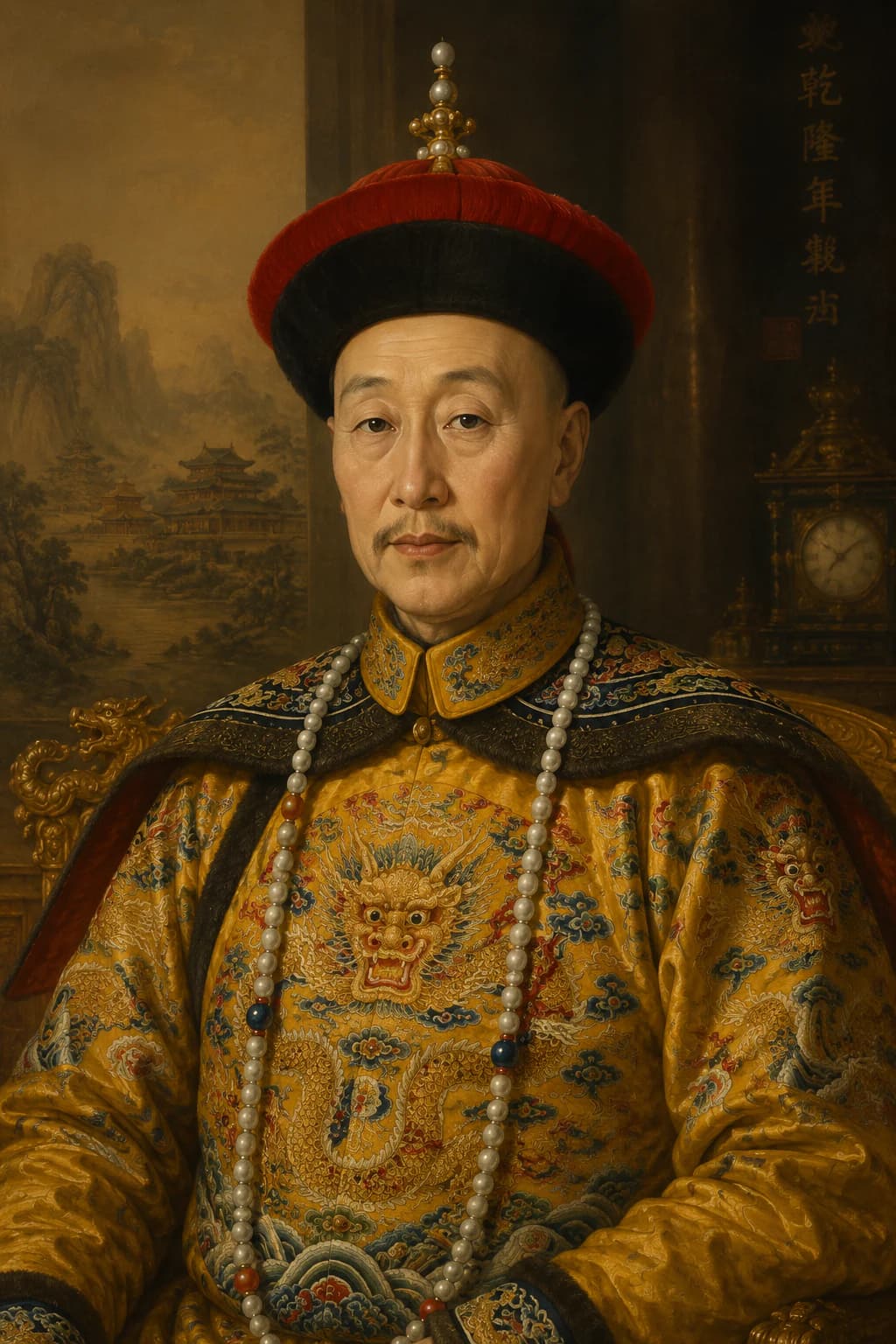
Complete chronology
Full overview and deeper context for every journey step.
1654
Born into conquest
Xuanye was born in 1654, only a decade after Qing forces entered Beijing and replaced the Ming dynasty. His childhood unfolded inside a court still adjusting to conquest. The Qing were Manchu rulers governing a vast Chinese population, and legitimacy had to be built through ritual, administration, military strength, and careful political performance. Xuanye inherited not simply a throne, but an unresolved imperial project. The dynasty had won Beijing, yet large regions, old loyalties, and frontier problems remained unsettled.
Kangxi's reign began from the central challenge of Qing history: how a Manchu dynasty could rule China.
1661
A child emperor
When the Shunzhi Emperor died in 1661, Xuanye came to the throne as a child. His reign name, Kangxi, is associated with peaceful harmony, but the early years were dominated by regents and court maneuvering. Child monarchy was always dangerous because authority could gather around ministers, relatives, and factions before the emperor had the age or experience to command. Kangxi's later reputation for personal rule rested partly on his ability to escape the shadow of regency and make the throne the active center of government.
His first political task was not conquest, but learning how to become more than a symbol.
1669
Removing Oboi
The removal of Oboi in 1669 was Kangxi's first great assertion of authority. Oboi had become the dominant figure among the regents, and his power threatened to limit the emperor's independence. Kangxi moved decisively, arresting him and taking personal control of government. The episode became an essential part of Kangxi's image: young, disciplined, and alert to the dangers of overmighty servants. It also warned the court that the emperor would not be managed indefinitely by those who claimed to serve him.
By defeating Oboi, Kangxi turned personal maturity into political authority.
1673–1681
Revolt of the Three Feudatories
The Revolt of the Three Feudatories was the greatest internal threat of Kangxi's reign. The Qing had relied on surrendered Ming generals to help control southern China, granting them broad regional power. When Kangxi moved to reduce that autonomy, rebellion followed. The war tested the dynasty's resources, loyalty networks, and military command. Victory in 1681 was decisive. It ended the danger of semi-independent military kingdoms within the empire and allowed the Qing state to govern China more directly. For Kangxi, it was the moment when conquest became consolidation.
Defeating the feudatories made Qing rule far more than a northern occupation.
1683
Taiwan and coastal control
The Zheng family regime on Taiwan had preserved a powerful anti-Qing base after the Ming collapse. In 1683, Qing naval forces defeated Zheng resistance and brought Taiwan under imperial control. The conquest mattered strategically and symbolically. It reduced coastal threats, ended a prominent Ming loyalist stronghold, and extended Qing administration across a key island frontier. Kangxi did not always pursue expansion for its own sake; he weighed the costs of governing distant territories. But Taiwan's incorporation strengthened the dynasty's claim to have pacified the realm.
The conquest of Taiwan closed one of the last major chapters of Ming loyalist resistance.
1680s–1710s
Scholarship and governance
Kangxi worked hard to appear as a legitimate Confucian monarch without ceasing to be a Manchu emperor. He sponsored scholarship, dictionaries, histories, and classical learning, while also preserving banner identity and imperial hunting traditions. His court welcomed Jesuit specialists, especially in astronomy, mathematics, cartography, and technology, because useful knowledge strengthened rule. This intellectual openness was practical rather than modern in a later sense. Kangxi valued expertise when it served order, precision, and imperial authority. His governance style combined personal diligence with a powerful awareness of image.
Kangxi understood that knowledge could be an instrument of legitimacy.
1680s–1690s
Northern frontiers
Kangxi's empire faced serious challenges beyond China proper. The Zunghar Mongols threatened Qing interests in Inner Asia, while Russian expansion pressed into the Amur region. The Treaty of Nerchinsk in 1689 set a border framework with Russia and showed Qing diplomacy operating on a Eurasian scale. Campaigns against Galdan Khan of the Zunghars demanded personal attention, logistics, and alliance-building. Kangxi's victories helped secure Mongolia within the Qing sphere, reinforcing the dynasty's character as a multiethnic empire rather than a purely Chinese monarchy.
Kangxi's Qing empire looked north and west as seriously as it looked south.
1700s–1722
A long reign strains
The length of Kangxi's reign became both a strength and a problem. Stability allowed institutions to mature, but the question of succession grew poisonous as adult sons competed for influence. The crown prince Yinreng was deposed, restored, and deposed again, exposing the emotional and political difficulty of managing imperial inheritance. Kangxi remained revered, but the court around him became tense with factional expectation. The crisis revealed a recurring weakness of dynastic monarchy: even a highly capable ruler could struggle to control what would happen after him.
The greatest reigns can still be shadowed by the question of succession.
1722 onward
Enduring reputation
Kangxi died in 1722, ending the longest reign of any emperor in Chinese history. His successor, the Yongzheng Emperor, inherited an empire more secure, more administratively capable, and more confident than the one Kangxi had received as a child. Kangxi's legacy rests on consolidation: defeating rebellions, extending frontier power, incorporating Taiwan, patronising learning, and making Manchu rule appear durable within Chinese political culture. He was not a gentle liberal monarch, but a hard-working imperial ruler whose success lay in making conquest look like order.
Kangxi turned Qing survival into Qing legitimacy.