Complete chronology
Full overview and deeper context for every journey step.
482–527
Rise through his uncle
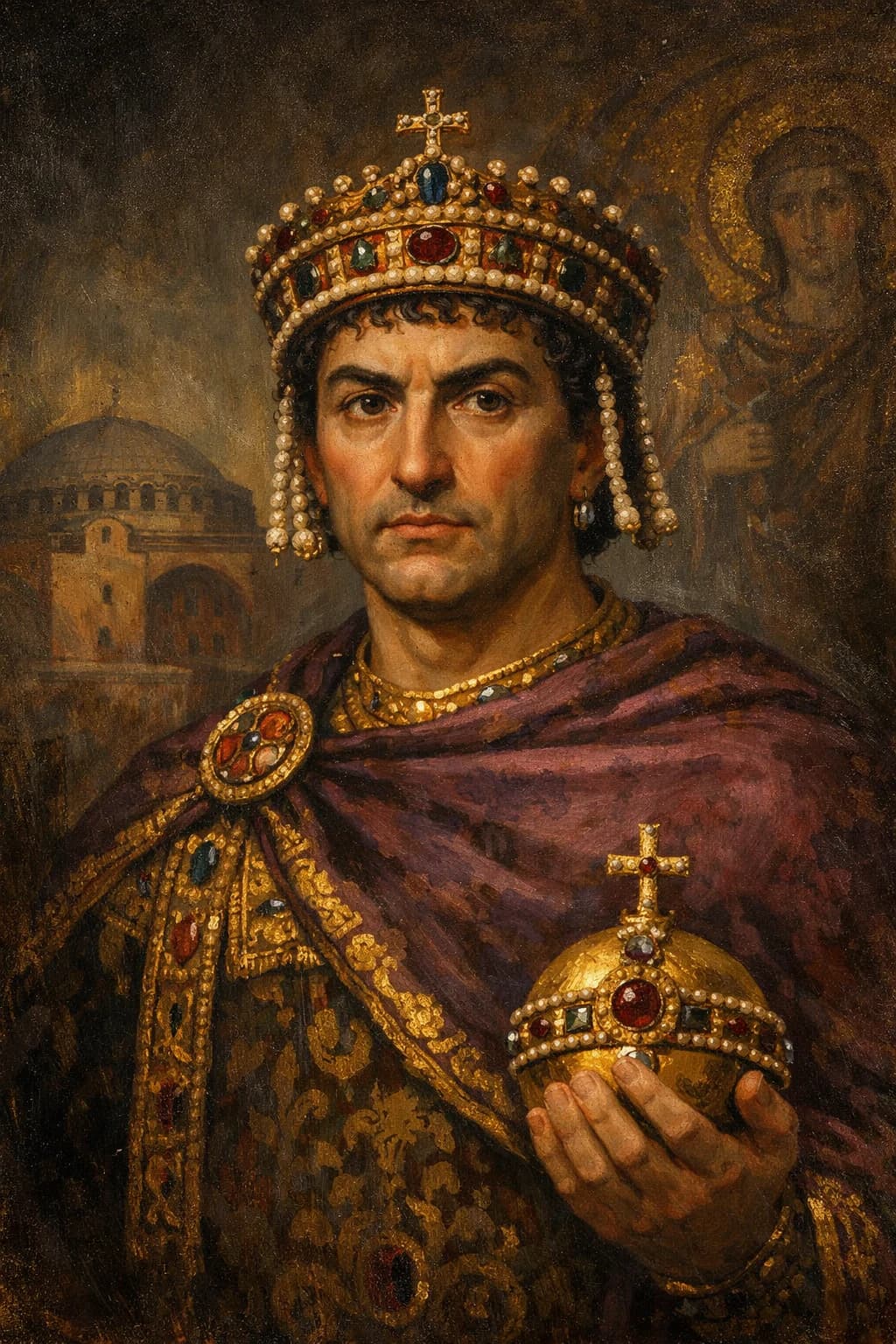
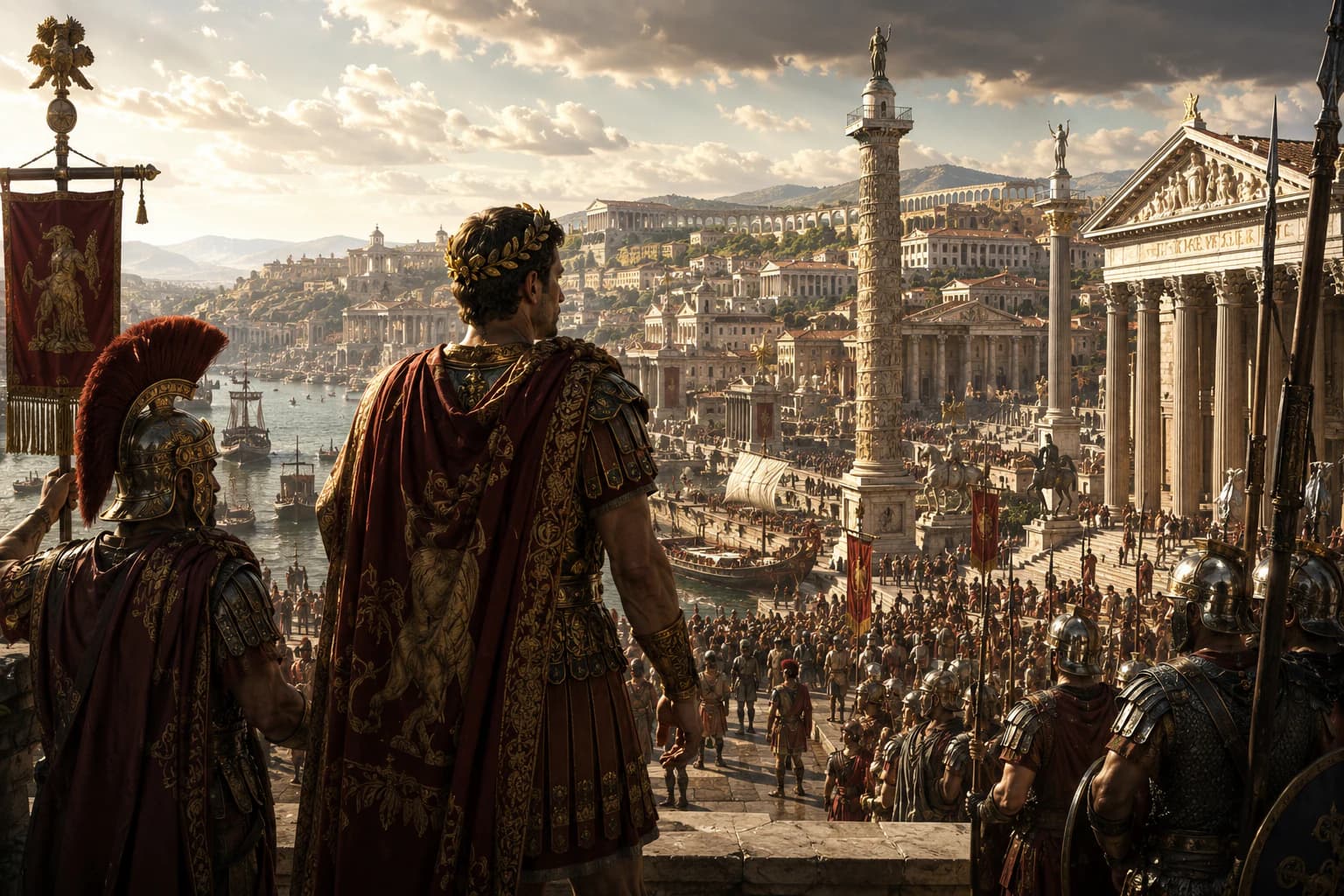
Justinian was born Petrus Sabbatius in a Latin-speaking Balkan community, probably in the region of modern North Macedonia or nearby Dardania, far from the old senatorial heart of Rome. His uncle Justin had risen through the army to command the palace guard in Constantinople, and when Justin unexpectedly became emperor in 518, Justinian's path opened. The younger man was educated, ambitious and administratively gifted. During Justin's reign he gained titles, influence and practical experience, becoming the mind behind much of the regime before he formally became emperor in 527. That background matters because Justinian was not an antiquarian dreaming vaguely of Rome. He was a provincial insider who understood army, law, church and palace politics, and who believed the emperor could impose order on all of them.
Informal power exercised over a long period before formal authority can be more transformative than the authority itself.
527–548
Empress Theodora
Theodora's rise was extraordinary in a society that ranked people sharply by birth, gender, office and respectability. Hostile sources, especially Procopius's Secret History, portray her early life in lurid terms, and those details must be treated with caution because they were written to wound. What is secure is that her background was unconventional for an empress and that Justinian changed the legal conditions that had blocked such marriages. As empress, Theodora was not ornamental. She had her own court, patronage networks and theological priorities, especially sympathy toward Miaphysite Christians whom Justinian often tried to reconcile with imperial orthodoxy. Their marriage functioned as a governing partnership. Justinian supplied relentless programmatic energy; Theodora supplied political steel, factional intelligence and the courage to stand firm when the throne trembled.
A partner who supplies complementary strengths and the courage to stay when others flee can make the difference between a regime that survives and one that collapses.
532
Nika riots
The Nika riots show how fragile imperial authority could be beneath ceremonial splendor. The Blues and Greens were chariot-racing factions, but they were also channels for urban identity, patronage, resentment and political pressure. In January 532, anger over punishments, taxation and unpopular ministers exploded into violence. Fires destroyed major buildings, including the earlier Hagia Sophia, and rebels proclaimed Hypatius, a nephew of a former emperor, as an alternative ruler. Justinian considered flight. Theodora's reported speech, insisting that imperial purple made a noble burial shroud, may be stylized by historians, but it captures the moment's drama. Justinian stayed. Narses divided the factions with money, and Belisarius and Mundus crushed the crowd in the Hippodrome. The repression was brutal, yet survival gave Justinian the political space to rebuild the capital and intensify his rule.
Crises that are survived at enormous cost can paradoxically create the conditions for the most significant subsequent achievements.
529–534
Codification of Roman law
Justinian's most durable achievement was not a conquest but an editorial and administrative revolution. Roman law had accumulated for centuries in imperial constitutions, juristic opinions, rescripts and local practice, often overlapping or contradicting itself. Justinian ordered legal experts led by Tribonian to collect, rationalize and authorize the empire's law. The result included the Codex, the Digest, the Institutes and later Novellae. It was completed with astonishing speed and backed by imperial command. The Digest alone preserved fragments of classical Roman jurists that might otherwise have disappeared. In the medieval West, when scholars at Bologna and elsewhere revived Roman legal study, Justinian's compilation became foundational. Civil law traditions across Europe, Latin America and beyond still carry its imprint. Justinian wanted to restore Rome; in law, he came closer than on any battlefield.
The achievement that outlasts all military conquests is often the administrative and intellectual one: the organisation of how people live together.
533–554
Reconquest of North Africa and Italy
Justinian's western wars were fueled by ideology, opportunity and calculation. The empire in Constantinople still called itself Roman, and Justinian believed territories once ruled from Rome could be restored to imperial obedience. In 533, Belisarius moved against the Vandal kingdom in North Africa and won with remarkable speed, giving the empire a wealthy province and a propaganda triumph. Italy was different. The Gothic War, beginning in 535, dragged on through sieges, shifting alliances, famine, plague and devastation. Rome changed hands more than once. Narses eventually completed the conquest in the 550s, but the Italy recovered by Justinian was poorer, depopulated and harder to defend. The reconquests made him look like the last great Roman restorer. They also exposed the difference between winning territory and making it governable.
Military success and strategic success are different things — winning the battles while ruining the prize is not a victory.
532–537
Hagia Sophia
Hagia Sophia was architecture as theology and statecraft. Completed in 537 by Anthemius of Tralles and Isidore of Miletus, it solved a problem no earlier church had solved at that scale: how to create an immense central space crowned by a dome that seemed to float above light. The building used marble, mosaics, columns, engineering daring and imperial money to make worship feel cosmic. Justinian is said to have claimed he had surpassed Solomon, and whether or not the line is exact, it captures the ambition. The church announced that Constantinople was not a diminished successor to Rome but the center of a Christian empire under divine favor. Its later lives as Orthodox cathedral, mosque, museum and mosque again only deepen its significance. Few buildings have carried so many layers of power.
A building that physically embodies an ambition can outlast the empire that built it by millennia.
541–549
Plague of Justinian
The Justinianic Plague was one of the great shocks of late antiquity. Modern evidence identifies it as part of the first known bubonic plague pandemic, though estimates of mortality vary widely and should be stated carefully. Contemporary writers describe Constantinople overwhelmed by death, with bodies collected in heaps and ordinary life suspended. Justinian himself reportedly became ill and recovered. The pandemic did not instantly destroy the empire, but it damaged the foundations of power: taxpayers died, farms and workshops lost labor, armies became harder to recruit and supply, and fiscal pressure intensified. The plague arrived just as Justinian was trying to sustain wars in Italy, North Africa, the Balkans and the eastern frontier. Nature did what enemies could not quite do: it made his restored Roman world harder to hold.
Military and political ambition cannot survive a demographic catastrophe, however brilliant the strategy.
548–565
Final decades
The final decades of Justinian's reign were not empty, but they were heavier. Theodora's death removed a partner whose political intelligence had helped steady the regime. Italy was finally conquered, but it required new administration, troops and money. The Balkans faced Slavic and Bulgar pressure. The eastern frontier with Persia demanded constant diplomacy and military readiness. Justinian also remained intensely involved in church politics, seeking unity among Christians divided by the Council of Chalcedon and related theological disputes. His interventions could be sincere, subtle and exhausting, and in later years they sometimes created new controversy rather than reconciliation. When he died in 565, aged about eighty-three, he left an empire larger and more famous than the one he inherited, but also financially and militarily strained.
A regime defined by the drive of its leadership often loses momentum when that drive is gone, regardless of the institutional strength that drive created.
After 565
The last Roman emperor
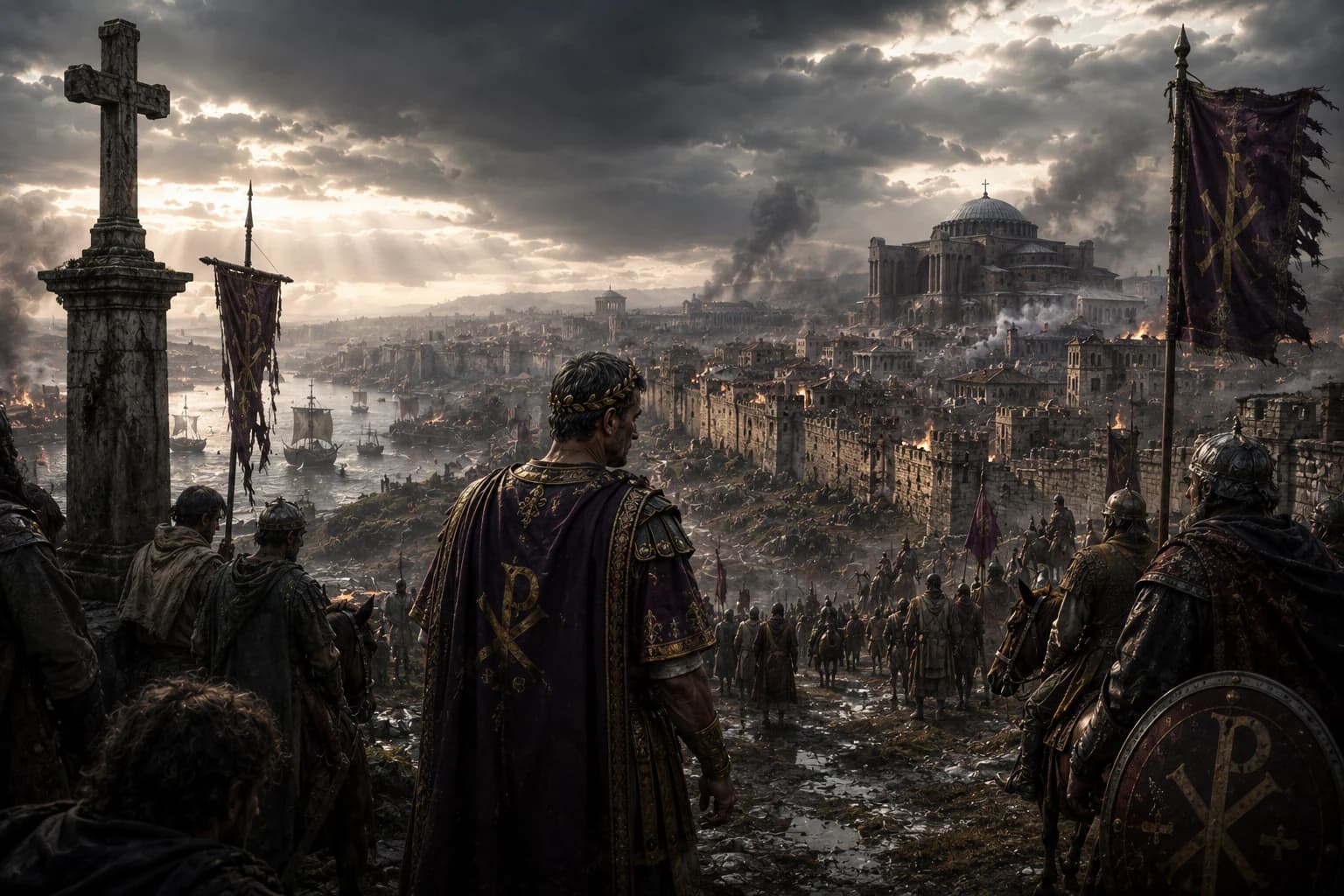
Justinian's legacy has always been divided. Admirers see the emperor of the Corpus Juris Civilis, Hagia Sophia and the last great Roman reconquest. Critics see taxation, repression, religious intolerance, ruined Italy and ambitions that exceeded the empire's capacity. Both views contain truth. North Africa remained in imperial hands for generations, while much of Italy was soon lost to the Lombards after 568. The legal code outlived both victories. Hagia Sophia outlived the empire that built it. Even the word Byzantine can mislead, because Justinian and his subjects understood themselves as Romans. His reign stands at a hinge in history: late Roman, early Byzantine, Christian, Mediterranean, imperial and medieval all at once. He did not restore the old Roman Empire permanently. He did something more complicated: he gave later worlds a legal, architectural and political memory of Rome that could survive territorial failure.
The most durable imperial legacies are those that live in institutions and texts rather than in territories, because texts and institutions survive the armies that created them.