Complete chronology
Full overview and deeper context for every journey step.
1874-1891
Norfolk beginnings
Howard Carter was born in Kensington, London, on 9 May 1874, the son of the artist Samuel John Carter and Martha Joyce Carter. He received limited formal schooling, but he inherited a practical artistic discipline from his father and developed a careful eye for line, texture and detail. That skill mattered. Archaeology in the late nineteenth century depended heavily on accurate drawing, copying and recording, especially before color photography became routine. Carter's route into Egyptology was therefore not through a university career or aristocratic patronage of his own. It began with the ability to look closely and reproduce what he saw. His early life gave him the craft that would later make him valuable in tombs, temples and excavation sites where fragile evidence had to be captured before time, weather or human handling altered it.
Carter entered archaeology through observation and draughtsmanship, skills that became essential to his greatest discovery.
1891-1899
First work in Egypt
Carter first went to Egypt in 1891, still a teenager, to work as an archaeological artist. He copied wall scenes at sites such as Beni Hasan and came into contact with the methods and expectations of professional Egyptology. Work under figures including Percy Newberry and Flinders Petrie exposed him to the discipline of excavation: measurement, context, pottery, stratigraphy, conservation and the importance of resisting the treasure-hunter's impatience. Carter was not always easy. He could be stubborn, proud and socially abrasive. Yet he learned the ground-level reality of archaeology in Egypt, where heat, dust, local labor, foreign institutions, Ottoman and then British imperial power, Egyptian authorities and private funders all shaped what could be dug and who controlled the results. His career began inside that unequal world, and his later fame cannot be separated from it.
His apprenticeship turned artistic talent into archaeological discipline, but it also placed him inside the colonial structures of early Egyptology.
1899-1905
Inspector of antiquities
In 1899, Carter was appointed an inspector in the Egyptian Antiquities Service, serving first in Upper Egypt. The position gave him authority over important ancient sites, including areas connected with Thebes and the Valley of the Kings. He supervised conservation, managed guards, dealt with excavators and helped protect monuments from damage and theft. In 1904, he was transferred to Lower Egypt. The job required diplomacy as well as expertise, and diplomacy was not always Carter's strength. A dispute in 1905 involving French tourists and Egyptian site guards at Saqqara escalated badly. Carter defended the guards and refused to make the apology demanded of him. The incident led to his resignation. It damaged his official career, but it also revealed the stubbornness that would later keep him digging when others thought the Valley of the Kings was exhausted.
Carter's official career gave him deep field experience, while his resignation exposed the pride and rigidity that shaped his reputation.
1905-1907
Years of uncertainty
Carter's resignation left him professionally exposed. For a time he made a living through watercolor painting, guiding, antiquities-related work and whatever commissions his knowledge of Egypt could secure. These were not wasted years. They kept him close to the landscape, objects and networks of Egyptology while forcing him to survive without the protection of an official post. Carter's personality could make enemies, but his competence remained hard to dismiss. He knew sites, workers, records, tomb architecture and the practical routines of excavation. In a field where wealthy patrons often needed skilled professionals to turn ambition into results, Carter still had value. His next major opportunity came through the aristocrat who would fund the discovery that made both their names famous.
Professional setback did not remove Carter from Egyptology; it pushed him into the patronage world that shaped major excavations.
1907-1917
Working with Lord Carnarvon
In 1907, George Herbert, 5th Earl of Carnarvon, hired Carter to oversee his Egyptian excavations. Carnarvon supplied money, status and access; Carter supplied expertise, patience and field command. Their partnership was not equal in social rank, but it proved effective. Carter improved the quality of Carnarvon's excavations and publications, and the two men gradually turned toward the Valley of the Kings. By then the valley had been dug repeatedly. Many believed the major royal tombs had already been found, and the remaining ground seemed unlikely to reward years of expense. Carter disagreed. He believed evidence still pointed to a missing tomb connected with Tutankhamun, a young Eighteenth Dynasty pharaoh then far less famous than Thutmose III, Amenhotep III or Ramesses II. His conviction became the engine of the search.
The discovery of Tutankhamun's tomb depended on a partnership between aristocratic funding and professional persistence.
1917-1922
The long search
Carter began serious work in the Valley of the Kings under Carnarvon's concession after the disruptions of the First World War. The task was slow and often unrewarding. The valley was not an untouched field waiting for discovery; it was a crowded archaeological landscape scarred by ancient robbery, earlier excavation, spoil heaps and modern assumptions. Carter worked methodically, clearing areas that others had neglected or left beneath debris. By 1922, Carnarvon was close to ending the effort. Years of digging had produced no intact royal tomb, and the costs were substantial. Carter persuaded him to fund one more season. That decision became one of the most consequential acts of patience in archaeological history. The first step of a buried stairway appeared in November 1922 near the tomb of Ramesses VI.
Carter's breakthrough came not from luck alone, but from refusing to accept that an overworked landscape had no secrets left.
1922
Tutankhamun's tomb
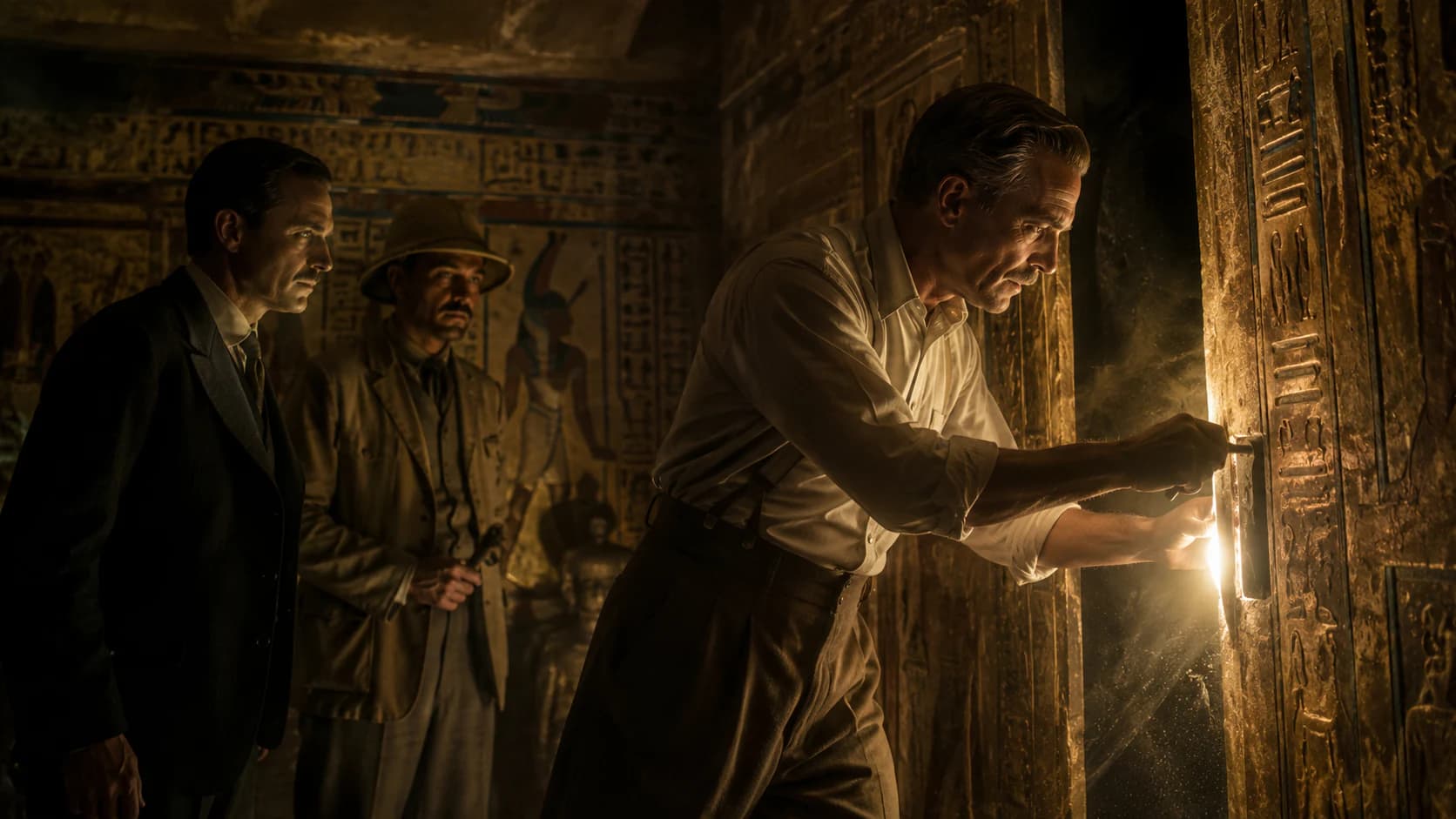
The discovery unfolded with controlled suspense. Carter's team uncovered steps leading to a sealed doorway, then a rubble-filled corridor and another sealed door. Carter sent for Carnarvon, who arrived from England with his daughter, Lady Evelyn Herbert. On 26 November 1922, Carter made a small opening and looked inside by candlelight. Asked if he could see anything, he gave the answer that became famous: 'Yes, wonderful things.' The antechamber was crowded with gilded couches, chests, disassembled chariots, statues and objects intended for the king's afterlife. The burial chamber itself still lay beyond. The tomb, known as KV62, had been disturbed in antiquity but not stripped bare. Its survival offered the most complete royal burial assemblage ever found in the Valley of the Kings.
The power of the discovery lay not simply in gold, but in the sudden return of an entire royal afterlife to view.
1923-1932
Recording the treasure
Opening the tomb was only the beginning. Carter and his colleagues faced the immense task of recording, conserving, photographing, packing and moving thousands of objects. The work required patience, chemistry, drawing, numbering systems, storage planning and constant negotiation with Egyptian authorities. It also unfolded under intense public attention. Newspapers turned the discovery into a global sensation, while the death of Lord Carnarvon in 1923 fed sensational stories about a supposed curse. Carter himself clashed with officials and was temporarily excluded from the tomb during a dispute in 1924. Behind the romance of discovery stood a more complicated reality: questions of control, Egyptian sovereignty, foreign privilege, museum claims, tourism and the ethics of excavation. Carter's achievement was enormous, but it belonged to an era whose assumptions later generations would rightly scrutinize.
The tomb's afterlife became a story of science, media, nationalism and power as much as archaeology.
1932-1939
Later years and legacy
The clearance of Tutankhamun's tomb was completed in 1932. Carter never made another discovery of comparable scale, and no discovery could realistically have matched it. He spent his later years lecturing, writing, dealing in art and antiquities, and living with the complicated fame the tomb had brought him. He died in London on 2 March 1939. Howard Carter's legacy is double. He was a skilled, persistent archaeologist whose careful work preserved a record of Egyptian royal burial unmatched in richness. He also worked within a colonial-era system in which foreign excavators, patrons and museums held power that modern Egyptology has had to reassess. To ask why Howard Carter was important is therefore to ask two questions at once: how one discovery transformed knowledge of ancient Egypt, and how the modern world came to possess, display and argue over the ancient past.
Carter matters because he revealed Tutankhamun to the modern world and because his career shows how archaeology itself has a history.