Complete chronology
Full overview and deeper context for every journey step.
1923–1938
Escape from Germany
Kissinger's childhood began in Fuerth, a German town where Jewish life was increasingly narrowed by Nazi law, intimidation, and violence. His family escaped to the United States in 1938, just before the full machinery of destruction closed around European Jewry. The rupture shaped him profoundly. He did not develop his interest in order, power, and state survival from books alone; he had seen a cultured society turn predatory and legal exclusion become physical danger. In New York he remade himself as Henry Kissinger, learned English, worked while studying, and carried with him a hard lesson that would define his later realism: international order was fragile, and moral aspiration without power could be helpless.
Experiencing upheaval firsthand can push a thinker toward prioritizing stability over idealism.
1940s–1950s
American education
Kissinger returned to Germany as a U.S. soldier and intelligence specialist, an experience that joined personal history to American power. At Harvard after the war, he studied government and diplomatic history, eventually writing on the Congress of Vienna and the statesmen who rebuilt Europe after Napoleon. That subject was revealing. Kissinger admired systems that contained conflict through balance, legitimacy, and disciplined negotiation. His academic work did not treat diplomacy as polite conversation; it treated it as the architecture that prevented catastrophe. By the 1950s he had become a prominent Harvard scholar, fluent in the language of nuclear strategy, alliance management, and historical analogy. The professor was already preparing to become an operator.
Academic exploration gave him tools to translate historical patterns into practical policy thinking.
1950s–1960s
Policy adviser rise
Kissinger's early public reputation rested on his attempt to think through nuclear danger without surrendering to either panic or wishful thinking. His book on nuclear weapons and foreign policy argued that strategy had to confront the possibility of limited nuclear war, a position later criticised but important in its time because it challenged simple assumptions about deterrence. He advised government agencies, foundations, and political figures, including Nelson Rockefeller. Gradually he learned the difference between academic influence and official authority. Washington rewarded ideas, but it rewarded access even more. By the late 1960s Kissinger had become exactly the kind of figure presidents noticed: intellectually formidable, ambitious, discreet, and eager to turn analysis into action.
Influence often grows at the intersection of ideas and access to power.
1969
National Security role
When Nixon entered the White House, he wanted foreign policy centralised, secretive, and controlled from the executive office. Kissinger was the ideal instrument. As National Security Advisor, he bypassed much of the State Department, managed back channels, and helped design a diplomacy built on leverage: pressure in one theatre could produce concessions in another; rivals could be played against each other; public statements could conceal private negotiations. This style produced breakthroughs, but it also concentrated power in remarkably few hands. Kissinger became one of the most influential unelected officials in American history, shaping war, peace, alliances, covert action, and the language through which the United States explained its global role.
Proximity to executive power can turn theoretical ideas into immediate global actions.
1971–1972
Opening to China
The opening to China was Kissinger's most dramatic diplomatic success. The United States and the People's Republic of China had been estranged since 1949, but the Sino-Soviet split created an opportunity. Kissinger travelled secretly to Beijing in 1971, using Pakistan as a channel, and laid the groundwork for Nixon's 1972 visit to Mao Zedong and Zhou Enlai. The move did not make China an American ally, and it did not erase ideological hostility. It changed the strategic geometry. Moscow now had to consider that Washington and Beijing could communicate, while the United States gained leverage in a triangular Cold War. Kissinger's achievement was to recognise that old enemies could become useful counterweights without becoming friends.
Strategic breakthroughs often come from engaging former adversaries rather than confronting them directly.
1969–1973
Vietnam negotiations
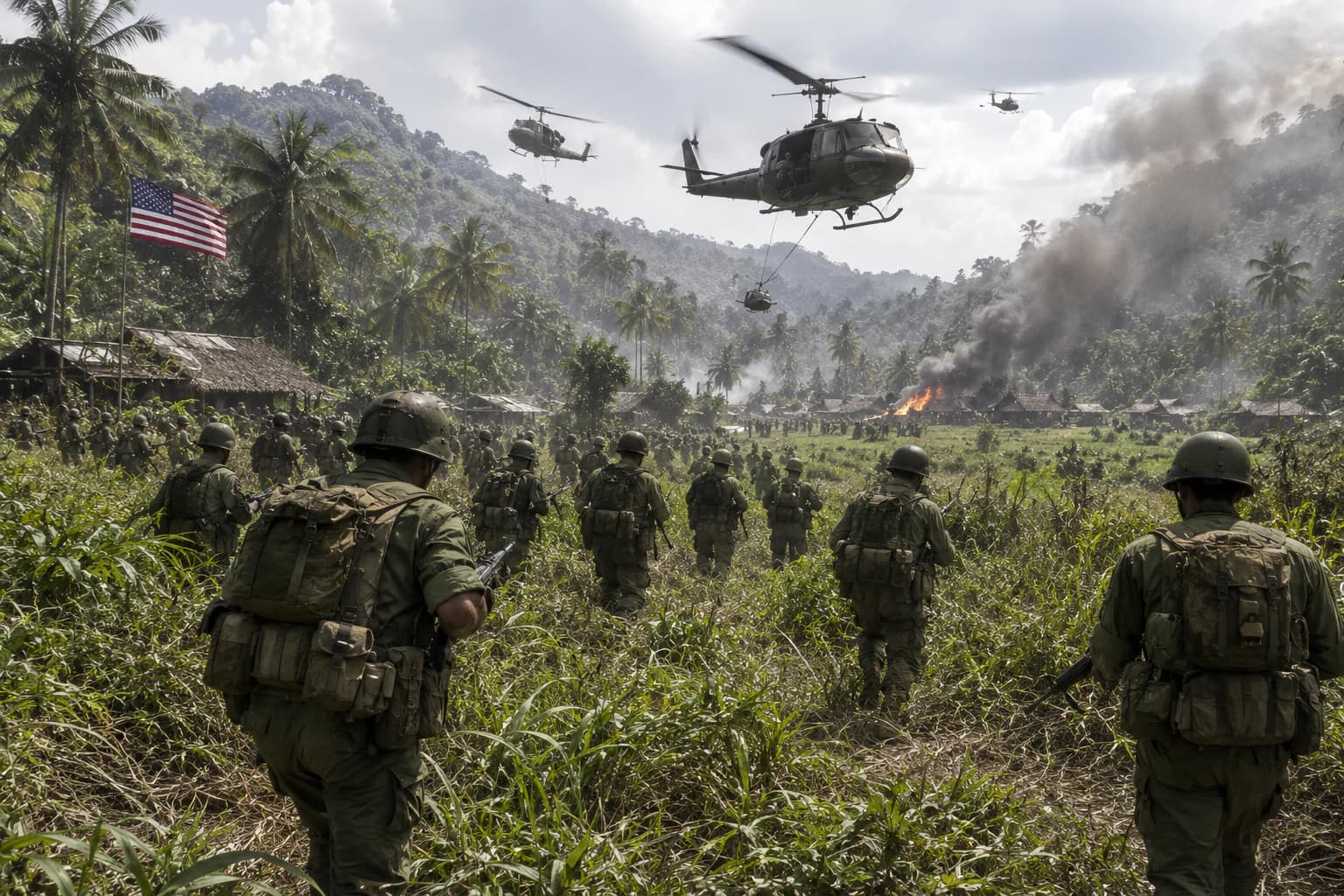
Vietnam made Kissinger famous, honoured, and permanently controversial. He negotiated secretly with Le Duc Tho while Nixon pursued Vietnamisation, bombing, and pressure designed to force a settlement that preserved American credibility. The 1973 Paris Peace Accords ended direct U.S. military involvement and brought Kissinger the Nobel Peace Prize, which Le Duc Tho refused. Yet the war did not truly end for Vietnam, and South Vietnam fell in 1975. The secret bombing of Cambodia, authorised as part of the wider war effort, remains central to criticism of Kissinger's legacy because it brought immense civilian suffering and destabilisation beyond Vietnam's borders. Supporters argue he inherited an impossible war; critics answer that his methods prolonged and widened it.
Ending a conflict can be as fraught and contested as entering it.
1973–1977
Secretary of State
Kissinger became Secretary of State in 1973 while still serving as National Security Advisor, an extraordinary concentration of diplomatic power. He helped advance detente with the Soviet Union, including arms-control frameworks, while also practising crisis diplomacy after the Yom Kippur War. His shuttle diplomacy between Israel, Egypt, and Syria did not create final peace, but it helped move the Middle East from immediate war toward negotiated disengagement. At the same time, his record in Chile, East Timor, Bangladesh, southern Africa, and other theatres exposed the moral cost of a worldview that often treated human rights as secondary to strategic alignment. Kissinger's statecraft was brilliant at sequencing, pressure, and balance; it was far less convincing when judged by the lives of people caught beneath great-power calculation.
Balancing competing priorities often requires accepting trade-offs that remain debated for decades.
1977–2000s
Global adviser
Kissinger never held office again after the Ford administration, but he did not leave power's orbit. Through Kissinger Associates, books, speeches, private advice, and elite networks, he remained a global presence. Presidents, ministers, business leaders, and foreign governments sought his judgement, partly because he had become a symbol of hard-headed realism. He wrote on diplomacy, China, world order, and artificial intelligence, constantly returning to the problem of how states manage danger in a changing system. The post-office career also deepened controversy. To admirers he was a wise elder statesman; to critics he was a man who escaped accountability while profiting from the prestige of decisions that had harmed millions.
Influence can persist long after formal authority has ended.
2023
Enduring legacy
Kissinger lived long enough to become both participant and monument. His achievements were real: the opening to China, detente, arms-control diplomacy, and Middle Eastern disengagement all changed the strategic map. So were the indictments: Cambodia, Chile, East Timor, Pakistan's war in Bangladesh, and a broader willingness to accept repression when it served perceived American interests. The debate over Kissinger is therefore not a footnote to his biography; it is the biography's central fact. He forces the hardest question in modern foreign policy: whether order purchased through secrecy, coercion, and selective blindness can be called wisdom. His legacy endures because no simple verdict can contain the scale of what he did or the cost others paid for it.
A powerful legacy is often defined as much by its critics as by its admirers.