Complete chronology
Full overview and deeper context for every journey step.
c. 830
Unknown beginnings
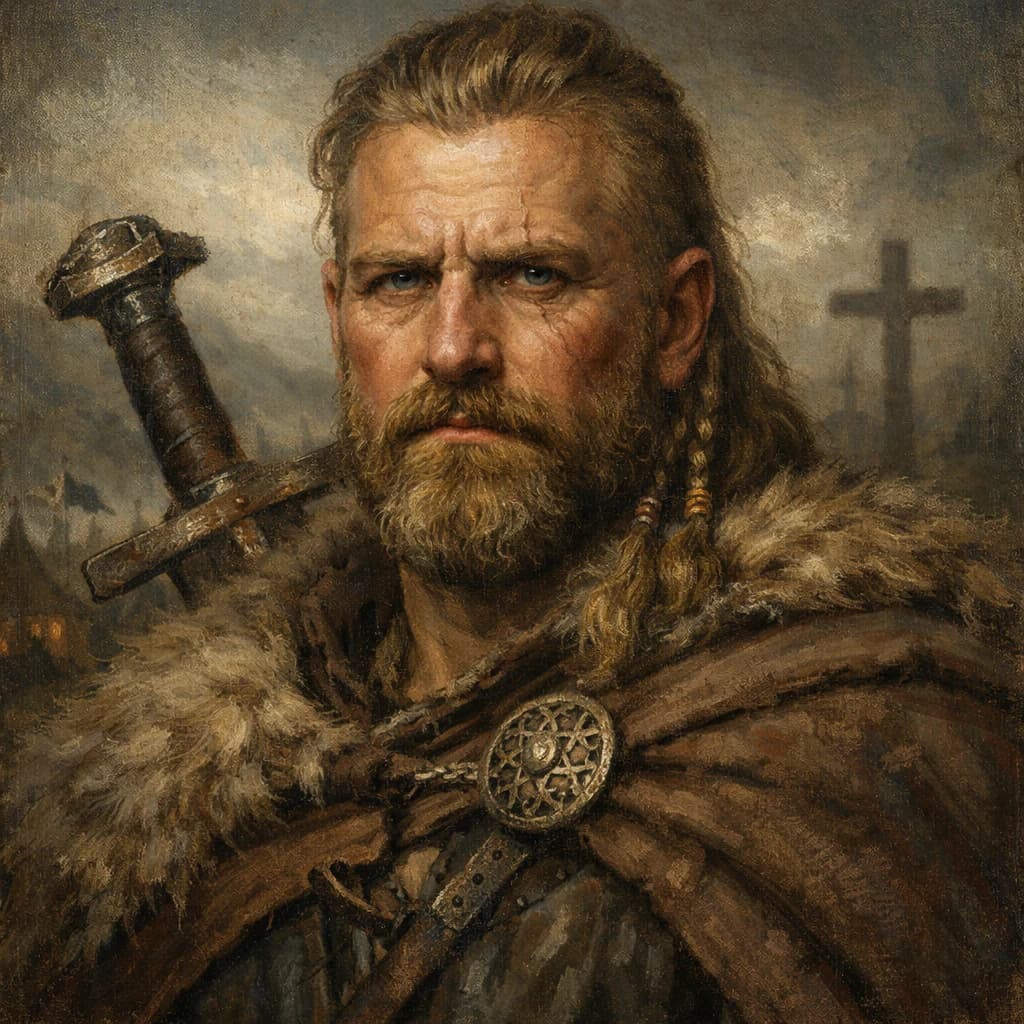
Guthrum's origins are poorly recorded, which is itself revealing. Anglo-Saxon sources noticed him when he became dangerous to England, not when he was growing up. He likely emerged from the mobile Scandinavian military culture that rewarded seamanship, loyalty, plunder, and the ability to hold a warband together. Leadership among Viking armies was not simply inherited in a neat royal line. It had to be performed: through distribution of wealth, success in battle, and the capacity to persuade ambitious warriors to stay with a campaign. By the time Guthrum appears clearly in English history, he was already a commander of consequence, part of a movement that had outgrown seasonal raiding and was beginning to seize kingdoms.
His obscured origins highlight how leadership in Viking society depended more on ability than recorded lineage.
860s
Arrival in England
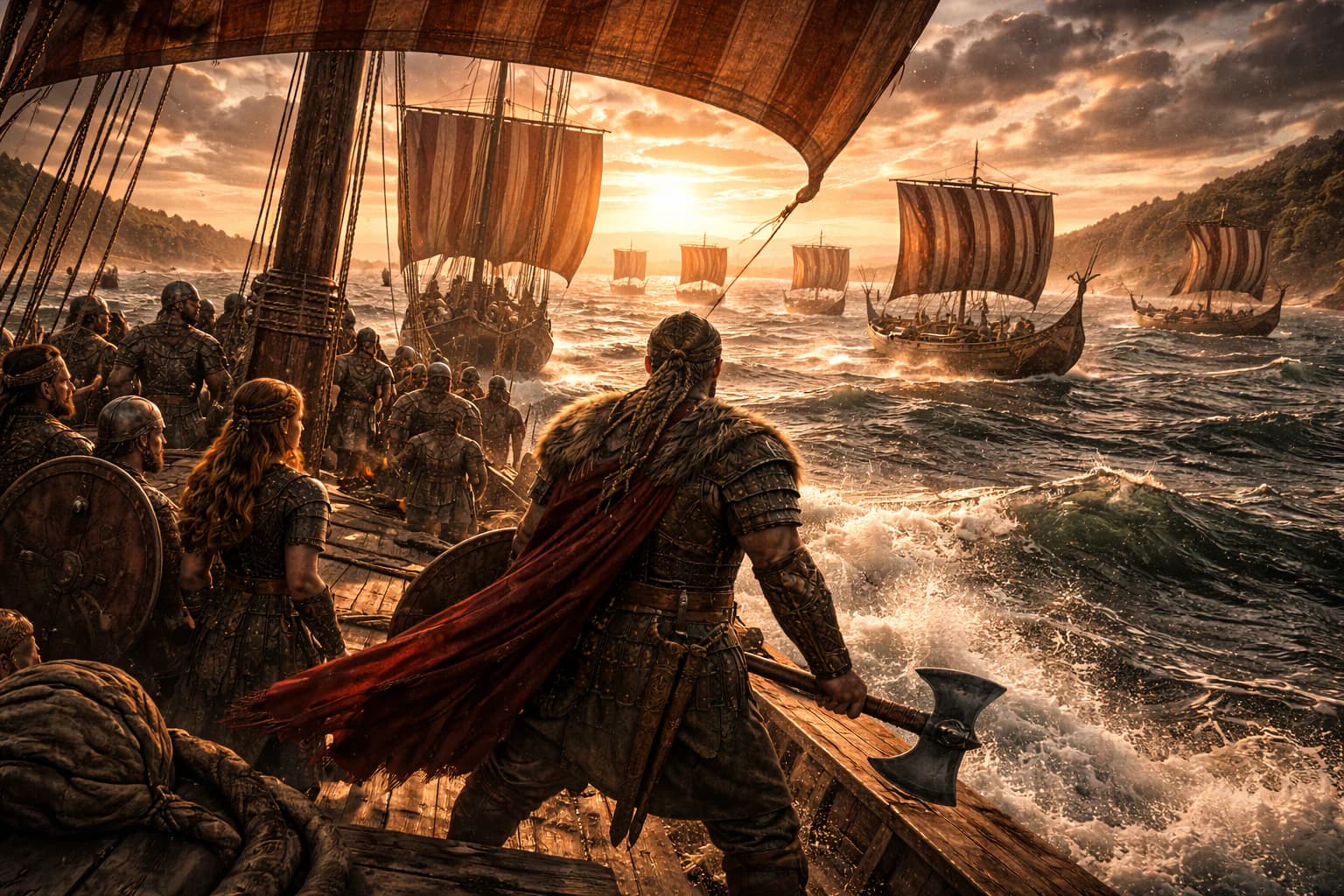
The England Guthrum entered was divided among kingdoms: Northumbria, Mercia, East Anglia, and Wessex, each with its own dynasty and interests. That fragmentation created opportunity. The so-called Great Heathen Army, arriving in the 860s, was not a brief coastal raid but a sustained military presence able to winter, bargain, move inland, and dismantle political structures. Northumbria was broken, East Anglia was conquered, and Mercia came under severe pressure. Guthrum belonged to this new phase of Viking activity. The goal was increasingly land, tribute, and authority, not simply portable treasure. His career sits at the hinge between the Viking Age as raiding and the Viking Age as political settlement.
His move to England reflects a broader transition from raiding to planned territorial expansion.
870s
Rise to command
Guthrum's rise can be measured by the scale of the threat he posed to Wessex. Viking armies were coalitions of leaders, crews, and followers whose unity depended on success. To command within that environment required more than battlefield aggression. Guthrum had to manage rival ambitions, choose targets, keep warriors supplied, and turn victories into lasting leverage. Wessex mattered because it remained the strongest independent Anglo-Saxon kingdom after the devastation of the north and east. If Wessex fell, organised Anglo-Saxon resistance might have collapsed entirely. Guthrum's campaigns therefore placed him at the centre of one of the decisive contests in early English history.
His leadership shows how Viking commanders had to balance strength with diplomacy to maintain influence.
876–878
War with Wessex
Guthrum's war against Wessex was a campaign of pressure rather than a single dramatic raid. In 876 he seized Wareham, forcing Alfred into negotiation. After further manoeuvres, he struck in midwinter 878 at Chippenham, a royal centre where Alfred had been staying. The attack was devastatingly timed. Alfred was driven into the marshes around Athelney with a small following, and for a moment Wessex seemed close to the fate of East Anglia and Northumbria. Guthrum's achievement was not accidental. He understood speed, surprise, and the political importance of royal sites. His near victory shows how narrow the survival of Wessex may have been.
His near victory reveals how close England came to falling entirely under Viking control.
878
Battle of Edington
Alfred's recovery was one of the great reversals of Anglo-Saxon history. From Athelney he rebuilt support, summoned men from Somerset, Wiltshire, and Hampshire, and met Guthrum's army at Edington. The battle ended in Alfred's victory. Guthrum withdrew to a fortified position and was besieged until he accepted terms. The defeat did not erase Viking power in England, but it ended the immediate possibility that Guthrum would swallow Wessex. His response was pragmatic. Rather than fight to destruction, he negotiated a future in which Scandinavian rule would survive elsewhere. Edington therefore mattered for both men: Alfred saved his kingdom, and Guthrum preserved a transformed version of his authority.
His decision to negotiate shows a leader willing to adapt rather than be destroyed by defeat.
878
Conversion and treaty
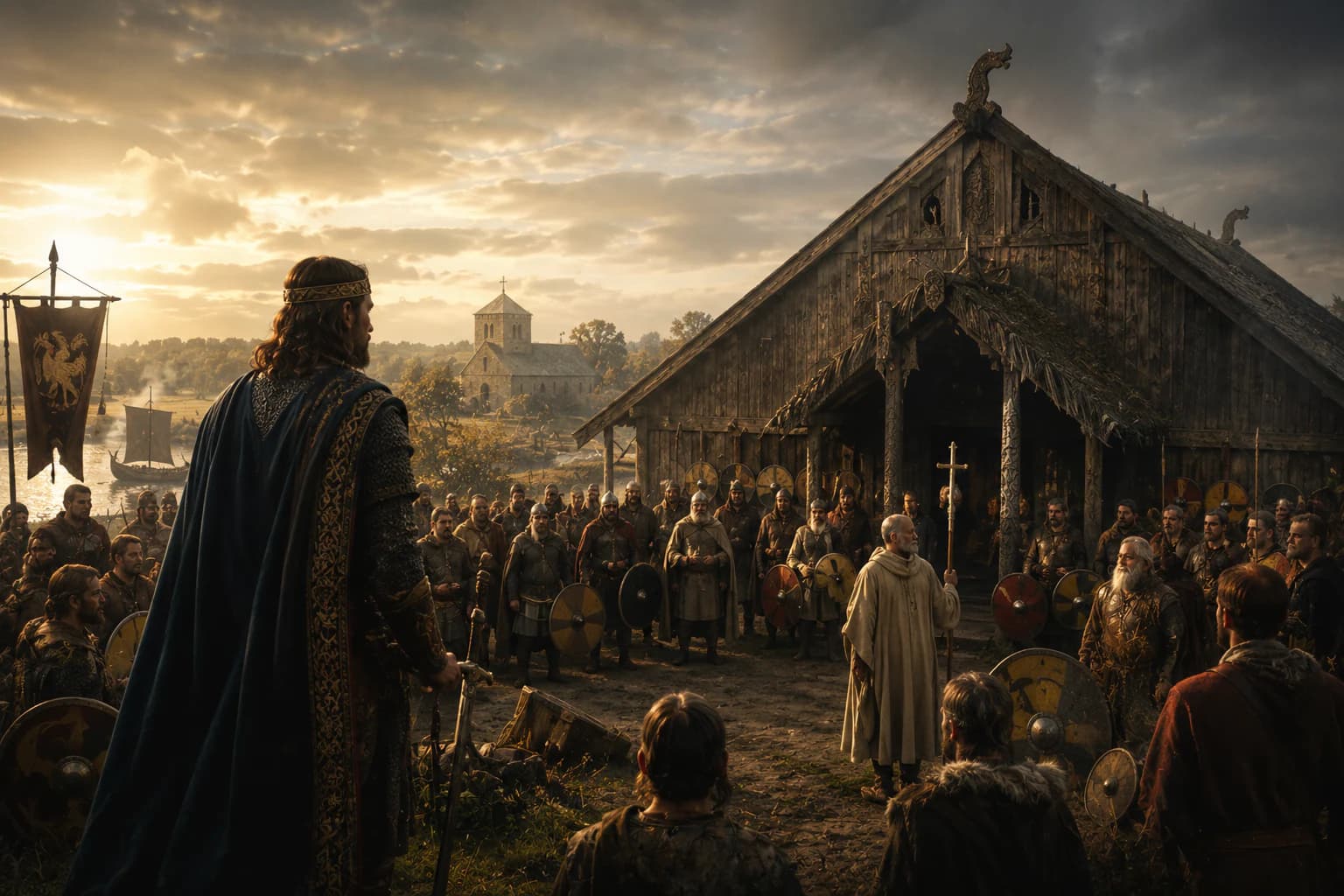
The settlement after Edington included one of the most symbolically charged moments of the period: Guthrum's baptism, with Alfred standing as his sponsor. Guthrum took the Christian name Athelstan. Modern readers should be careful not to reduce this either to pure cynicism or pure spiritual conversion. In ninth-century politics, religion, legitimacy, alliance, and identity were deeply connected. Baptism allowed Guthrum to enter a recognised Christian diplomatic world and gave Alfred a way to bind a defeated enemy through ritual kinship rather than endless war. The later Treaty of Alfred and Guthrum defined boundaries and legal relations between their peoples. The peace did not create modern England, but it helped stabilise a divided one.
His conversion illustrates how belief could serve as a tool for political integration and survival.
late 870s–880s
Rule in East Anglia
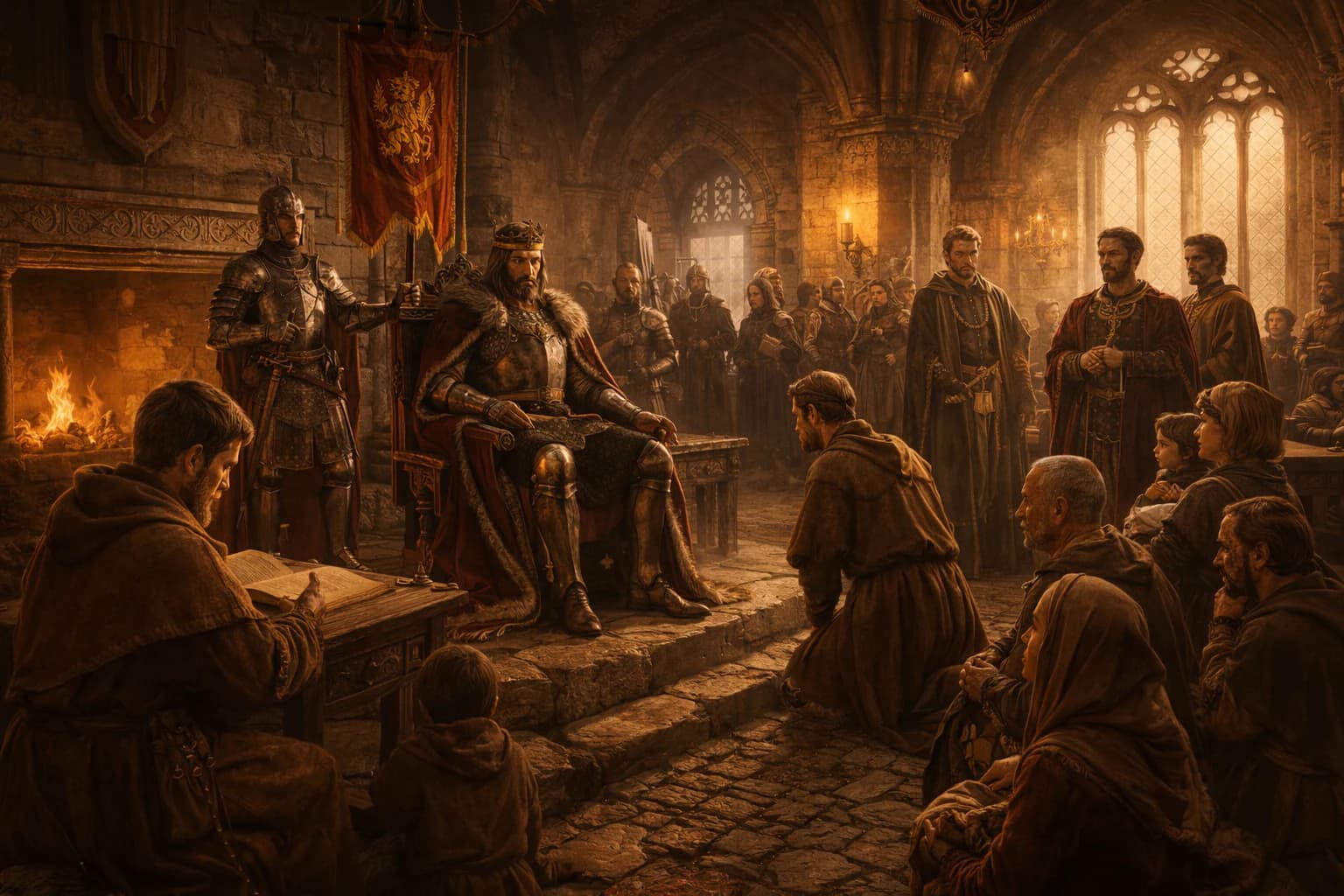
Guthrum's later rule in East Anglia shows the other side of Viking power. Conquest had to become government. Land needed to be allocated, tribute regularised, disputes settled, and local populations managed. Coinage associated with his Christian name, Athelstan, points to an authority that wanted recognition in forms familiar to Anglo-Saxon society. East Anglia under Scandinavian rule was not simply a camp of raiders. It became part of the broader Danelaw world, where law, language, settlement patterns, and lordship blended Scandinavian and Anglo-Saxon elements. Guthrum's importance lies here as much as on the battlefield: he helped turn invasion into a durable political community.
His rule demonstrates how former conquerors could become stable rulers through adaptation.
880s
Last years
The sources grow quieter after the great drama of 878, but that quiet is meaningful. Guthrum appears to have held East Anglia until his death around 890, and the peace with Alfred broadly endured. For a leader whose career had nearly destroyed Wessex, survival as a recognised ruler was a considerable achievement. It required restraint from both sides. Alfred used the breathing space to strengthen defences, burhs, military organisation, and royal authority. Guthrum used settlement to secure what war had gained. The result was not friendship in a modern sense, but a workable balance. In a violent century, that was no small political accomplishment.
His stability in later life shows that lasting influence often comes from restraint as much as conquest.
after 890
Enduring legacy
Guthrum is often remembered through Alfred's greatness, but he deserves attention in his own right. He was the opponent who forced Alfred to the edge and the defeated ruler whose accommodation helped shape England's political map. His career captures the Viking Age at a turning point: ships and warbands becoming kingdoms, enemies becoming neighbours, and pagan Scandinavian leaders entering Christian frameworks of legitimacy. The consequences reached beyond one reign. Eastern England retained Scandinavian influences in place-names, law, language, and identity. Guthrum did not make England, but by failing to conquer Wessex and succeeding in ruling East Anglia, he helped define the conditions from which a later English kingdom would emerge.
His legacy lies in transformation, showing how conflict can evolve into cultural fusion over time.