Complete chronology
Full overview and deeper context for every journey step.
1762–1780s
A difficult heir
George Augustus Frederick was born on 12 August 1762, the eldest son of George III and Queen Charlotte. He grew up in a royal household shaped by his father's moral seriousness, frugality and suspicion of aristocratic excess. The heir moved in the opposite direction. By early adulthood he was famous for fashion, appetite, sociability, debt and theatrical self-display. The Hanoverian pattern of father-son hostility returned with force: George III saw his son as irresponsible and immoral, while the prince saw his father as restrictive and joyless. When he moved to Carlton House, he turned it into a stage for the persona he wanted Britain to admire: elegant, cultivated, worldly and expensive. The bill would be paid by politics.
A child raised in deliberate contrast to a parent's character rarely becomes the balanced middle point between two extremes.
1785–1796
Marriage and debts
George's private life became a constitutional problem because royal desire collided with law, religion and money. In 1785 he secretly married Maria Fitzherbert, a Catholic widow. The marriage had emotional reality for him, but it was invalid under the Royal Marriages Act and politically impossible under the Protestant succession settlement. His debts then forced him toward a public dynastic marriage to Caroline of Brunswick in 1795. The match was catastrophic from the first meeting. They separated after the birth of their only child, Princess Charlotte, in 1796. George's treatment of Caroline became a public scandal because it exposed the gap between royal dignity and personal cruelty. He wanted freedom from her; the country saw a wife humiliated by a husband whose own conduct was hardly defensible.
A political marriage made to solve a financial problem rarely produces anything except additional problems.
1811–1820
Regency
George became Prince Regent in February 1811 after George III's final incapacity made direct royal government impossible. Many Whigs expected favor because the prince had long moved in their circles, but he kept Tory ministers in office, choosing stability and self-interest over old friendships. The Regency that followed is remembered for elegance, architecture, clubs, fashion, Jane Austen, Romantic poetry and Nash's transformation of London. It was also an age of wartime taxation, postwar distress, radical protest and harsh repression. George's cultural world glittered while many Britons faced hunger, unemployment and political exclusion. That contrast is essential to understanding why Regency style remains seductive and why the regent himself was so widely disliked.
An age defined by cultural brilliance and social polish can simultaneously be one of real economic suffering for most of its people.
1780s–1820s
Brighton Pavilion and cultural patronage
George IV's cultural patronage was the strongest part of his legacy. The Brighton Pavilion, reshaped by John Nash into an extraordinary Indo-Saracenic fantasy, remains one of Britain's most original royal buildings. His remodeling of Windsor Castle with Jeffry Wyatville and his development of Buckingham Palace helped define the physical language of the modern monarchy. He collected paintings, furniture, porcelain and decorative art on a grand scale, strengthening what became the Royal Collection. The criticism of cost was justified; his spending was extravagant even by royal standards. Yet the work was not empty vanity alone. George had a real eye for design and a sustained commitment to visual magnificence. He damaged monarchy politically while enriching its material inheritance.
Extravagance and genuine cultural contribution are not mutually exclusive, though the extravagance tends to dominate the historical memory.
Post-1815
Waterloo mythology
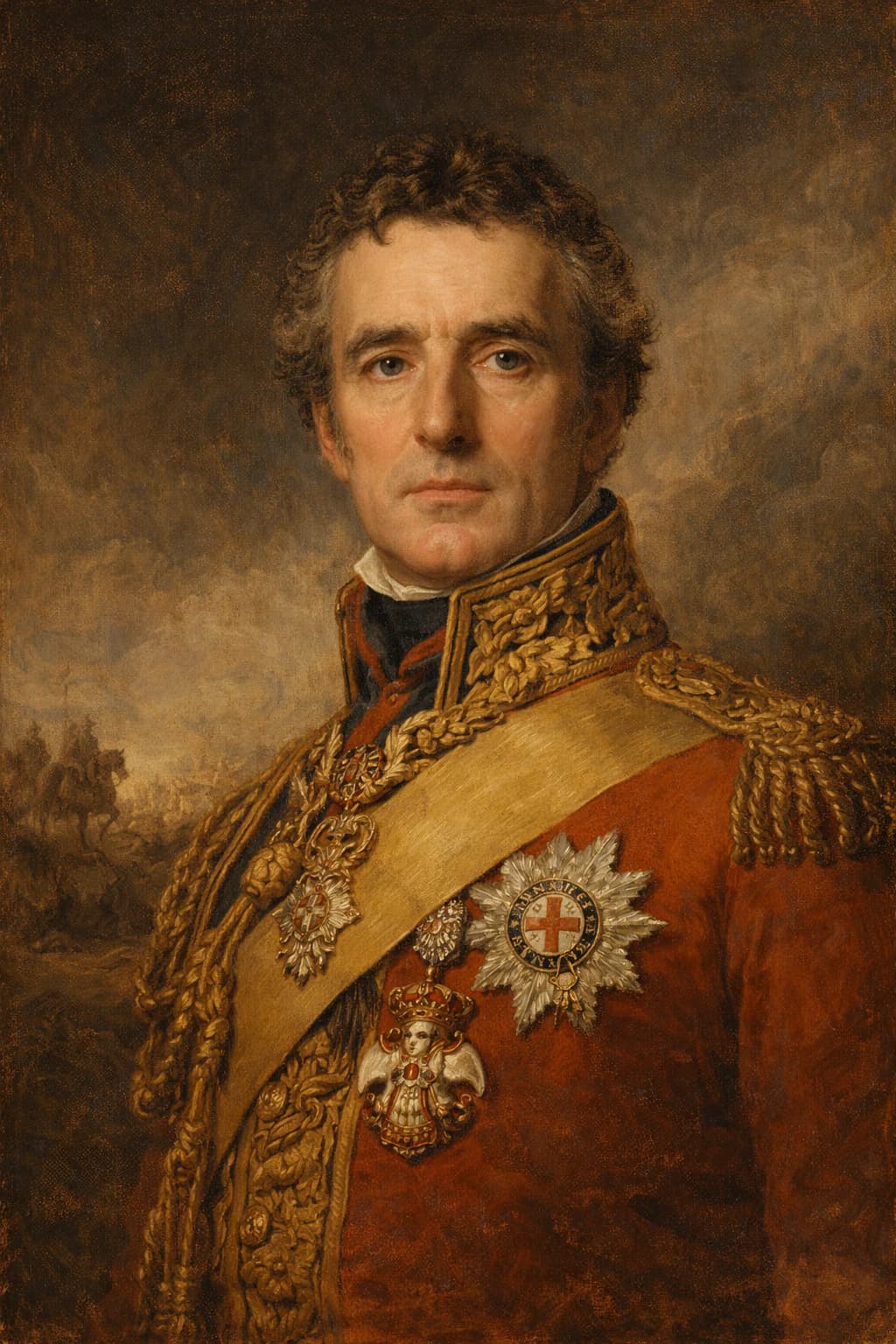
George played no military role in the defeat of Napoleon, but he loved the imagery of martial glory. After Waterloo, he embroidered his own place in the story until courtiers were expected to tolerate claims that bore little relation to fact. The Duke of Wellington's dry responses to such fantasies became part of the legend. The episode matters because it reveals George's deepest political weakness: he mistook performance for achievement. In an age when the state had been carried through war by ministers, generals, sailors, soldiers and taxpayers, the regent wanted the emotional reward of heroism without the discipline or danger. The public was not fooled.
Self-mythology in a powerful person goes unchallenged by those who depend on them, which makes it progressively worse.
1820
The Caroline affair
When George III died in 1820, Caroline returned from abroad to claim recognition as queen. George IV tried to remove her through a Bill of Pains and Penalties, a parliamentary proceeding built around allegations of adultery. The trial became national theatre. Radicals, reformers and ordinary crowds rallied to Caroline less because she was universally admired than because she embodied resistance to an extravagant, hypocritical king. The bill passed the Lords by such a narrow margin that ministers abandoned it. George then excluded her from his coronation; she died weeks later. The affair did serious damage because it let the public judge royal private life as political conduct, and George lost that judgment badly.
Pursuing private revenge through public institutions tends to humiliate the pursuer rather than the pursued.
July 1821
Coronation splendour
George IV's coronation on 19 July 1821 was the most lavish Britain had seen. He treated ceremony as art, costume and theatre, spending sums that shocked a country still living with postwar distress. The spectacle at Westminster Abbey impressed many observers, even critics, because George understood the visual power of monarchy. But magnificence could not repair the Caroline affair or erase years of debt and indulgence. The coronation showed both his gift and his failure. He knew how to stage monarchy as enchantment; he did not know how to make himself worthy of the enchantment. Later monarchs would use spectacle more carefully, with greater attention to public mood.
Spectacular performance of monarchy can build or destroy credibility depending entirely on whether the performer has already spent it.
1820s–1830
Physical decline
George's last years were marked by obesity, illness, isolation and dependence on alcohol and laudanum. He withdrew to Windsor, appearing less and less in public while ministers conducted government around him. Catholic emancipation in 1829 passed under the Duke of Wellington and Robert Peel despite the king's resistance, showing how limited his real power had become when political necessity was clear. Contemporary judgments were savage. Some were moralistic, but the underlying point was hard to avoid: George had consumed enormous public resources while giving little political service in return. He died on 26 June 1830, mourned officially but not deeply loved.
A reputation built on personal conduct rather than achievement can erode entirely when the conduct becomes impossible to overlook.
Post-1830
Cultural legacy
George IV's legacy is a study in separation between person, office and era. As a man, he was widely judged selfish, vindictive and extravagant. As a constitutional actor, he mattered less than the ministers who governed through war, repression, reform pressure and Catholic emancipation. As a patron, however, he left buildings, collections and ceremonial habits that still shape the monarchy's visual identity. The Regency world associated with his name includes Austen, Byron, Keats, Nash, fashion, clubs and urban elegance, much of it larger than him and much of it created by people he did not direct. To ask why George IV was important is to see how monarchy can be culturally influential even when the monarch is politically weak and personally discredited.
The most instructive historical figures are sometimes those whose era transcended them, leaving the question of how much individual monarchs ever really matter.