Complete chronology
Full overview and deeper context for every journey step.
1564
Birth in Pisa
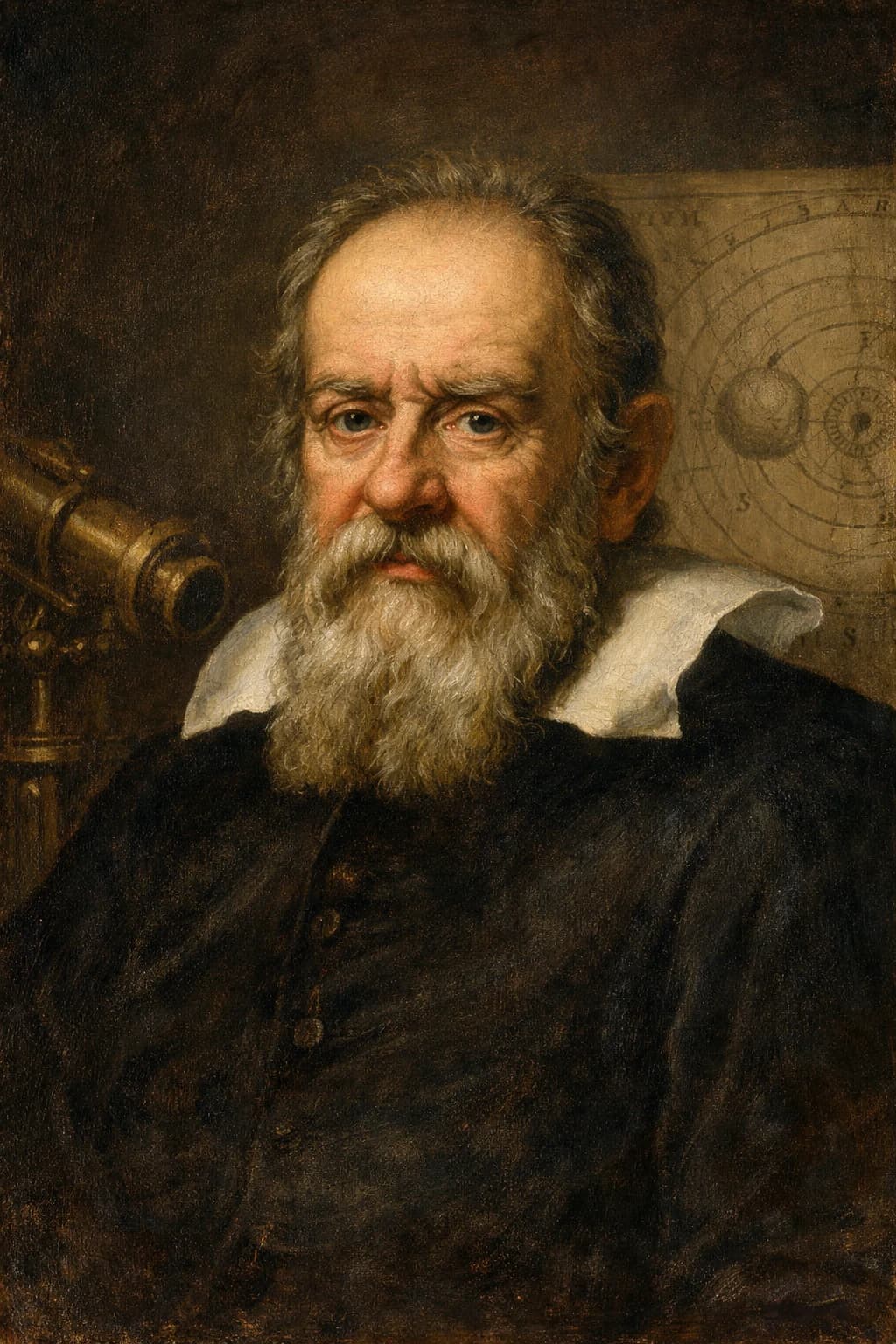
Galileo Galilei was born in Pisa on 15 February 1564, the same year Michelangelo died and Shakespeare was born. His father, Vincenzo Galilei, was a musician and theorist who questioned inherited rules about harmony through experiment and measurement. That household mattered. Galileo grew up in a culture still shaped by Aristotle, scholastic teaching and Renaissance humanism, but he also learned that authority could be tested. Pisa and later Florence placed him near universities, courtly ambition and practical mathematics. His curiosity was not abstract wonder alone. It was a habit of asking what could be measured, repeated and shown to others.
A mindset shaped by curiosity and structure can guide discovery long before formal study begins.
1581–1585
University shift
Galileo entered the University of Pisa to study medicine, a sensible route for family advancement, but mathematics drew him away. He became fascinated by geometry, mechanics and the possibility that physical behavior could be expressed in numerical relationships. This was more than a change of subject. In late sixteenth-century universities, natural philosophy often rested on textual authority, especially Aristotle as interpreted through centuries of teaching. Galileo's instinct was different: simplify the problem, observe carefully, use mathematics and look for a rule. He left without a medical degree, but he had found the intellectual method that would make him dangerous to comfortable explanations.
Changing direction early can open the door to deeper and more original contributions.
1589–1592
Motion studies
As a teacher at Pisa and then Padua, Galileo studied motion with a persistence that later made him central to physics. The famous story of dropping weights from the Leaning Tower of Pisa is uncertain, but the deeper reality is more important: he used controlled reasoning and experiments, especially inclined planes, to think about acceleration, falling bodies and projectiles. By slowing motion down, he could make patterns visible. He challenged the older idea that heavier objects naturally fell much faster than lighter ones in simple proportion to weight. His work did not yet produce Newtonian mechanics, but it helped clear the ground for it by treating motion as something governed by mathematical regularity rather than common-sense hierarchy.
Careful measurement can overturn ideas that have been accepted for generations.
1609
Telescope adoption
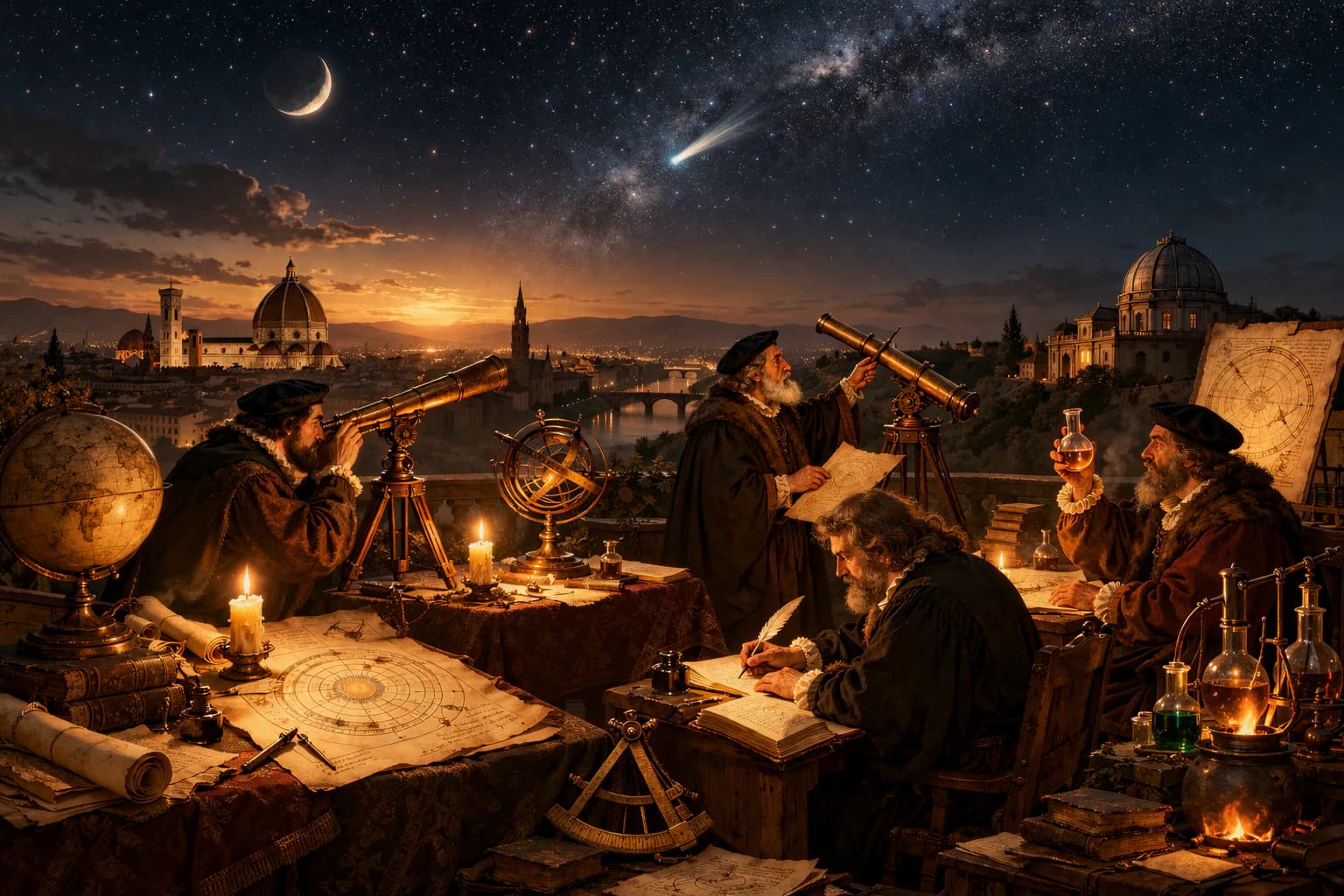
In 1609 Galileo heard reports of a Dutch spyglass and quickly built improved versions of his own. He first understood its military and commercial value, offering it to Venice as a tool for seeing ships at a distance. Then he aimed it at the sky. That decision changed astronomy because it turned the heavens from a realm interpreted through inherited models into a field of fresh evidence. The telescope did not automatically settle every debate, and early instruments were imperfect. But Galileo grasped the persuasive power of repeated observation. What mattered was not simply that he saw new things. It was that he published them fast, clearly and with the confidence of a man inviting Europe to look again.
New tools can transform not just what we see, but what we believe is possible to understand.
1610
Celestial findings
In 1610 Galileo published Sidereus Nuncius, the Starry Messenger. Its claims were startling: the Moon had mountains and valleys, the Milky Way resolved into countless stars, and four small bodies orbited Jupiter. Those Jovian moons, which he named for the Medici, were especially important because they showed that not every heavenly body revolved around Earth. Later observations of the phases of Venus gave further support to a Sun-centered arrangement, at least against the older Ptolemaic system. The discoveries did not instantly prove every detail of Copernicus, but they badly damaged the idea of a perfect, Earth-centered cosmos. Galileo had turned the sky into evidence with political consequences.
Direct evidence can shift understanding more powerfully than argument alone.
1610–1615
Support for Sun-centered model
Galileo did not invent heliocentrism; Nicolaus Copernicus had published the Sun-centered model in 1543. Galileo's importance was that he gave the idea new observational force and argued for it in a brilliant, combative Italian voice that reached beyond specialist circles. The phases of Venus, the moons of Jupiter and the roughness of the Moon all made the old cosmos harder to defend. The issue became dangerous because astronomy touched scriptural interpretation, university authority and the prestige of the Catholic Church in the age after the Reformation. Galileo argued that Scripture taught salvation, not planetary mechanics, and that nature should be read through evidence. That was intellectually powerful and institutionally provocative.
Evidence-based thinking often challenges deeply rooted beliefs and invites resistance.
1633
Confrontation and trial
Galileo was warned in 1616 not to hold or defend heliocentrism as physical truth. For years he maneuvered carefully, hoping that patronage, argument and the favor of Pope Urban VIII would allow him room. His Dialogue Concerning the Two Chief World Systems, published in 1632, presented arguments through conversation but clearly favored the Copernican side. The Roman Inquisition summoned him in 1633. Under pressure, he abjured and was sentenced to house arrest. The trial is often simplified into science versus religion, but the reality included personality, politics, censorship, scriptural interpretation and the Church's fear of disorder. Even so, the central historical fact remains: an evidence-based argument was officially constrained because it threatened established authority.
Ideas grounded in observation can endure even when their advocates are silenced.
1633–1642
Final research
House arrest did not end Galileo's work. Old, increasingly blind and watched by authorities, he returned to problems of motion that had occupied him for decades. His Discourses and Mathematical Demonstrations Relating to Two New Sciences, published outside Italy in 1638, gathered his mature thinking on strength of materials and motion. This book mattered as much for physics as the telescope had mattered for astronomy. It treated falling bodies, acceleration and projectile motion with mathematical discipline, helping later thinkers such as Christiaan Huygens and Isaac Newton. Galileo's final years show why his biography is not only about persecution. It is about intellectual persistence under restriction.
Limitations on freedom do not always prevent meaningful intellectual progress.
1642 and beyond
Enduring influence
Galileo died in 1642, the year Newton was born. That coincidence is too neat to explain history, but it captures a real transition. Galileo did not create modern science alone, and the myth of a solitary hero obscures the work of Copernicus, Kepler, Tycho Brahe, Islamic astronomers, instrument makers and many others. His legacy lies in the force with which he joined mathematics, experiment, instrument-based observation and public argument. He made nature answerable to measurement and made readers feel the excitement of seeing an old universe become unstable. To ask why Galileo was important is to see how knowledge changed when authority had to compete with repeatable evidence.
A new way of asking questions can matter as much as the answers themselves.