Complete chronology
Full overview and deeper context for every journey step.
1830
Imperial birth
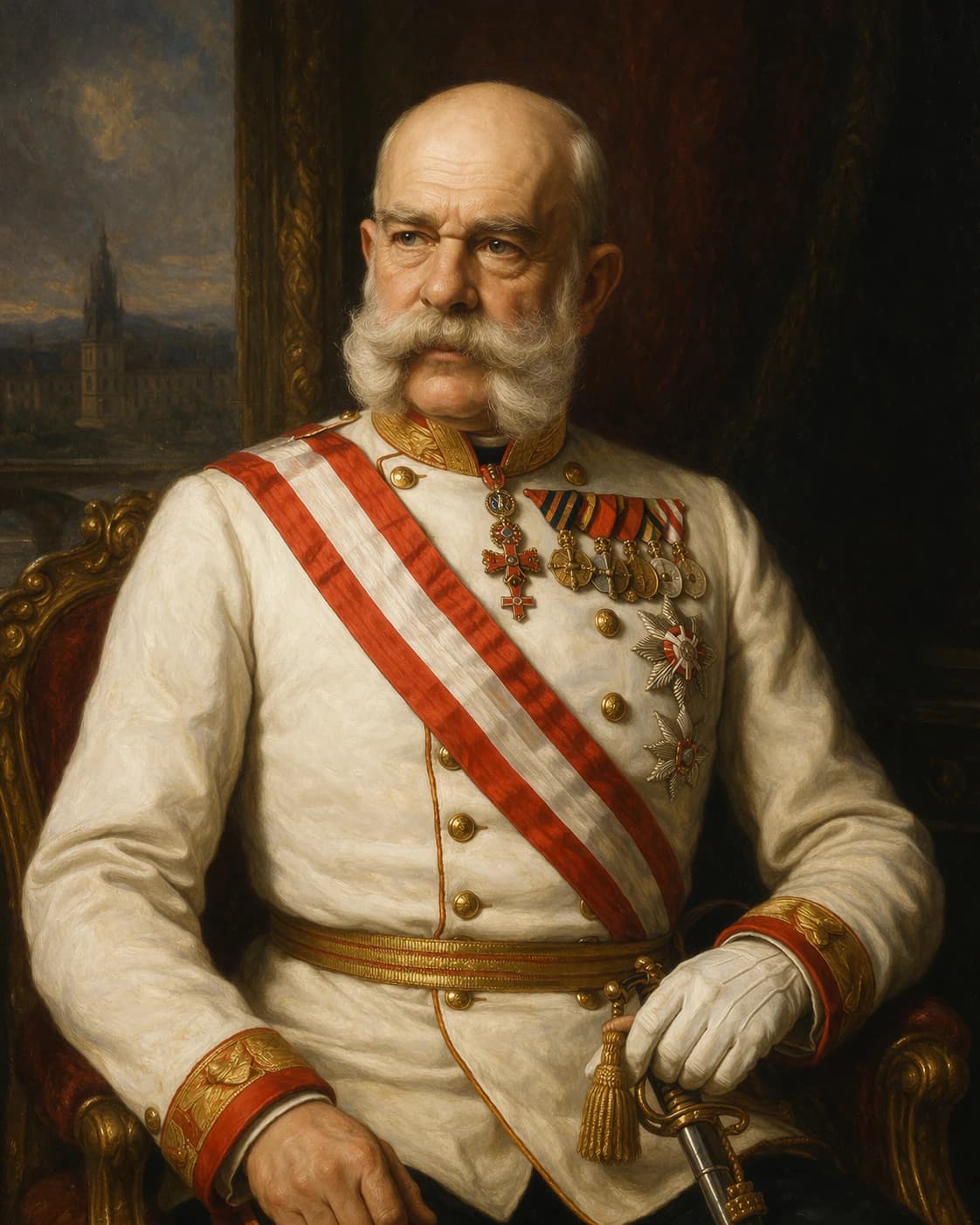
Franz Joseph was born at Schonbrunn Palace on 18 August 1830, a grandson of Emperor Francis I and a nephew of the future Ferdinand I. From childhood he was trained less as a private person than as a servant of dynasty. The Habsburg monarchy ruled Germans, Hungarians, Czechs, Slovaks, Croats, Poles, Ruthenians, Italians, Romanians, Slovenes and others, and its survival depended on habit, army, bureaucracy and imperial prestige. Franz Joseph absorbed the court's language of duty, Catholic piety and military discipline before he understood the political storm gathering outside Vienna. That education gave him stamina and self-command, but it also made him suspicious of nationalism, liberal constitutionalism and popular politics. He learned to endure; he did not learn easily to yield.
Early conditioning for duty gave him strength in crisis but narrowed his ability to adapt to change.
1848
Revolutionary youth
The revolutions of 1848 shook the Habsburg world from Vienna to Budapest, Milan and Prague. Liberals demanded constitutions, national movements demanded recognition, and imperial authority suddenly looked breakable. Ferdinand I abdicated in December, and Franz Joseph, only eighteen, was placed on the throne because senior ministers and family advisers believed a young emperor could renew dynastic legitimacy. His accession was therefore born in fear as much as hope. He watched armies, not parliaments, rescue the monarchy, and that lesson marked him for life. To Franz Joseph, revolution was not romantic liberation. It was disorder threatening to dissolve a centuries-old state.
Taking power in crisis pushed him toward control rather than negotiation as a governing instinct.
1849–1859
Restoring order
After 1848, Franz Joseph and his advisers rebuilt authority through soldiers, police, officials and central administration. Hungarian resistance was crushed with Russian help in 1849, Italian revolt was contained, and Vienna tried to govern the empire as a more uniform state from above. This neo-absolutist system made sense to men who had just seen revolution nearly break the dynasty. It also ignored the fact that national politics had not disappeared. Hungarians remembered defeat, Czechs resented exclusion, Italians looked increasingly toward unification, and liberals saw censorship and bureaucracy as proof that the monarchy had learned too little. Franz Joseph restored order, but the peace he created depended on pressure rather than consent.
Stability achieved through force often preserves order while quietly building future conflict.
1859
Italian setbacks
The war of 1859 against Piedmont-Sardinia and France exposed how brittle Habsburg power could be when diplomacy, military preparation and popular feeling moved against it. Defeat at Magenta and Solferino cost Austria Lombardy and damaged the prestige on which Franz Joseph's system relied. The emperor was not suddenly converted into a liberal, but he could no longer pretend that central command alone would solve every problem. Financial strain, military humiliation and pressure from provincial elites forced experiments with constitutional government. The deeper issue was not only Italy. It was whether a dynastic empire could adapt quickly enough in an age when nations were becoming political actors.
Military defeat often reveals deeper weaknesses that cannot be solved by force alone.
1867
Dual monarchy formed
The Austro-Hungarian Compromise of 1867 was Franz Joseph's most important act of political adaptation. After Austria's defeat by Prussia in 1866, the monarchy could not afford a permanent Hungarian crisis. The settlement made Franz Joseph both Emperor of Austria and King of Hungary, with two governments, two parliaments and shared responsibility for foreign affairs, war and certain finances. It stabilized relations with the Magyar political elite and gave the Habsburg state another half-century of life. Yet the bargain was deliberately uneven. Czechs, South Slavs, Romanians and others did not receive equivalent status. Austria-Hungary became more durable in the short term because one national problem was partly solved; it became more fragile in the long term because so many others were left waiting.
Compromise can preserve a system, but uneven concessions often leave deeper questions unanswered.
1860s–1890s
Personal tragedies
Franz Joseph's public image of discipline hid a life repeatedly struck by private disaster. His brother Maximilian, placed on the throne of Mexico, was executed in 1867. His only son and heir, Crown Prince Rudolf, died at Mayerling in 1889 in a scandal that shattered the dynasty's future. His wife, Empress Elisabeth, was assassinated in Geneva in 1898. These losses deepened the emperor's retreat into routine: early rising, paperwork, uniforms, audiences and a nearly mechanical devotion to office. The habit made him appear reliable to subjects who feared upheaval, but it also narrowed his political imagination. He became the living symbol of continuity while the family and empire around him kept showing signs of fracture.
Personal loss can deepen commitment to duty while quietly shaping a leader’s inner world.
1900–1914
Aging empire
By 1900 the Habsburg monarchy was not simply dying, as older stereotypes suggest. Vienna and Budapest were dynamic cities, industry was growing, the army remained significant, and imperial institutions still mattered. But the political system was overloaded. Parliamentary obstruction, language disputes, social democracy, clerical politics, Magyar domination in Hungary and South Slav nationalism all strained the dual monarchy. Franz Joseph understood administration better than mass politics. He could arbitrate, delay and discipline, but he rarely offered a generous constitutional vision able to bind the empire's peoples together. His longevity became a paradox: the longer he ruled, the more Austria-Hungary depended on one aging figure to impersonate unity.
Longevity in power can become a weakness when leadership fails to evolve with changing realities.
1914
War begins
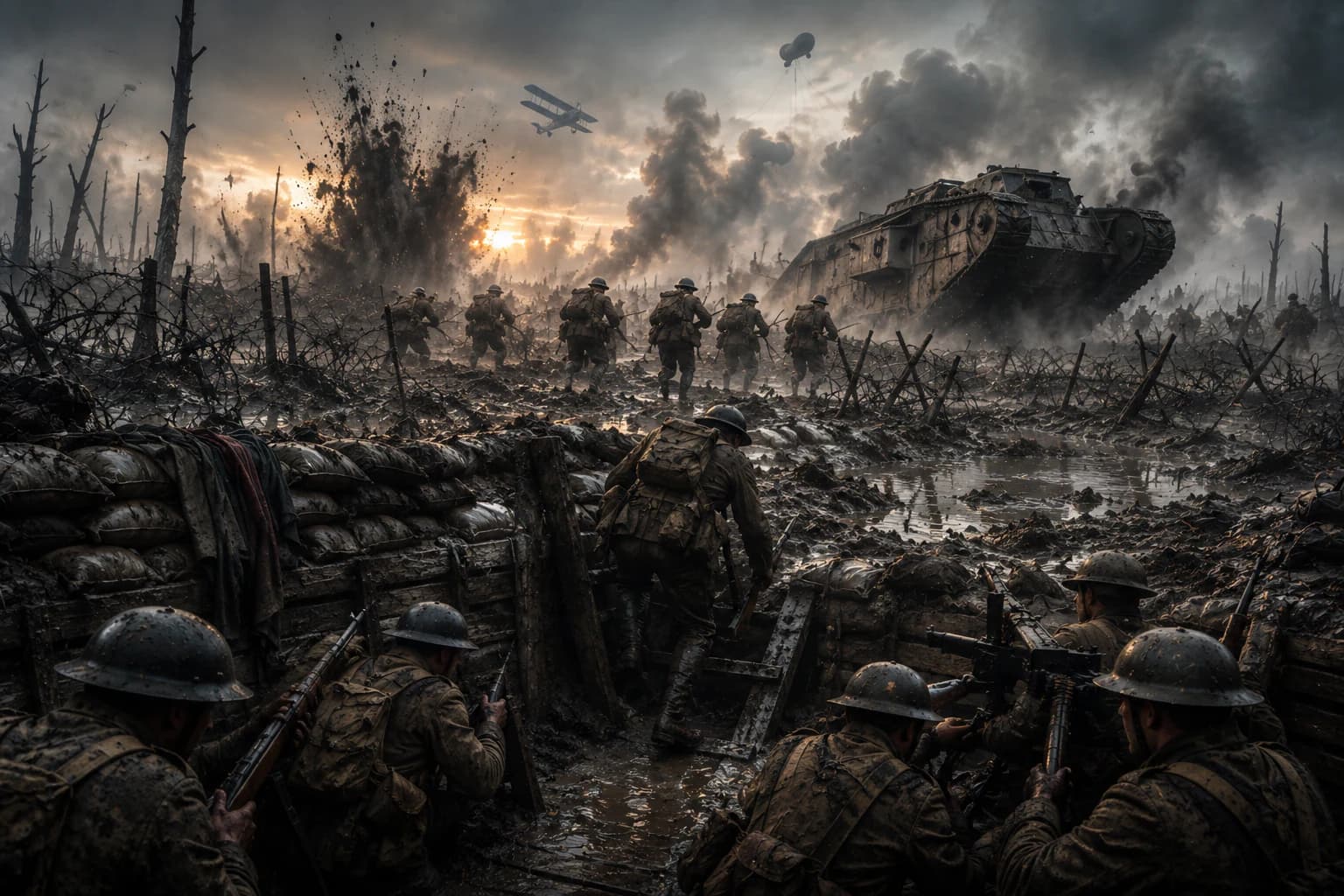
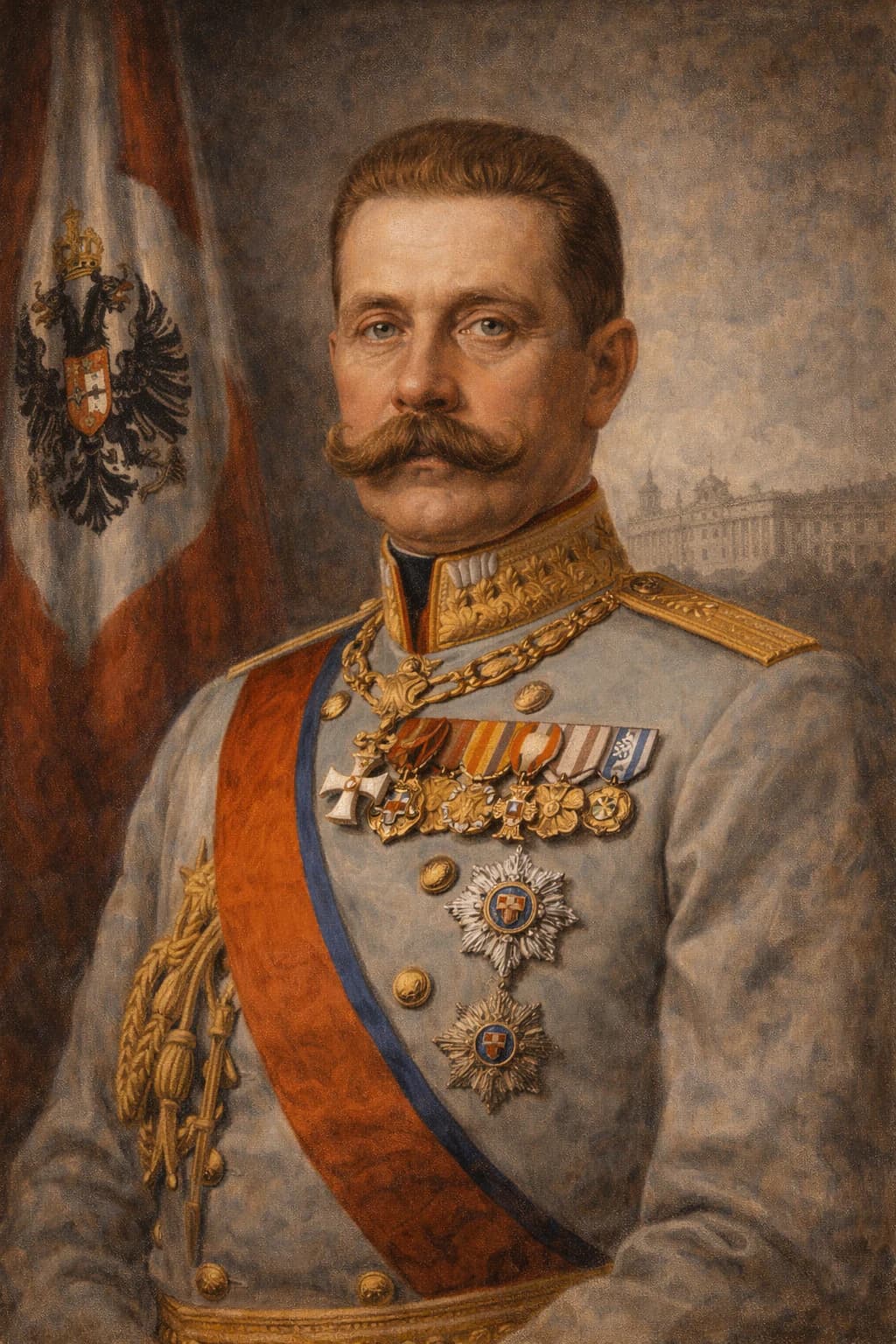
The assassination of Archduke Franz Ferdinand at Sarajevo on 28 June 1914 struck at the succession and the monarchy's prestige. Franz Joseph was not the most aggressive voice in Vienna, but he accepted the argument that Serbia had to be confronted or Austria-Hungary would look powerless in the Balkans. The July Crisis then turned imperial calculation into continental catastrophe. Germany's support, Russia's mobilization, alliance commitments and military timetables widened the conflict into the First World War. The elderly emperor signed decisions shaped by ministers and generals, but the responsibility of sovereignty still attached to him. The war he entered to preserve imperial authority became the force that made the empire's survival nearly impossible.
Decisions made in moments of shock can trigger consequences far beyond their original intent.
1916
End of reign
Franz Joseph died on 21 November 1916 after one of the longest reigns in European history. His successor, Charles I, inherited war exhaustion, food shortages, military dependence on Germany and national movements increasingly unwilling to accept Habsburg rule. Within two years, Austria-Hungary had dissolved. Franz Joseph's legacy is therefore double-edged. He was not a fool presiding passively over decline; he was a diligent, austere ruler who kept a complicated empire functioning through revolution, defeat and compromise. Yet his strengths were also limits. He preserved the monarchy more often by endurance than renewal. To understand why Franz Joseph I was important is to see how an old dynastic order could survive deep into the modern age, and why survival was not the same as transformation.
A ruler can sustain a system for decades, yet still leave it unable to survive beyond their lifetime.