Complete chronology
Full overview and deeper context for every journey step.
1904
Rural Beginnings
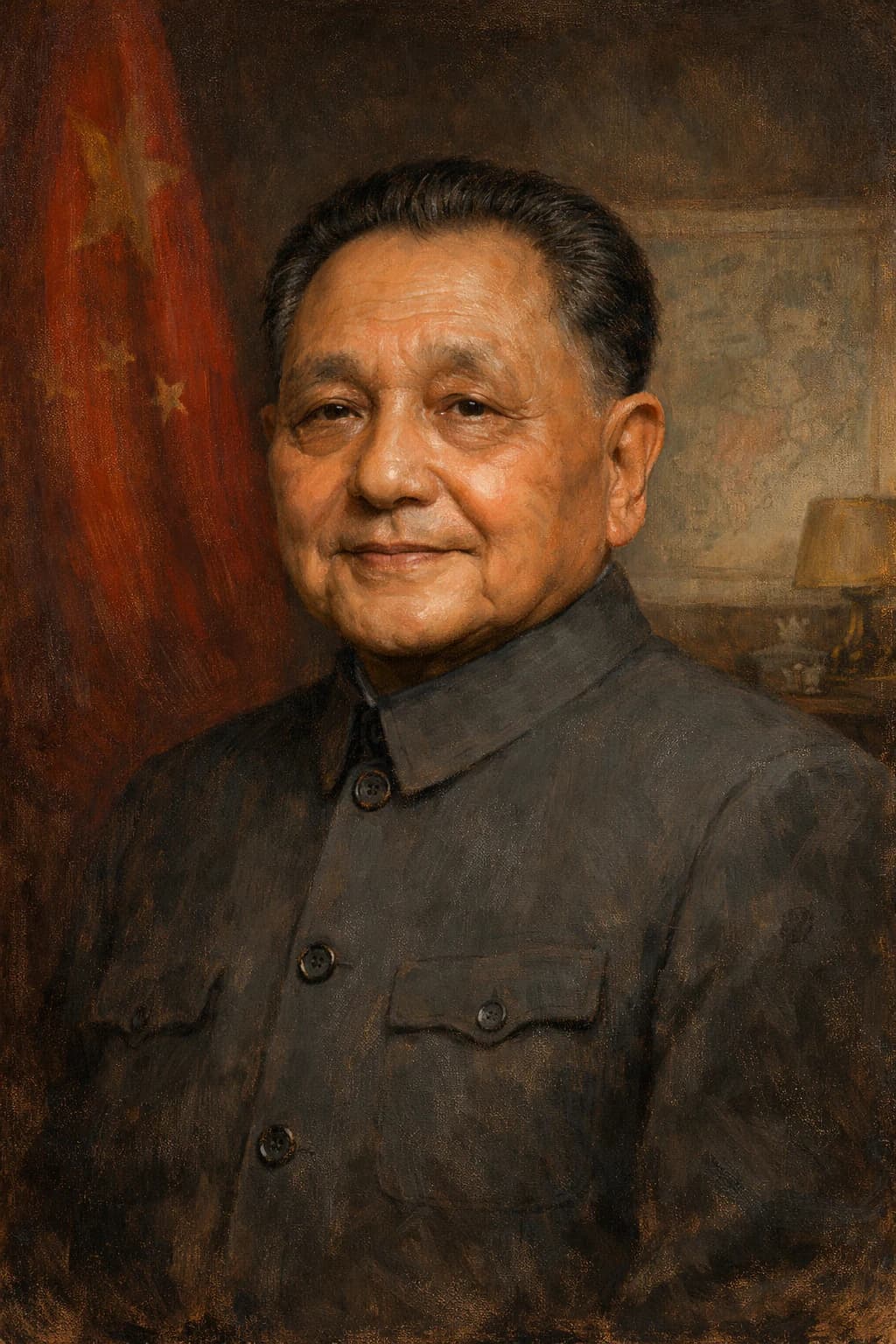
Deng Xiaoping was born in 1904 in Guang’an county, Sichuan, into a rural family with enough resources to value education but not enough to place him securely among China’s old elite. His youth unfolded as the Qing dynasty collapsed, the Republic struggled to establish authority, and foreign pressure exposed China’s weakness. That atmosphere mattered. Deng grew up in a country searching for a way to become strong without simply copying the old order that had failed. His early life did not make him a natural liberal or a market reformer. It made him practical. He saw that slogans meant little if a state could not feed, organize, defend, and modernize itself. The famous pragmatism of his later career had roots in a childhood shaped by national humiliation and local discipline.
His rural upbringing fostered a lifelong focus on tangible outcomes rather than abstract theory.
1920–1926
Study Abroad
In 1920 Deng joined the work-study movement that sent young Chinese students to France. The promise was education through labour; the reality was often hunger, factory work, and political awakening. In Europe he encountered Marxism, labour organization, anti-imperial politics, and other Chinese radicals, including future Communist leaders such as Zhou Enlai. France gave Deng a view of industrial capitalism from the workshop floor rather than the lecture hall. It also connected China’s crisis to a wider world of revolution and empire. He later spent time in the Soviet Union, absorbing communist organization and discipline. These years turned him from a provincial student into a revolutionary cadre. They also taught him a lesson that never left him: movements survive through organization, not sentiment.
Hardship abroad sharpened his belief that change required both discipline and adaptability.
1920s
Joining Revolution
Deng joined the Chinese Communist movement when its future looked anything but secure. The alliance with the Nationalists collapsed in 1927, and Communist organizers faced repression, flight, and military defeat. Deng worked in party organization, propaganda, and military-political roles, learning the craft of survival inside a revolutionary movement under pressure. He took part in the Long March era and later became closely associated with the Communist base areas and the armies that fought both Japan and the Nationalists. His strength was not charismatic theory. It was execution: building networks, enforcing discipline, solving practical problems, and remaining useful to stronger figures. By the time the People’s Republic was founded in 1949, Deng had become a seasoned revolutionary who understood power as an organizational system.
His early commitment tied his fate to a movement that demanded both loyalty and endurance.
1940s–1950s
Rise to Leadership
After 1949 Deng helped turn revolutionary victory into state power. He held major regional posts in southwest China, then rose in Beijing as a senior party administrator and eventually General Secretary of the Chinese Communist Party. The new regime faced land reform, war recovery, institutional construction, and the enormous task of imposing central authority over a fragmented country. Deng’s reputation rested on competence and discipline. He was trusted to make structures work. Yet the Mao era punished competence when it appeared to challenge ideological purity. During the aftermath of the Great Leap Forward, Deng and Liu Shaoqi supported more pragmatic measures to restore production after catastrophe. Their willingness to correct failure made them effective, but it also made them vulnerable once Mao reasserted radical control.
His strength lay in quiet effectiveness rather than public prominence.
1966–1976
Political Downfall
The Cultural Revolution destroyed Deng’s position. Branded a capitalist roader, he was stripped of authority, humiliated, and sent to work in Jiangxi while his family suffered severely; his son Deng Pufang was left disabled after persecution. Deng survived partly because he did not openly challenge Mao and partly because experienced administrators remained useful when chaos threatened the state itself. He was restored in the 1970s, purged again after Zhou Enlai’s death, and waited while the political tide turned against the Gang of Four. These reversals shaped him profoundly. Deng did not emerge as a democrat. He emerged convinced that ideological frenzy could wreck a country and that the party had to regain control, reward expertise, and judge policy by results.
Survival during chaos taught him the value of patience over confrontation.
1977
Return to Power
After Mao’s death in 1976 and the fall of the Gang of Four, Deng outmanoeuvred Hua Guofeng without needing the highest formal title. By 1978 he had become China’s paramount leader through alliances, prestige, control of appointments, and the argument that China needed modernization more than ritual loyalty to Mao’s every instruction. The Third Plenum of 1978 became the symbolic beginning of reform and opening up. Deng promoted the Four Modernizations: agriculture, industry, national defense, and science and technology. He rehabilitated purged officials, restored university entrance examinations, and encouraged a more professional state. His authority was informal but decisive. The lesson of his comeback was that in Communist Party politics, real power could sit behind titles if it controlled direction, personnel, and consensus.
He proved that influence does not always require formal titles.
1978–1980s
Economic Reforms
Deng’s reforms did not arrive as one master plan. They advanced through experiment, local initiative, and cautious permission. In agriculture, the household responsibility system allowed families more control over production after the failures of collectivized farming. In the south, Special Economic Zones such as Shenzhen invited foreign investment, export manufacturing, and market incentives. Township and village enterprises expanded. Prices, ownership, and trade were gradually loosened, often in uneven and improvised ways. Deng’s phrase about crossing the river by feeling the stones captured the method. The transformation lifted hundreds of millions from extreme poverty and turned China toward global economic power. But Deng never separated reform from Communist Party supremacy. Markets were tools for national strength, not a path to pluralist politics.
He separated economic freedom from political openness, a balance that defined modern China.
1989
Crisis and Control
The 1989 Tiananmen crisis revealed the hard boundary of Deng’s reform era. Student-led demonstrations, joined by workers and citizens in Beijing and other cities, demanded action against corruption, greater openness, and political accountability. Deng and other elders viewed the movement through the memory of disorder: Cultural Revolution chaos, party fracture, and the risk that political liberalization could unravel the state. He backed martial law and the use of military force to clear Tiananmen Square and surrounding areas in June 1989. The crackdown brought international condemnation, deaths whose exact number remains disputed, and a decisive halt to hopes for near-term political opening. It also preserved party rule. Deng’s legacy cannot be understood without this bargain: economic dynamism was permitted; organized political challenge was not.
His commitment to stability came at a profound human and political cost.
1990s–1997
Lasting Legacy
Deng’s final great intervention came in 1992, when his southern tour revived reforms after the conservative reaction that followed Tiananmen. Visiting Shenzhen, Zhuhai, and Shanghai, he signalled that growth, openness, and experimentation should continue. The message helped set China on the path toward the export-led boom of the 1990s and beyond. Deng died in 1997, the same year Hong Kong returned to Chinese sovereignty under the one country, two systems formula he had championed. His legacy is immense and unresolved. He did more than any leader after Mao to reshape China’s economy, social life, and global position. He also strengthened the Leninist political structure that contained those changes. Deng Xiaoping matters because modern China still lives inside the architecture he left: prosperity, nationalism, party control, and the conviction that stability is worth almost any price.
He left behind a model that prioritized growth and control in equal measure.