Complete chronology
Full overview and deeper context for every journey step.
1451
Genoese Origins
Christopher Columbus was born in Genoa in 1451, in a republic whose fortunes depended on merchants, sailors, bankers, and maritime risk. He was not a prince or scholar formed in a royal academy. He came from the practical world of trade, where a young man could learn languages badly, mathematics unevenly, and seamanship intensely because profit and survival required it. Genoa connected the Mediterranean to Atlantic markets, and Columbus’s early career carried him through the commercial networks of Portugal, Madeira, and perhaps as far north as England or Iceland, though some details remain uncertain. What is clear is that he absorbed the habits of a working mariner: reading winds, judging crews, bargaining for patrons, and imagining geography as opportunity. His later confidence was not born from ignorance alone. It grew from real experience combined with a dangerous miscalculation.
His surroundings made exploration seem not extraordinary, but achievable.
1470s–1480s
Seafaring Career
By the 1470s and 1480s, Columbus had become part of the Atlantic world that Portuguese expansion was rapidly widening. Portugal’s sailors were probing the African coast, learning wind systems, building fortified trading posts, and seeking a sea route to Asian spices and luxury goods. Columbus married into a family connected with the Madeira islands and studied charts, travel accounts, and cosmographical arguments. His central idea was not that the Earth was flat; educated Europeans already knew it was round. His mistake was scale. He combined optimistic readings of ancient and medieval authorities with his own assumptions to shrink the distance between Europe and Asia. That error made his westward plan seem achievable. The courage of the proposal and the false arithmetic behind it cannot be separated.
Experience at sea built the confidence needed to pursue unconventional routes.
1480s–1492
Seeking Support
Columbus spent years trying to turn a theory into a royal contract. Portuguese experts rejected his proposal, probably because their own Atlantic knowledge made the distance problem obvious and because the African route looked increasingly promising. Columbus then looked to Castile and Aragon, where Ferdinand and Isabella were finishing the conquest of Granada and consolidating their rule. Even there, committees hesitated. Columbus demanded extraordinary rewards: titles, privileges, and a share of profits if he succeeded. In 1492, after Granada fell, the Spanish monarchs accepted the gamble. Their decision was shaped by rivalry with Portugal, missionary ambition, dynastic prestige, and the possibility of access to Asian wealth. The agreement did not fund a modern scientific expedition. It backed a speculative commercial and imperial venture at a moment when Spain was ready to look outward.
Persistence in the face of skepticism can turn uncertain ideas into historic ventures.
1492
First Atlantic Crossing
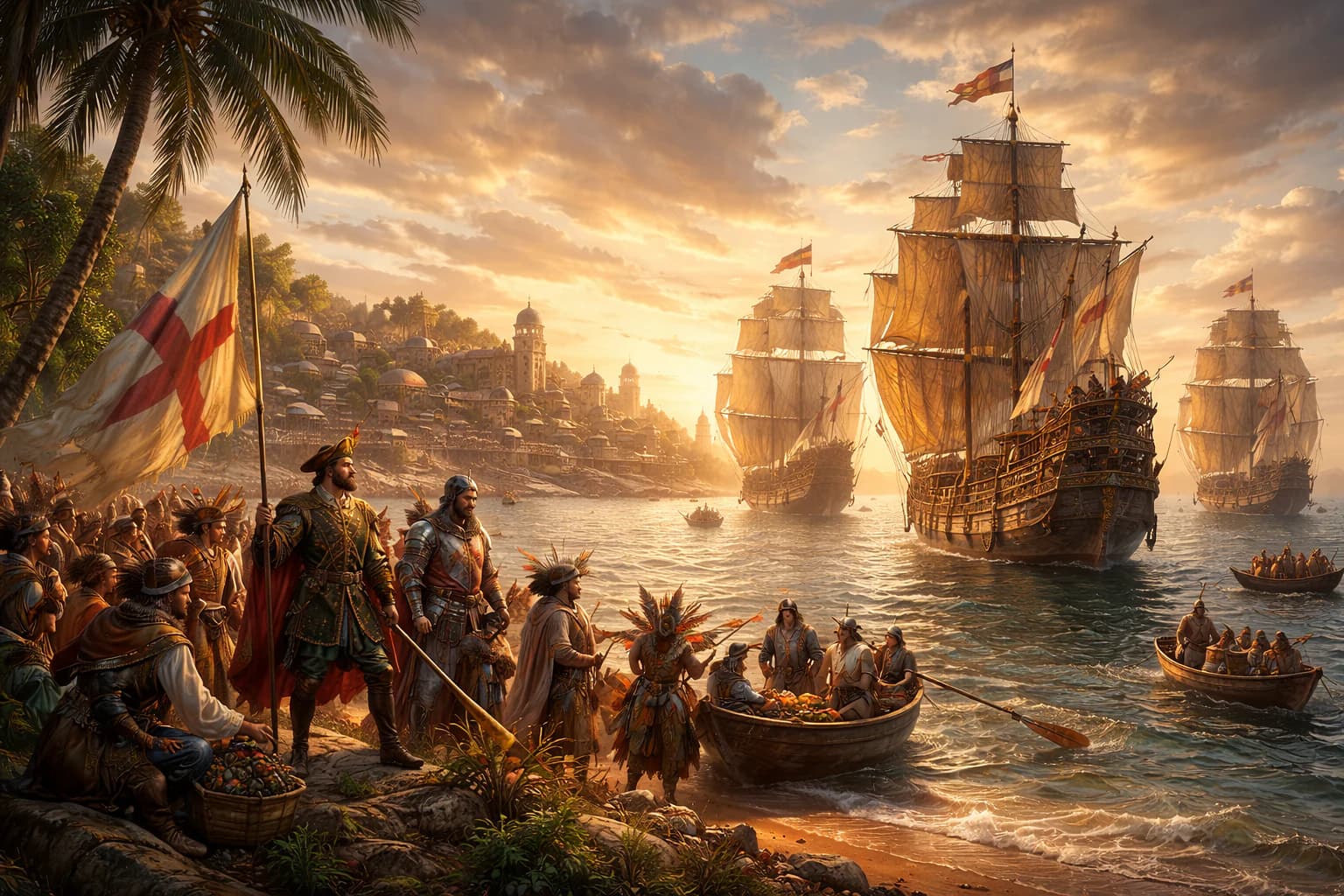
Columbus left Palos in August 1492 with the Nina, Pinta, and Santa Maria. His navigation relied on experience, dead reckoning, Atlantic winds, and a willingness to keep anxious crews moving west beyond familiar limits. On 12 October, the expedition reached land in the Bahamas, encountering Indigenous Taíno communities whose world was neither empty nor waiting to be discovered. Columbus believed he had reached islands near Asia and called the inhabitants 'Indians' within that mistaken framework. He then explored parts of Cuba and Hispaniola, searching for gold, interpreters, and signs of the Asian mainland he expected to find. The voyage was a navigational success built on a geographical failure. Its importance lies in what followed: repeated crossings, reports, claims, settlements, and the beginning of sustained contact between hemispheres long separated by the Atlantic.
The voyage succeeded in reaching new lands, even if its original goal was misunderstood.
1493–1504
Further Expeditions
The first voyage made Columbus famous; the later voyages revealed the darker and more complicated nature of his project. In 1493 he returned with a much larger fleet, settlers, animals, soldiers, priests, and expectations of profit. What began as exploration rapidly became colonization. Spanish demands for labor and gold collided with Indigenous societies already facing disease, disruption, violence, and coercion. Columbus explored more of the Caribbean and the northern coast of South America across four voyages, but he never accepted that he had encountered continents unknown to his maps. He continued to interpret evidence through the lens of Asia. That stubbornness mattered. It shaped his decisions, his reports to the crown, and his inability to understand the full scale of the world his voyages had forced Europeans to confront.
Exploration quickly evolved into attempts at control and settlement.
1490s–1500
Colonial Administration
Columbus proved far less effective as a colonial governor than as an Atlantic navigator. Hispaniola became the testing ground for Spanish settlement, and it exposed the weaknesses of his leadership. Settlers complained about shortages, discipline, and broken expectations of quick wealth. Indigenous communities faced tribute demands, forced labor, punishment, and the shattering arrival of European power. Columbus and his brothers tried to maintain authority through a mixture of reward, severity, and personal control, but the colony became unstable. The problem was not simply that Columbus was administratively clumsy, though he was. It was that the whole enterprise rested on impossible promises: abundant gold, obedient settlers, convertible subjects, and royal profit extracted at speed. When those promises failed, blame moved toward the admiral who had sold them.
Skills that enable exploration do not always translate to effective governance.
1500
Loss of Authority
In 1500, royal investigator Francisco de Bobadilla arrived in Hispaniola, found a colony in disorder, and sent Columbus back to Spain in chains. The image of the admiral imprisoned shocked some contemporaries and later became part of Columbus’s own sense of grievance. Ferdinand and Isabella released him and allowed another voyage, but they did not restore his full governing authority. The crown had learned that overseas rule was too important to be left entirely to one ambitious contractor. Columbus’s fall marked a transition from personal enterprise toward more direct imperial administration. It also exposed the limits of the titles he had negotiated in 1492. He wanted recognition as discoverer, governor, and hereditary lord; the monarchy wanted control over a widening empire.
Early success did not shield him from accountability when governance faltered.
1500–1506
Later Life
Columbus’s fourth voyage from 1502 to 1504 was a hard, storm-battered attempt to find a passage through Central America to the riches he still associated with Asia. He reached the coasts of present-day Honduras, Nicaragua, Costa Rica, and Panama, but no strait appeared. Shipwreck, illness, and conflict left him stranded in Jamaica for months. When he returned to Spain, his great patron Isabella was dead, his influence had diminished, and other navigators were beginning to understand that the Atlantic discoveries formed part of a vast landmass rather than Asia’s outer edge. Columbus spent his final years pressing legal and financial claims. He died in Valladolid in 1506, still defending his privileges and still interpreting his achievements within a map the world had already begun to outgrow.
Even transformative achievements do not always bring lasting personal security.
After 1506
Global Consequences
Columbus’s legacy is inseparable from scale and consequence. He did not prove the Earth was round, did not reach Asia, and did not discover an empty world. He did open the route that made sustained European colonization of the Americas possible. The Columbian Exchange moved crops, animals, pathogens, people, technologies, and ideas across oceans, enriching some societies while devastating others. Indigenous populations suffered catastrophic disease, enslavement, dispossession, and violence as European empires expanded. At the same time, the Atlantic became the center of a new global economy linking Europe, Africa, and the Americas, including the growth of plantation slavery. To ask who Christopher Columbus was is therefore to confront both navigational daring and imperial disaster. He was a skilled mariner, a poor governor, a man of his age, and a figure whose voyages changed history far beyond anything he understood.
His legacy lies in initiating connections that reshaped the world, for better and for worse.