Complete chronology
Full overview and deeper context for every journey step.
1600–1612
Second son, unexpected heir
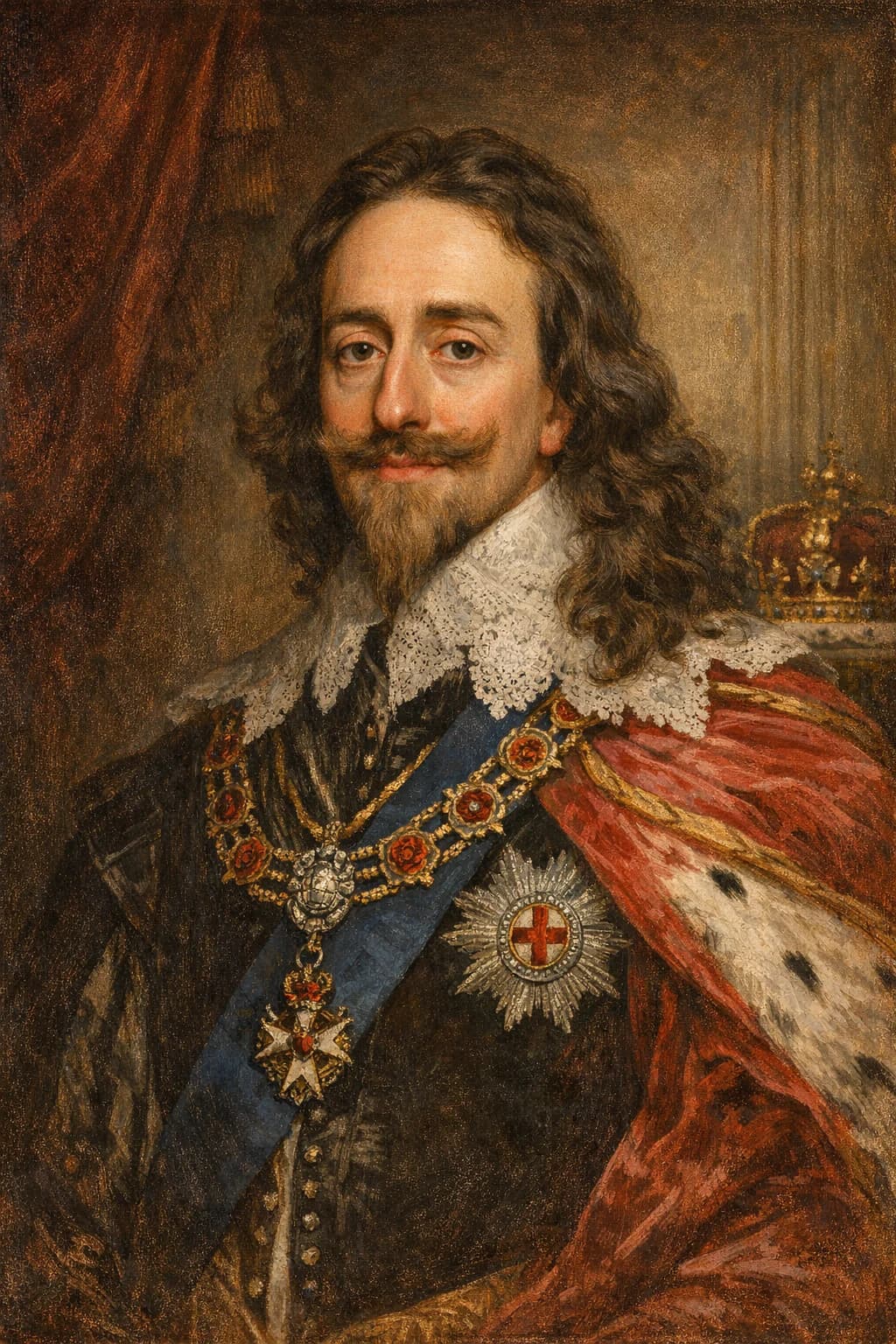
Charles Stuart was born at Dunfermline Palace in November 1600 as the second son of James VI of Scotland, soon to become James I of England, and Anne of Denmark. A physically small and late-developing child, he struggled with his health and early speech difficulties, and lived overshadowed by his charismatic older brother Henry, Prince of Wales, who was widely admired and considered everything a future king should be. When Henry died suddenly in 1612 at the age of eighteen, Charles was transformed from a secondary prince into the heir apparent. He was twelve years old, uncertain of himself, and deeply attached to the memory of an older brother he could not hope to match. The insecurity this installed would manifest throughout his life as a compensating rigidity and an inability to show weakness.
Being shaped by comparison to someone else's brilliance can produce a person who finds compromise unbearable.
1623
Spanish Match fiasco
In one of the more extraordinary episodes of the Stuart court, the twenty-two-year-old Charles and his father's favourite Buckingham travelled to Madrid incognito in 1623 to press the case for Charles's marriage to the Spanish Infanta. The expedition was romantic in conception and disastrous in practice. Spanish court protocol, religious requirements, and fundamental incompatibility between what each side wanted ensured failure. Charles returned to England having been humiliated rather than charmed, and he returned angry. The popular reception at home was enthusiastic — Protestant England had no desire for a Spanish Catholic queen — but the episode deepened the mutual distrust between Charles and Spain while doing nothing to resolve the European crises his father had left unaddressed.
Personal diplomatic ventures that fail can be more damaging than formal failures because they carry individual pride into the wreckage.
1625–1628
Accession and Buckingham
Charles inherited the throne in March 1625 and the dominance of the Duke of Buckingham almost simultaneously. His loyalty to Buckingham was absolute, even as the Duke's two major military expeditions — at Cadiz in 1625 and to the Île de Ré in 1627 — ended in catastrophic failure. Parliament blamed Buckingham for the disasters and moved toward impeachment; Charles dissolved parliament rather than allow it. The Petition of Right, which parliament forced Charles to accept in 1628, set out constitutional limitations on royal action including the prohibition of arbitrary imprisonment and taxation without consent. Charles signed it under financial duress and treated it as a temporary obstacle. Buckingham was assassinated by a discontented officer in 1628, removing the lightning rod but not the underlying tensions.
Protecting a favourite from accountability by dissolving the body that threatens them does not remove the grievance; it intensifies it.
1629–1640
Personal rule
After the acrimony of his early parliaments, Charles dissolved parliament in 1629 and governed alone for eleven years, a period his critics called the Eleven Years' Tyranny and his supporters defended as necessary personal rule. Revenue came through revived or stretched fiscal devices including distraint of knighthood, forest fines, monopolies and ship money, which had precedents but was applied in ways that provoked widespread resistance when extended inland. His Archbishop of Canterbury, William Laud, pursued a programme of church uniformity that pushed the English church in a more ceremonial and Arminian direction, generating fierce opposition among Puritans who suspected a drift toward Catholic practice. When these policies were extended to Scotland through a new prayer book in 1637, resistance produced the Bishops' Wars. Military failure forced Charles to recall parliament in 1640 in desperate need of money, only to find it unwilling to fund him without fundamental concessions.
Governing without opposition is not the same as governing well; it merely postpones the accounting.
1640–1642
Long Parliament and crisis
The Long Parliament, which first met in November 1640, moved rapidly to dismantle the machinery of personal rule. Ship money was declared illegal, the prerogative courts of Star Chamber and High Commission were abolished, and parliament passed acts requiring its own consent before dissolution. Charles accepted much of this under duress, but the relationship was beyond repair. The Irish Rebellion of October 1641, which raised the question of who would command an army to suppress it, brought the constitutional crisis to its sharpest point. Charles's disastrous attempt to arrest five members of parliament in January 1642, physically entering the Chamber with soldiers to find the men had escaped, destroyed whatever remained of the political relationship. By August 1642, both sides were raising armies.
The moment a king enters a legislative chamber with soldiers, he has already lost the argument he came to win.
1642–1645
Civil war
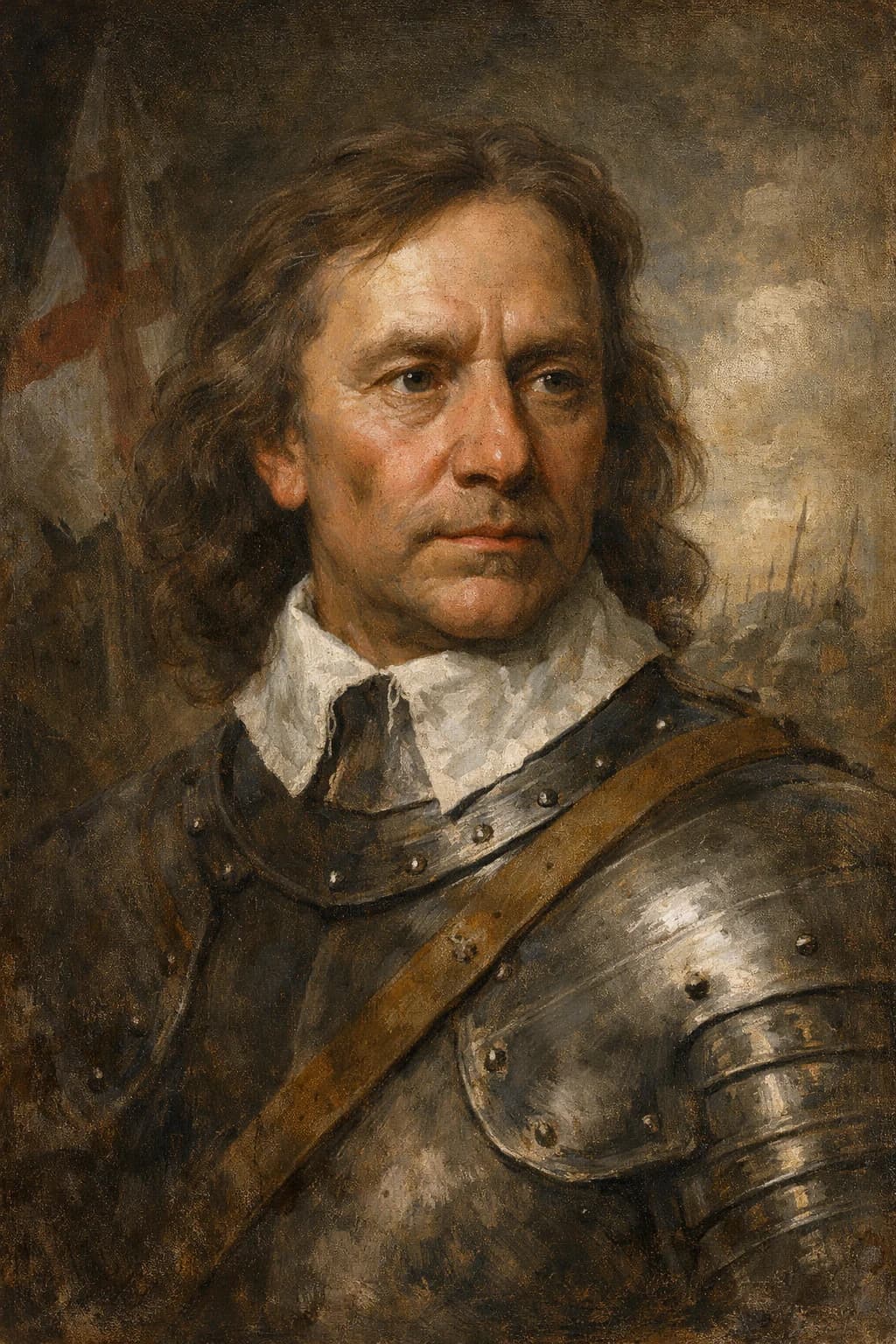
The Civil War began in August 1642 with Charles raising his standard at Nottingham and ended his cause's military phase with his surrender to the Scots in 1646. The opening campaigns were genuinely close: the Royalists had strong support in the north and west, the professional military experience of many gentlemen, and Charles's own determination. But parliament's alliance with Scotland, the creation of the New Model Army under Fairfax and Cromwell in 1645, and its better access to London's financial resources and the navy shifted the balance. The Battle of Naseby in June 1645 effectively ended the Royalist military cause. Charles spent the following years as a prisoner attempting to play different factions against each other rather than making the genuine compromises that might have saved him.
A ruler who will not compromise in victory rarely finds better terms available after defeat.
1646–1648
Captivity and negotiation
From his various captivities, Charles attempted to play the different parties — parliament, the New Model Army, and the Scots — against each other, signing agreements he had no intention of honouring. The engagement he made with the Scots in December 1647 promised to impose Presbyterianism in England in exchange for Scottish military support, triggering the Second Civil War in 1648. This conflict, though eventually suppressed by the parliamentary armies, finally convinced many in the army that Charles could never be trusted and that any settlement that left him on the throne was no settlement at all. Pride's Purge in December 1648 removed the parliamentary members most inclined toward accommodation, leaving a Rump Parliament of those willing to proceed against the king.
Repeated bad faith in negotiation eliminates the moderates who were your last protection.
January 1649
Trial and execution
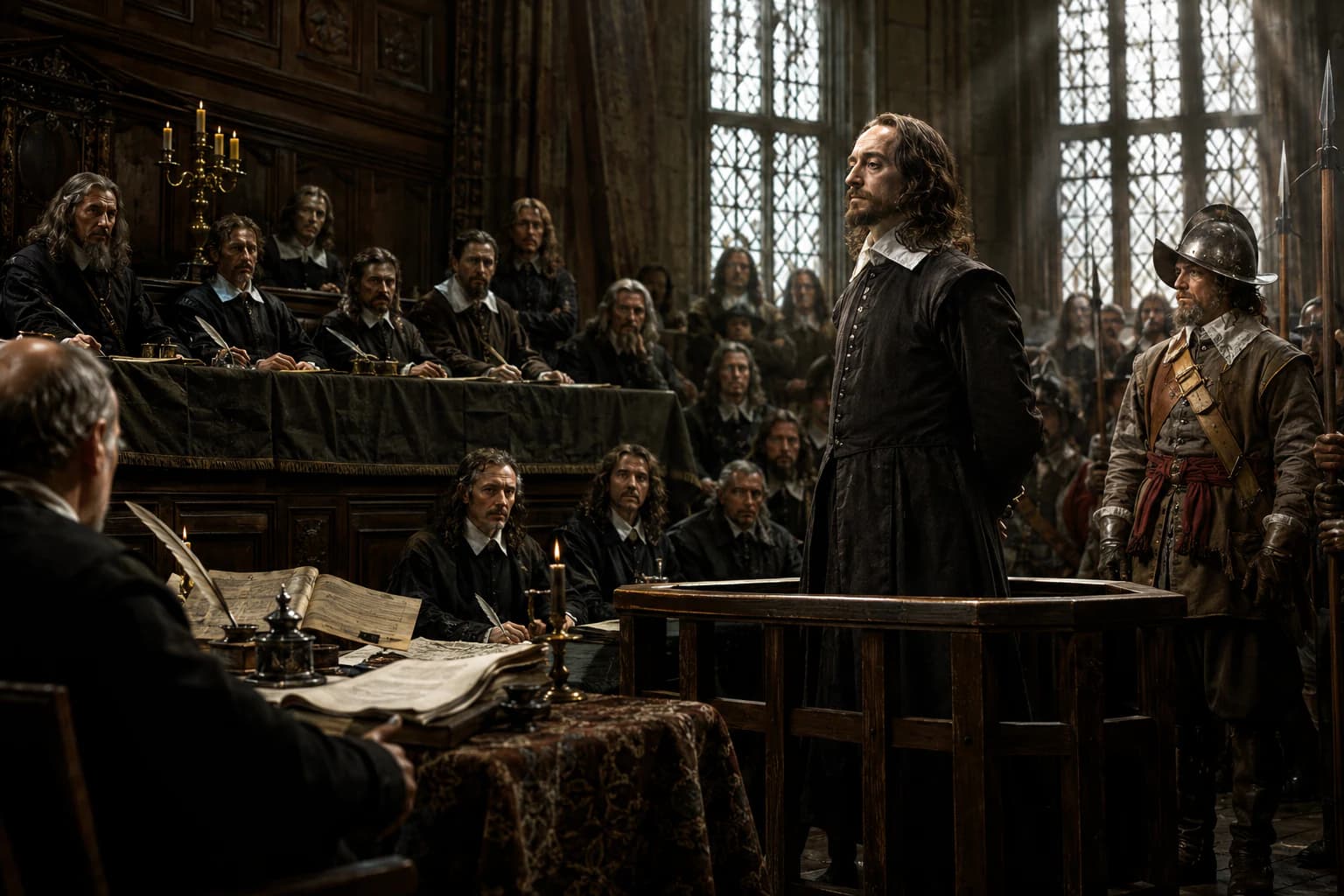
Charles's trial before the High Court of Justice, which he refused to acknowledge as having any legitimate authority over a king, was constitutionally unprecedented. He declined to enter a plea, denied the court's jurisdiction, and conducted himself with a composure and coherence that had not always been visible during his reign. His argument — that the people's liberties were best protected by the king, not by a court — was genuinely believed rather than merely tactical. On 30 January 1649, he was beheaded outside the Banqueting House in Whitehall. He wore two shirts to prevent shivering from the cold being mistaken for fear. At the moment of the axe, witnesses reported a collective groan from the assembled crowd. What exactly that groan expressed was, and has remained, debated.
A man who lived by the principle of divine right found in its defence the clearest expression of who he was.
Post-1649
The royal martyr
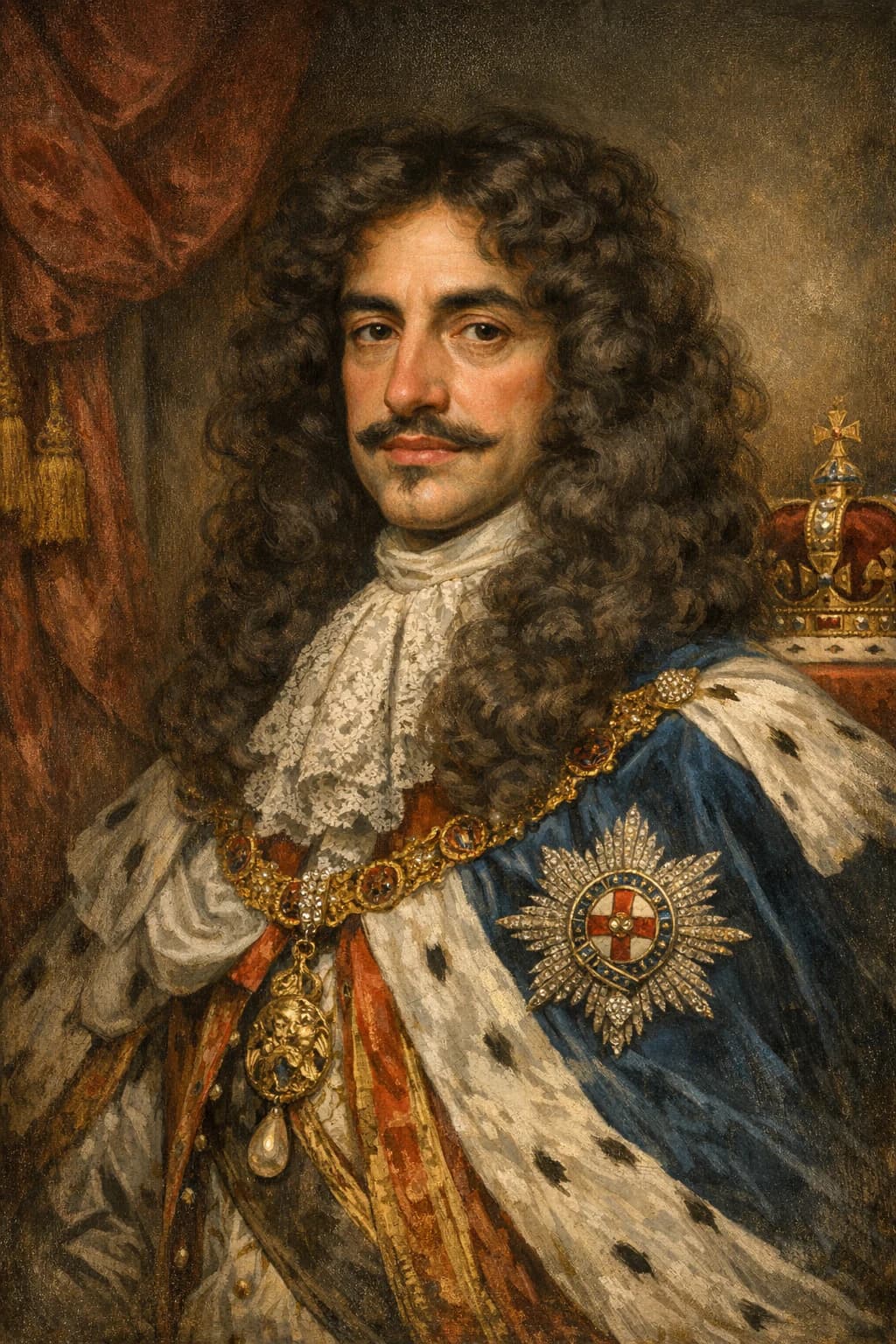
Charles's death produced Eikon Basilike, a devotional work attributed to the king himself that presented his suffering as Christian martyrdom. It became an immediate bestseller and shaped royalist sentiment powerfully during the Interregnum, though authorship was disputed then and remains historically contested. Charles I was eventually recognised as a saint and martyr by the Church of England, with an annual commemoration on 30 January. The wider constitutional legacy was paradoxical: his execution demonstrated that a king could be held accountable and removed, but the instability of the Interregnum that followed eventually produced the Restoration and a monarchy more powerful in some respects than the Rump Parliament had intended. The long-term consequence was not a permanent republic but a constitutional monarchy that developed the idea, slowly and unevenly, that royal power had limits that could not be permanently crossed.
A king's death can make a point that his life spent thirty years trying to deny.