Complete chronology
Full overview and deeper context for every journey step.
1706–1723
Humble beginnings
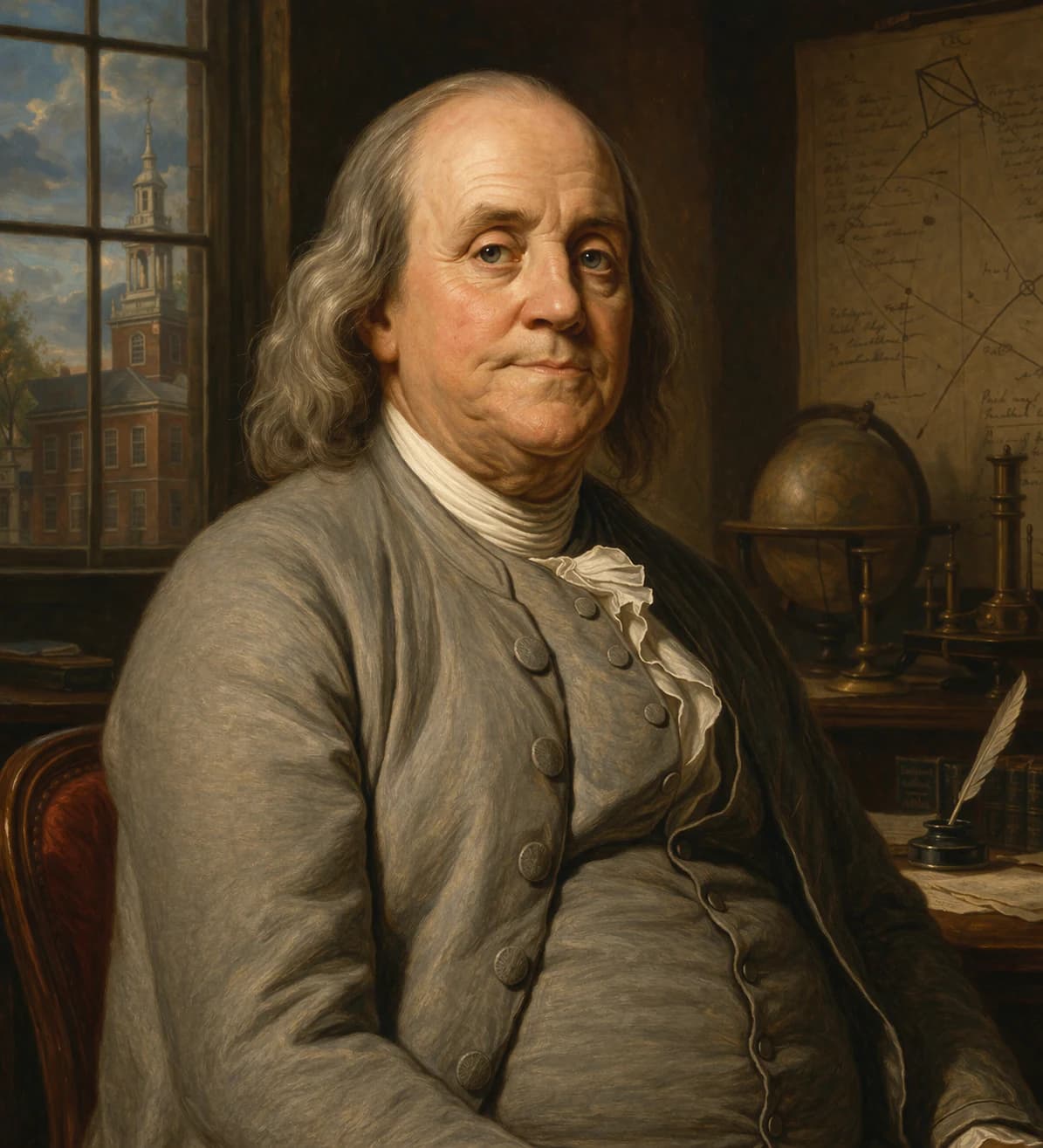
Benjamin Franklin was born in Boston in 1706, the fifteenth child of Josiah Franklin, a candle and soap maker. His formal schooling lasted only briefly, but limited classroom time did not limit his education. Franklin read hungrily, copied prose to improve his style, argued in print under pseudonyms, and treated self-improvement as a lifelong experiment. Apprenticed to his brother James, a printer, he learned the trade that would make his public career possible. Printing placed him inside the circulation of news, satire, sermons, science, politics, and commerce. It also taught him that words could create communities. Franklin's early biography is not just a tale of humble beginnings. It is the story of a young man discovering that literacy, wit, discipline, and timing could become forms of power.
Limited schooling did not restrict him; it pushed him to invent his own way of learning.
1723–1729
Printer’s trade
Franklin left Boston after conflict with his brother and arrived in Philadelphia as a runaway apprentice, poor but ambitious. The city became the stage on which he reinvented himself. After a difficult trip to London and return to Pennsylvania, he built a printing business through competence, social intelligence, and relentless networking. He printed newspapers, pamphlets, government documents, and practical material for a growing colonial public. The Pennsylvania Gazette became a platform for information and opinion, while his business success gave him the independence to pursue science and civic projects. Franklin understood the economics of reputation. Reliability brought customers; wit brought readers; public usefulness brought trust. His rise in Philadelphia shows how the print economy could turn a tradesman into an intellectual and political force.
Control of the printed word gave him both voice and leverage in society.
1730s
Rise as writer
Franklin's writing worked because it was useful, funny, memorable, and carefully aimed. Poor Richard's Almanack, published under the persona of Richard Saunders, mixed weather, calendars, jokes, proverbs, and advice about thrift, industry, and prudence. Its sayings became part of American cultural memory, though Franklin's own life was more complex than the tidy virtues he promoted. He wrote satire, hoaxes, essays, political arguments, and practical proposals, often using masks to reach audiences that might resist direct instruction. His style made improvement feel common-sense rather than elite. Writing also let Franklin build a public character: plain, clever, modest, experimental, and morally practical. That character was partly real and partly crafted. Franklin became famous by understanding that persuasion often arrives best dressed as entertainment.
He understood that influence grows when ideas feel useful and relatable.
1740s–1750s
Scientific curiosity
Franklin's scientific fame came especially from his work on electricity in the 1740s and 1750s. He proposed the language of positive and negative charge, studied lightning, and helped show that lightning was electrical. The famous kite experiment is surrounded by later simplification; Franklin did not recklessly fly a kite into a storm in the cartoonish way often imagined. The core achievement was his experimental reasoning and the practical invention of the lightning rod, which turned knowledge into protection. His electrical work won recognition in Europe and placed a colonial printer among the Enlightenment's respected natural philosophers. Franklin also investigated heat, storms, ocean currents, population, and inventions such as bifocals and the Franklin stove. His science mattered because it joined curiosity to use. He wanted ideas that could be tested, shared, and made beneficial.
His science succeeded because it aimed to clarify, not just impress.
1730s–1750s
Civic builder
Franklin was one of colonial America's great institution builders. In Philadelphia he helped found or organize the Junto discussion club, the Library Company, a fire company, the American Philosophical Society, militia efforts, street improvements, a hospital, and what became the University of Pennsylvania. These projects reveal his deepest civic habit: identify a practical problem, gather interested people, design a workable institution, and make cooperation feel useful. Franklin did not wait for distant authority to solve every public need. He believed citizens could build capacity themselves. That civic vision had limits, including the exclusions of his age, but it helped define a durable American style of voluntary association. His genius was not only invention in the mechanical sense. It was social invention: creating structures that made ordinary public life work better.
He treated community improvement as a shared responsibility, not a distant ideal.
1750s–1770s
Political voice
Franklin spent years trying to hold the British Empire together on terms colonists could accept. As a colonial agent in London, he represented Pennsylvania and other colonies, arguing for colonial rights while still imagining a reformed empire. The Stamp Act crisis and his 1766 testimony before Parliament made him one of the clearest explainers of American grievances. Over time, British suspicion and imperial arrogance wore down his loyalty. The 1774 humiliation before the Privy Council, where he was attacked over leaked letters from Massachusetts governor Thomas Hutchinson, helped push him decisively toward the patriot cause. Franklin's radicalization was gradual and important. He was not born an American revolutionary. He became one after concluding that reconciliation without political respect was impossible.
His political path shows how moderation can evolve under pressure into firm conviction.
1776–1783
Diplomatic success
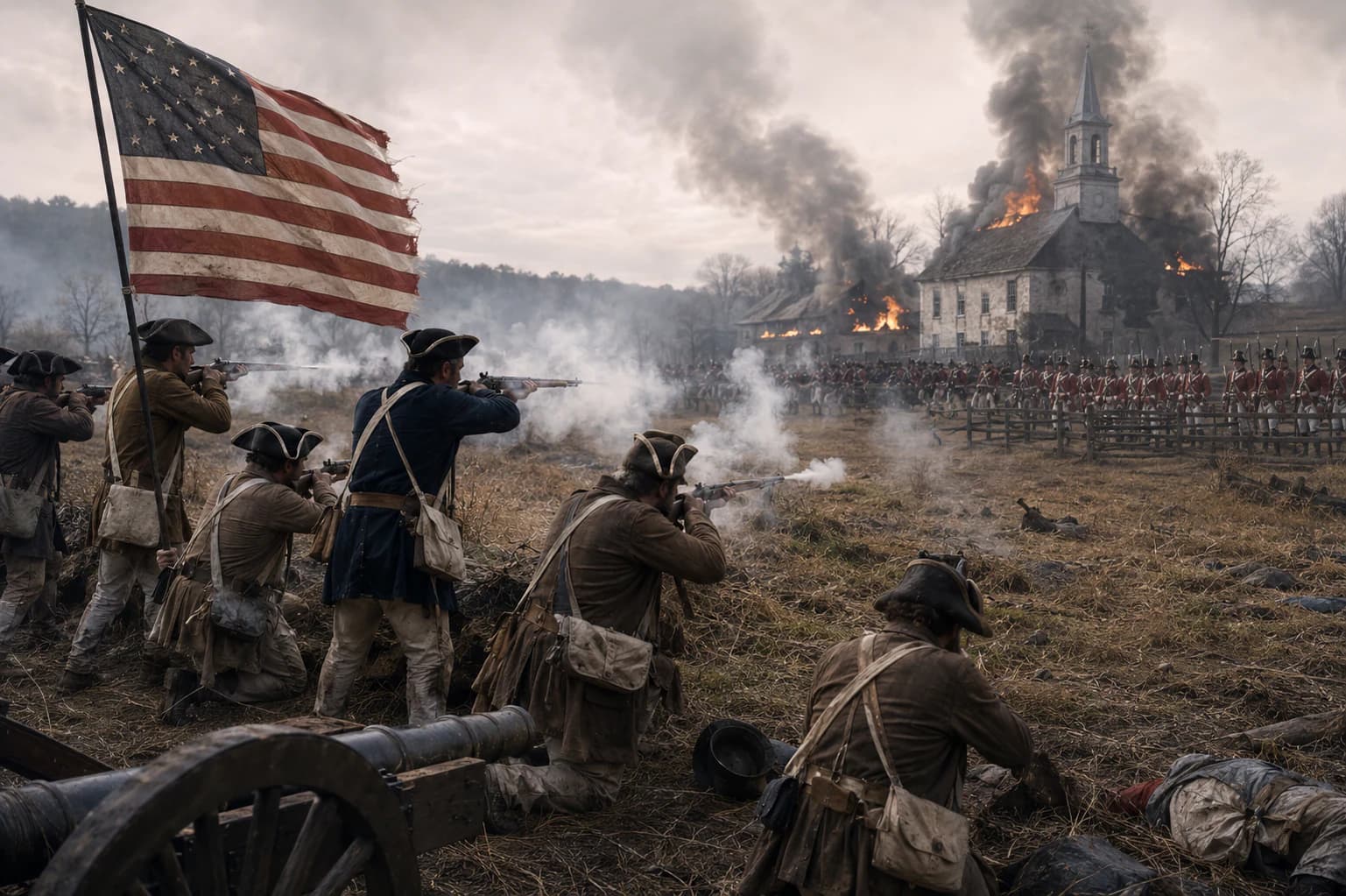
Franklin's greatest service to American independence came in France. Sent as a diplomat in 1776, he arrived already famous as a scientist and cultivated the image of a plain New World sage in a fur cap. The performance was brilliant because French society wanted to see America as virtuous, natural, and anti-British. Franklin worked with fellow diplomats, navigated court politics, managed rivalries, and helped secure the 1778 alliance after the American victory at Saratoga made the cause look viable. French money, arms, naval support, and military intervention proved decisive in the Revolutionary War. Franklin did not win independence alone, but without French support the American struggle would have been far harder. His diplomacy shows his mature genius: charm joined to patience, symbolism joined to strategy, and personal fame turned into national leverage.
He understood that wars are won not only on battlefields but also through persuasion.
1780s
Final years
Franklin returned to America old, internationally celebrated, and still politically useful. He served as president of Pennsylvania's executive council and as a delegate to the Constitutional Convention of 1787. There he was not the dominant architect of the Constitution, but his prestige and instinct for compromise mattered. His famous appeal for delegates to doubt a little of their own infallibility captured the practical wisdom he had spent a lifetime refining. Franklin's final years also included a significant antislavery turn. Having earlier benefited from and participated in a society where slavery was present, he became president of the Pennsylvania Abolition Society and petitioned Congress against the slave trade and slavery in 1790. That evolution does not erase earlier complicity, but it makes his last public act morally important.
He viewed later life not as retreat, but as a chance to refine his influence.
1790–present
Enduring legacy
Franklin died in 1790 as one of the most famous Americans in the world. His legacy resists narrow categories. He was a printer, writer, scientist, inventor, entrepreneur, civic organizer, colonial agent, revolutionary, diplomat, constitution-maker, and late-life abolitionist. That breadth can make him seem almost mythical, but the connecting thread is practical intelligence. Franklin repeatedly asked how knowledge could be made useful: how fire could be prevented, lightning diverted, books shared, streets cleaned, alliances secured, and arguments made persuasive. His legacy also carries contradictions. He promoted virtue while crafting his image carefully, celebrated liberty while living much of his life in a slaveholding Atlantic world, and became a symbol of American self-making despite benefiting from networks and empire. Franklin matters because he helped define the American belief that improvement is possible when curiosity, cooperation, and public purpose meet.
His legacy lies in showing that practical intelligence can shape both ideas and institutions.