Complete chronology
Full overview and deeper context for every journey step.
480–500
Birth and early life
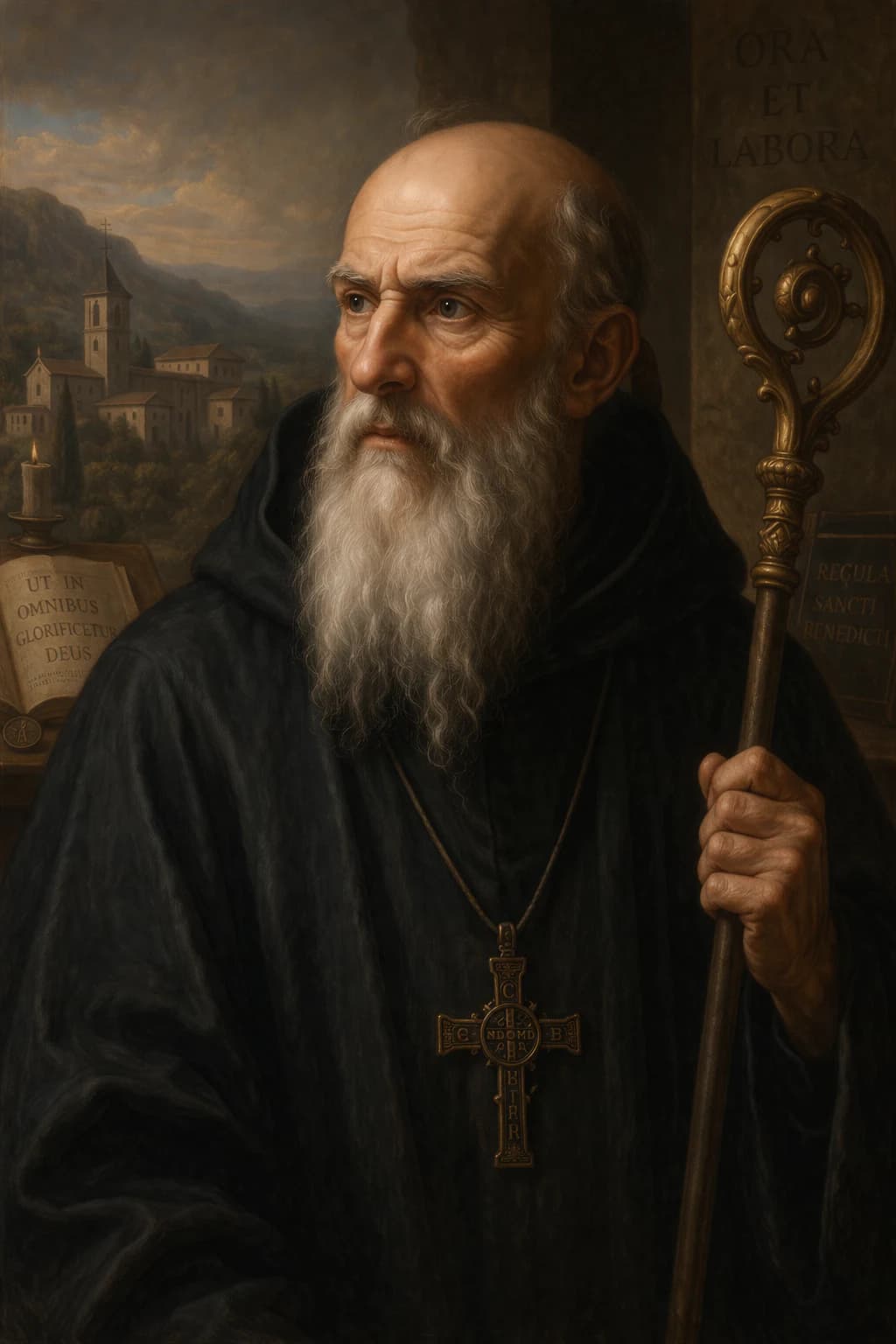
Benedict was born in Nursia in central Italy around 480, just after the formal end of the Western Roman Empire. The details of his youth come mainly through Pope Gregory the Great, writing decades later with the purpose of presenting a saintly life, so they must be read with care. Gregory says Benedict was sent to Rome for education and recoiled from the moral disorder he found there. Whether every detail is exact, the larger setting is plausible: Italy was politically unstable, old Roman institutions were weakening, and elite education no longer guaranteed a stable public career. Benedict's withdrawal was not simple disgust or escapism. It was a search for a form of life that could survive collapse by creating order at a smaller, more disciplined scale. His rejection of Rome became the first step toward building an alternative.
Disillusionment with an existing order can be the first step toward building a better one.
c. 500–520
Cave at Subiaco
The cave at Subiaco, set in the hills east of Rome, became the symbolic center of Benedict's formation. Gregory describes him living there in prayer, fasting, and solitude, helped by a monk named Romanus who brought him food. The story includes miracle and moral drama, but its historical meaning is clear: Benedict first pursued holiness by withdrawal, then discovered that withdrawal created authority. People began to seek him out. Nearby monks asked him to lead them, but his discipline reportedly proved too severe, producing resistance and even a poisoning attempt in Gregory's account. Whether literal or shaped for spiritual teaching, the episode captures a real tension in monastic life. Charisma could attract followers, but community required rules. Benedict's next step at Subiaco was therefore organizational: he began forming small groups of monks under structured leadership.
A reputation built in solitude can draw obligations that solitude itself cannot satisfy.
c. 529
Foundation of Monte Cassino
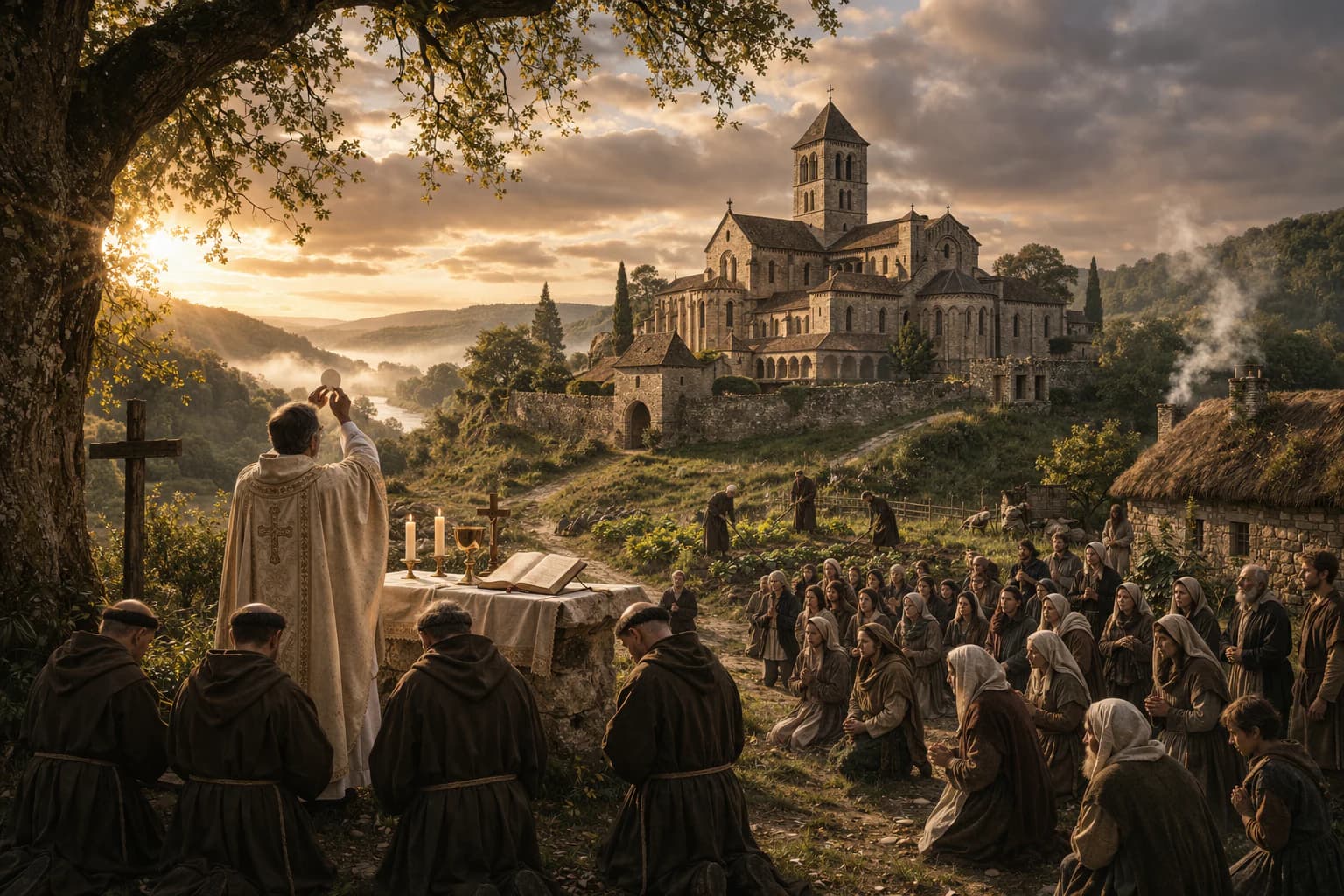
Around 529, Benedict moved with followers to Monte Cassino, a hilltop between Rome and Naples. Gregory presents the site as a place where lingering pagan worship was displaced by Christian monastic life, a story that reflects both spiritual conquest and the practical reuse of sacred landscapes. Monte Cassino's position was important: elevated, visible, and removed from city disorder without being cut off from the world. There Benedict built the monastery most closely associated with his name. It became a laboratory for disciplined community: prayer, work, obedience, hospitality, hierarchy, correction, and stability all had to be made practical for real human beings. Buildings could be destroyed, and Monte Cassino later was, more than once. But the way of life refined there proved portable, which is why the monastery's most enduring structure was textual: the Rule.
What endures is not always the physical structure but the community of practice it houses.
c. 530–540
Writing the Rule
The Regula Benedicti is powerful because it is practical. It organizes monastic life around prayer, reading, work, silence, obedience, hospitality, humility, and stability. The Divine Office gives the day its sacred rhythm, while manual labor and study prevent spirituality from becoming detached from ordinary discipline. The abbot receives real authority, but not permission to become a tyrant; he must consult the community and answer before God for those entrusted to him. Penalties are graduated, recognizing that monks fail and must be corrected rather than instantly discarded. Benedict drew on earlier monastic traditions, especially the Rule of the Master, but his version is shorter, more humane, and more adaptable. Its genius lies in its view of human nature. It expects weakness, pride, fatigue, and conflict, then builds a structure sturdy enough to carry them.
A rule designed for imperfect human beings will outlast one designed for perfect ones.
c. 529–547
Growth of the community
Benedict's reputation grew through disciples, visitors, and stories. Gregory the Great presents him as a prophet and wonder-worker, able to read hearts, defeat demons, and guide souls. Modern historians cannot treat every miracle story as straightforward reportage, but they can see what the stories reveal: Benedict was remembered as a man whose authority combined discipline, discernment, and care. The Rule itself points to a substantial community. It assumes an abbot, cellarer, porter, guests, novices, tools, property, correction, meals, illness, and the daily frictions of shared life. That texture is historically valuable. Benedict's achievement was not simply personal holiness. He created a model in which holiness could be organized, repeated, taught, and sustained by people who were not heroic every day.
A reputation for wisdom draws the very disciples needed to prove the wisdom was real.
480–547
A world in crisis
Benedict lived in an Italy marked by the afterlife of Roman collapse, Ostrogothic rule, and then Justinian's attempt to reconquer the peninsula. The Gothic Wars began while Benedict was at Monte Cassino and brought devastation that outlasted him. Roads, towns, estates, and older civic institutions all faced strain. Monte Cassino itself was destroyed by the Lombards around 580, a generation after Benedict's death, and the community was forced to relocate for a time. This context explains why the Rule mattered so much. Monasteries were not only places of prayer. They could preserve literacy, shelter travelers, distribute charity, cultivate land, copy books, and maintain routines when surrounding systems failed. Benedict did not set out to save Europe in a grand strategic sense. He built small, stable communities, and in an unstable world that was revolutionary enough.
Institutions built for spiritual purposes can become the most important practical institutions in a world where practical institutions have collapsed.
547
Death at Monte Cassino
Gregory's account of Benedict's death is deliberately holy: the saint receives the Eucharist, stands supported by his monks, and dies in prayer. The scene may be shaped as spiritual portraiture, but it expresses something true about Benedict's legacy. His death was imagined as the final act of the same disciplined life he had prescribed. Benedict died at Monte Cassino around 547, leaving behind no empire, no centralized order in the later sense, and no political office. What he left was more durable: a tested community and a text that could be copied. The Rule did not depend on Benedict's continuing charisma. It could travel without him, because it gave ordinary abbots and monks a way to make community function. That is why his influence outlived the man, the first monastery, and the political world around them.
The most durable legacies are those that do not require their creator's continued presence to function.
547–800
Adoption of the Rule
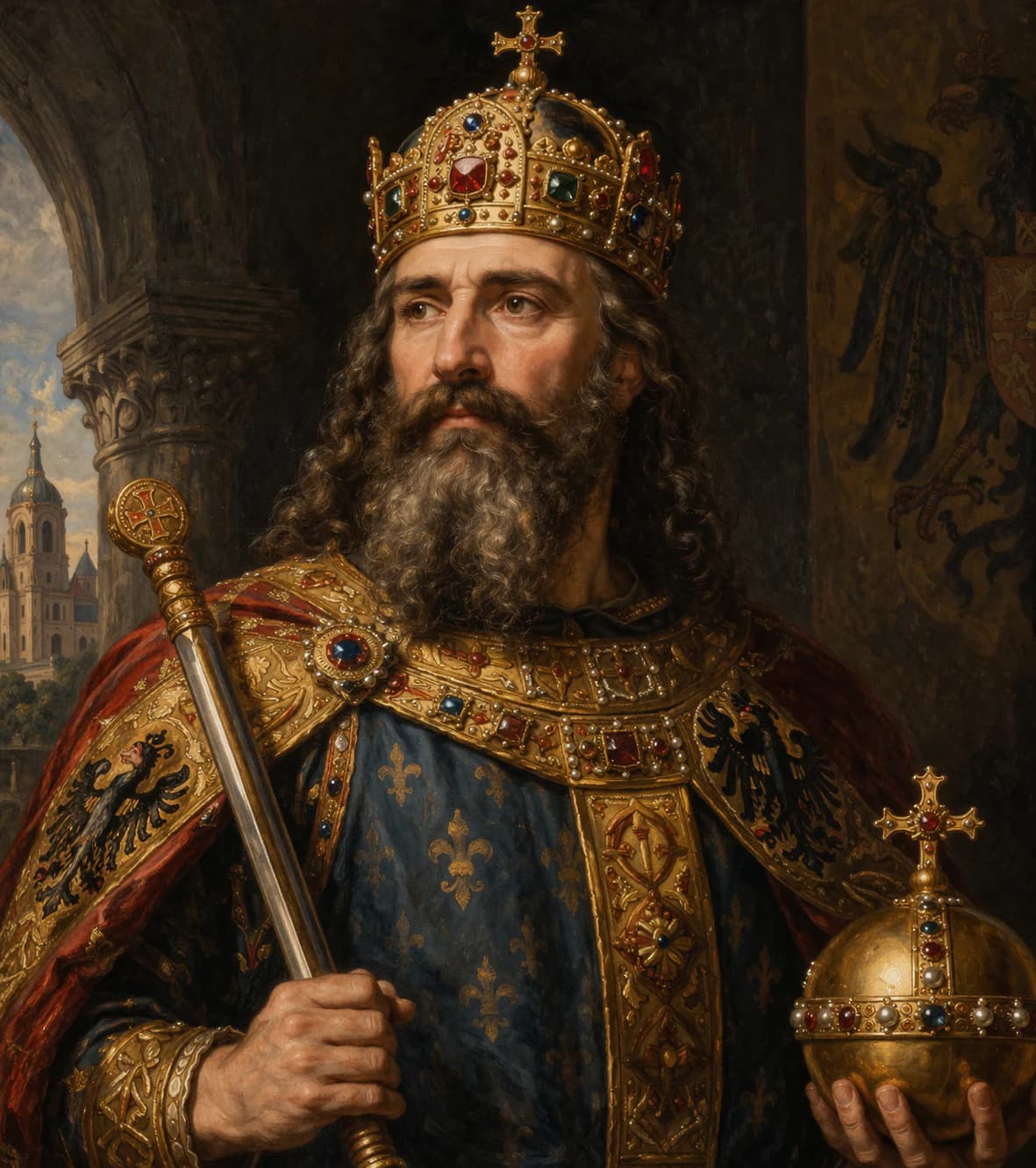
The spread of the Benedictine Rule was not immediate or inevitable. Other monastic rules competed with it, and for several centuries many monasteries operated according to local customs or mixed traditions. The Rule gained decisive momentum through its adoption by Charlemagne and his successor Louis the Pious, who sought to standardise monastic life across the Carolingian empire in the late eighth and early ninth centuries. From that point it became effectively the norm for western monasticism. The monasteries that adopted it became the primary centres of European literacy, copying manuscripts, running schools, providing healthcare, and preserving the knowledge that would eventually enable the medieval intellectual revival. None of this was what Benedict had explicitly intended, but all of it followed logically from what he had written.
An idea adopted by those with institutional power spreads at a different speed and scale than one left to find its own audience.
After 547
Patron of Europe
The designation of Benedict as patron of Europe in 1964 was an acknowledgement of an argument historians had been making for decades: that the monasteries established under his Rule had done more to preserve and transmit the culture of the ancient world than any secular institution of the early medieval period. At a time when schools, law courts, libraries, and governments had either ceased to function or functioned only sporadically, Benedictine monasteries maintained literacy, housed archives, trained scholars, and provided the administrative infrastructure that later medieval governance relied upon. The Rule that made this possible was a document of extraordinary practical intelligence: humane enough to function, structured enough to persist, and flexible enough to be applied across wildly different cultures and centuries.
A document that solves a practical human problem without demanding perfection of those it governs can last longer than any empire.