Complete chronology
Full overview and deeper context for every journey step.
1961–1979
Early Life
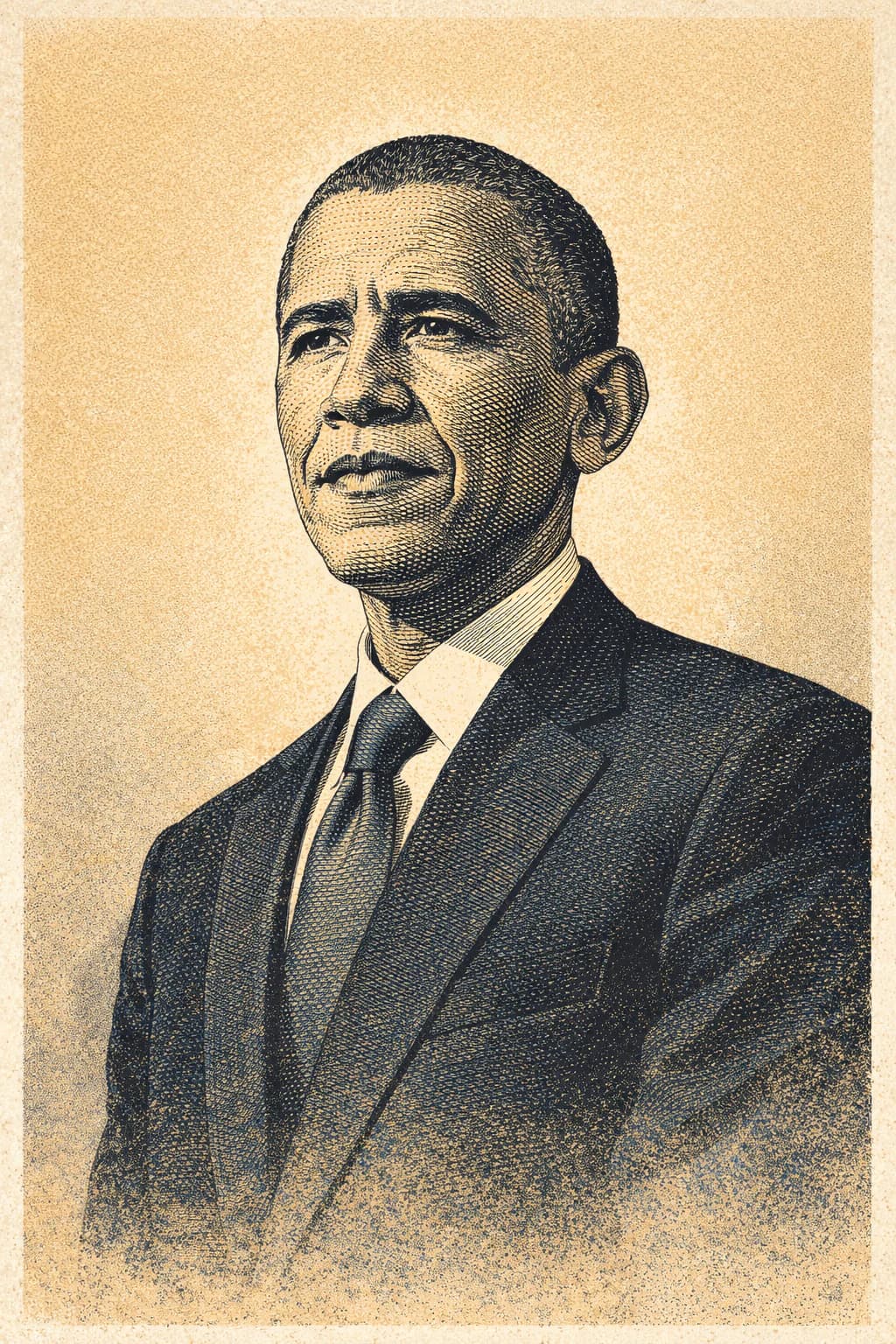
Barack Obama was born in Honolulu, Hawaii, in 1961 to Ann Dunham, a white American from Kansas, and Barack Obama Sr., a Kenyan student. His childhood crossed borders in ways unusual for a future American president. He lived for several years in Indonesia with his mother and stepfather before returning to Hawaii, where he was largely raised by his grandparents and educated at Punahou School. These movements gave him early experience of belonging and not belonging, privilege and distance, American identity and the wider world. Obama later turned that complexity into political language, presenting his own biography as evidence that the United States could contain difference without breaking. That story was powerful, but it was also carefully shaped. His early life did not predetermine his politics; it gave him material from which to build a public identity centered on bridge-building, aspiration, and restraint.
His formative years cultivated an instinct to bridge cultural and social divides.
1979–1991
Academic Path
Obama studied first at Occidental College, then transferred to Columbia University, where he completed a degree in political science. His intellectual development was not simply a march through elite institutions. It included uncertainty, self-fashioning, and a search for purpose that later shaped his memoir Dreams from My Father. After community work in Chicago, he entered Harvard Law School and became the first Black president of the Harvard Law Review. That achievement gave him national notice and proved his ability to navigate elite legal culture without losing the broader civic language he had developed outside it. Harvard sharpened his constitutional thinking, his respect for careful argument, and his instinct for coalition. It also positioned him within networks of law, politics, and media that would later accelerate his rise. His education mattered because it joined analysis to narrative.
His education combined intellectual discipline with leadership experience, preparing him for public life.
1980s
Community Organizer
Before he became a national figure, Obama worked as a community organizer on Chicago's South Side, especially with church-based groups in neighborhoods affected by deindustrialization, unemployment, housing problems, and public neglect. The work was slow, often frustrating, and far from glamorous. It required listening before speaking, finding local leaders, convening meetings, negotiating with officials, and accepting that progress might mean an asbestos-removal campaign or job-training program rather than a dramatic victory. This period became central to Obama's political self-understanding. It taught him that policy only matters when it reaches institutions people actually use: schools, churches, workplaces, streets, and homes. It also exposed him to the limits of idealism without power. Organizing gave him a moral vocabulary, but it helped persuade him that elected office offered tools community work alone could not provide.
Grassroots work taught him that lasting change depends on collective effort, not just policy design.
1996
Entry into Politics
Obama entered the Illinois State Senate in 1997, representing a district on Chicago's South Side. His legislative work included ethics reform, health care expansion, tax credits for working families, and criminal justice measures, including efforts to require videotaped interrogations in capital cases. These were not symbolic exercises. Illinois politics demanded patience, relationship-building, and a willingness to work with Republicans as well as Democrats when the numbers required it. Obama learned how bills moved, how committee work mattered, and how ambitious rhetoric had to survive the small print of legislation. He also suffered a major setback in 2000 when he lost a Democratic congressional primary to Bobby Rush. That defeat checked his momentum and taught him that biography, intellect, and promise were not enough. He needed timing, organization, and a wider political lane.
His early political career emphasized negotiation as a practical tool for achieving reform.
2004
National Emergence
Obama's keynote address at the 2004 Democratic National Convention made him a national figure almost overnight. The speech presented a biography of mixed inheritance and a politics of unity, arguing against a country divided into red and blue tribes. Its power lay in timing. After the Iraq War, partisan bitterness, and contested elections, many voters and commentators were ready to hear a language of civic repair. Later that year, Obama won election to the U.S. Senate from Illinois. In Washington he worked on issues including ethics, nonproliferation, veterans, and transparency, but his fame quickly outpaced his seniority. The 2004 speech created both opportunity and risk: he became a symbol before he had compiled a long national record. His next challenge was to turn promise into a presidential movement without seeming merely ambitious.
A single moment of visibility can accelerate a political career when it aligns with a compelling message.
2007–2008
Presidential Campaign
Obama announced his presidential campaign in 2007, challenging Hillary Clinton, the best-known Democrat in the race. His campaign fused message, organization, and technology with unusual discipline. 'Hope' and 'change' were not policy details, but they gave millions of supporters a way to imagine politics after the George W. Bush years and the Iraq War. The campaign built a large volunteer network, used digital fundraising and organizing effectively, and competed fiercely in caucus states often overlooked by older campaign models. Obama's victory in the Democratic primaries was not inevitable; it required strategic patience and an ability to survive questions about experience, race, religion, patriotism, and electability. In the general election, the financial crisis intensified demand for change. His election in November 2008 was historic because of race, but also because it marked a generational shift in American political style.
Mobilizing people around a shared narrative proved as important as the policies themselves.
2009–2013
First Term
Obama took office in January 2009 during the worst economic crisis since the Great Depression. His administration backed a large stimulus package, bank rescue measures begun under the previous administration, and auto industry support, arguing that emergency action was necessary to prevent deeper collapse. The recovery was real but uneven, and many Americans experienced it as too slow, too technical, or too favorable to institutions that had helped cause the crisis. His defining domestic achievement was the Affordable Care Act of 2010, which expanded coverage, regulated insurers, and became one of the most contested laws in modern American politics. Abroad, he inherited wars in Iraq and Afghanistan, authorized the operation that killed Osama bin Laden in 2011, and tried to reset America's global image. His first term revealed the central tension of his presidency: transformational promise operating inside crisis management, institutional limits, and fierce partisan resistance.
Leadership in crisis requires balancing urgent action with long-term structural change.
2013–2017
Second Term
Obama's second term unfolded in a more constrained political landscape. Republicans controlled the House for much of his presidency, and after 2014 controlled the Senate, limiting major legislation. Obama increasingly relied on executive action, regulation, diplomacy, and public argument. His administration helped negotiate the Paris climate agreement and the Iran nuclear deal, restored diplomatic relations with Cuba, supported marriage equality as public opinion shifted, and used executive authority on immigration after Congress failed to act. The second term also exposed severe limits. The Syrian civil war, the rise of ISIS, drone warfare, Russian intervention in Ukraine, and domestic debates over policing and race all complicated his image as a post-partisan healer. Obama remained calm and rhetorically gifted, but the country around him became more polarized. His presidency ended with achievements intact and divisions sharpened.
Sustained leadership often depends on adapting goals to shifting political realities.
2017–present
Post-Presidency Impact
After leaving office in January 2017, Obama remained one of the most influential figures in Democratic politics and global public life. Through the Obama Foundation, writing, speeches, and selective campaign involvement, he has emphasized civic leadership, democratic resilience, and the need to rebuild trust in institutions. His legacy remains deeply contested. Supporters point to the Affordable Care Act, economic recovery, climate diplomacy, the killing of bin Laden, and the symbolic power of the first Black presidency. Critics from the right see overreach and polarization; critics from the left argue that he was too cautious on Wall Street, inequality, immigration, war powers, and structural reform. The fairest reading holds the tension. Obama expanded what seemed politically possible, but he governed in a system designed to resist speed. His biography remains a story of hope tested by power.
Influence can persist beyond formal power through ideas, example, and continued engagement.