Complete chronology
Full overview and deeper context for every journey step.
1755–1772
Caribbean childhood
Alexander Hamilton's biography begins not in the mainland colonies but in the British Caribbean, a world of trade, empire, slavery, hurricanes, credit, and social hierarchy. Born on Nevis to Rachel Faucette and James Hamilton, he grew up with the stigma of illegitimacy and without the security of an established family name. His father left, his mother died, and Hamilton entered working life young as a clerk on St. Croix. That experience mattered. Before he became the architect of American finance, he had already seen bills of exchange, shipping risks, debt, insurance, commodity prices, and the fragility of commercial confidence in daily practice. A vivid published letter about a 1772 hurricane revealed his literary talent and persuaded local patrons to fund his education in North America. Hamilton's rise was not a simple escape from poverty; it was the making of a mind that understood how power moved through money, paper, trust, and institutions.
Early exposure to instability and commerce helped him value structure, order, and economic strength later in life.
1772–1775
Education in colonies
Hamilton studied first in New Jersey and then at King's College in New York, the institution later renamed Columbia. He arrived as a scholarship case but rapidly entered public argument. The imperial crisis gave ambitious young writers a stage, and Hamilton seized it. In pamphlets and speeches, he defended colonial rights with a confidence that made him seem older than he was. He attacked arbitrary power, argued for resistance, and displayed the gift that would define his career: the ability to make complicated constitutional and economic questions urgent. The Revolution offered Hamilton both a cause and a ladder. Unlike land-rich elites, he had no estate to inherit and no dynasty behind him. Public service, war, and writing became the path by which he could turn talent into authority.
His rapid rise in intellectual circles showed how persuasive communication could open doors to influence.
1775–1781
Revolutionary officer
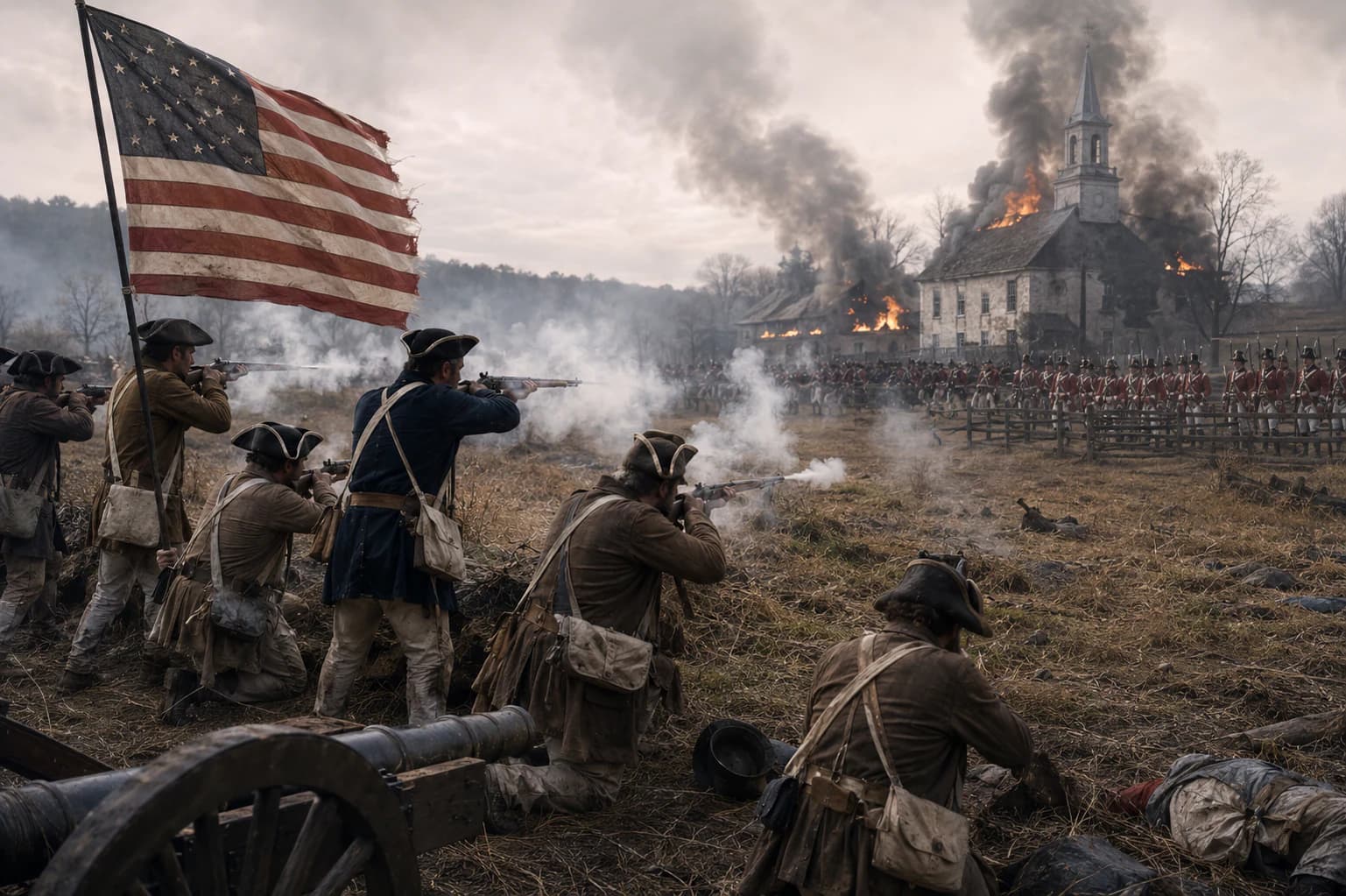
Hamilton entered the Revolutionary War with energy and impatience. He organized and led an artillery company in New York, then came to George Washington's attention and joined the commander in chief's military family as an aide-de-camp. The position was demanding: drafting letters, handling intelligence, coordinating with Congress and generals, and watching the weakness of the Continental system from inside headquarters. Hamilton admired Washington, but he also chafed at staff work because he wanted battlefield glory. He eventually received command and led an assault on Redoubt No. 10 at Yorktown in 1781, helping secure the decisive Franco-American victory over Cornwallis. The war confirmed his central political lesson. Independence could not survive on enthusiasm alone. It required revenue, supply, executive energy, military coordination, and a national government stronger than the Articles of Confederation allowed.
His wartime service reinforced his belief that strong centralized leadership was essential for success.
1781–1787
Push for union
Peace exposed the Revolution's unresolved problem: the United States had won independence before it had built a state capable of sustaining it. Congress struggled to raise revenue, pay debts, regulate commerce, negotiate with credibility, or respond to unrest. Hamilton, serving briefly in Congress and then practicing law in New York, became one of the sharpest critics of this weakness. He did not want monarchy, but he feared fragmentation, local jealousies, paper-money politics, and national humiliation. He helped push the meeting at Annapolis in 1786 that led toward the Constitutional Convention. For Hamilton, union was not sentimental. It was a practical necessity. A republic without public credit, fiscal capacity, and enforceable national authority would remain vulnerable to foreign pressure and domestic disorder.
He viewed disorder not as temporary growing pains but as a sign of deeper structural flaws.
1787–1788
Constitution advocate
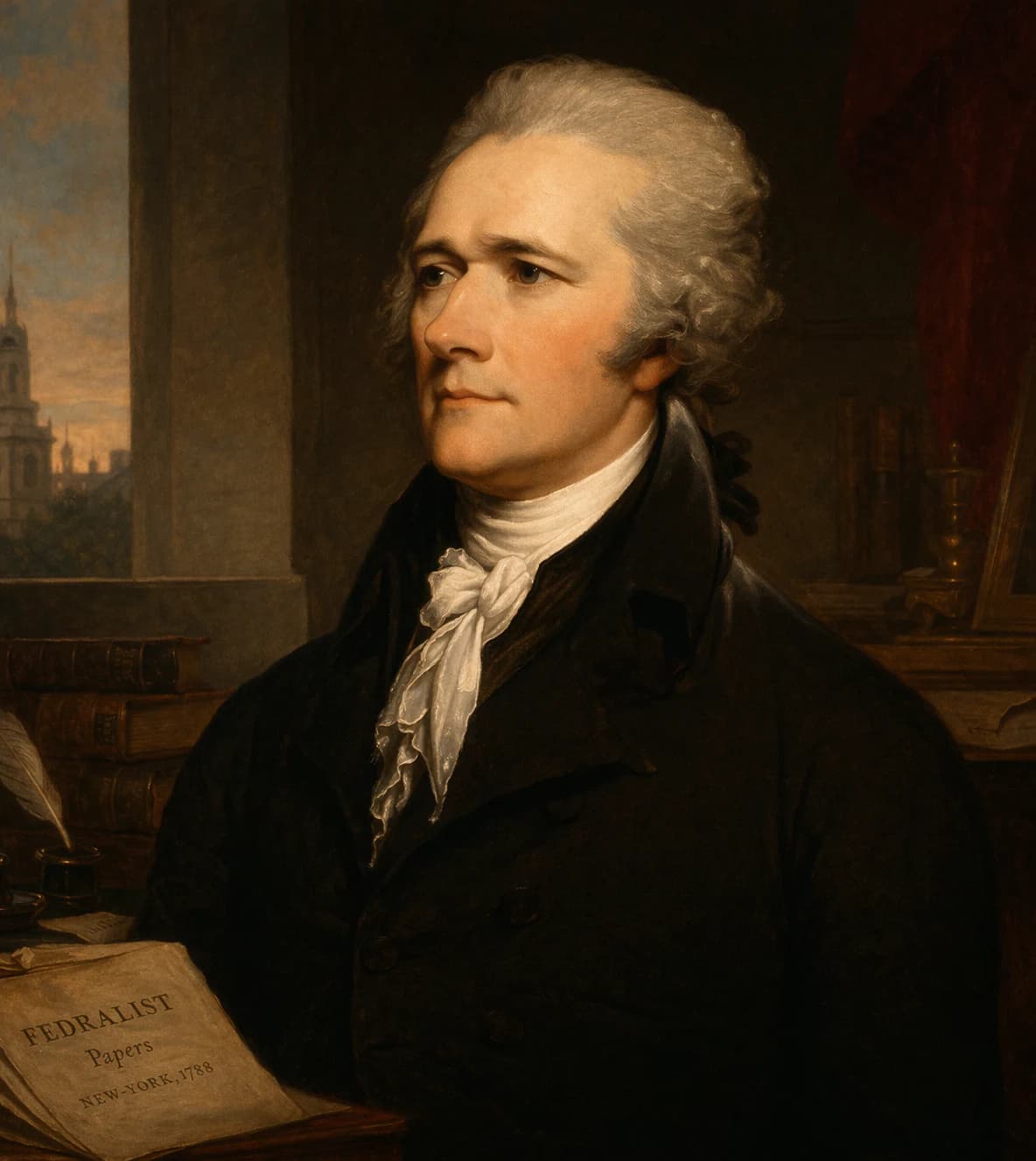
At the Constitutional Convention of 1787, Hamilton's own preferred model was far more centralized than most delegates would accept. He left disappointed in some respects, but he understood that the proposed Constitution was vastly stronger than the Articles and worth defending. With James Madison and John Jay, he wrote The Federalist Papers under the name Publius. Hamilton wrote the majority of the essays, including powerful defenses of union, taxation, executive power, the judiciary, and public administration. The essays were immediate political advocacy for ratification in New York, but they became something larger: a durable explanation of how the Constitution was supposed to work. Hamilton's achievement here was not simply eloquence. He gave readers a theory of government rooted in human ambition, faction, weakness, and the need for institutions that could channel conflict instead of pretending it would disappear.
He understood that ideas alone were not enough; public persuasion was essential for lasting change.
1789–1795
Financial architect
Hamilton's years as Treasury Secretary from 1789 to 1795 made his reputation and his enemies. The United States faced state and federal debts, weak revenue, unstable currency, and uncertain international credit. Hamilton proposed that the federal government assume state Revolutionary War debts, fund the national debt at full value, create reliable revenue through tariffs and excise taxes, establish a national bank, support manufacturing, and bind wealthy creditors to the success of the new government. Critics saw favoritism toward speculators, dangerous centralization, and a British-style financial system hostile to agrarian republicanism. Hamilton saw something different: a republic that needed credit to survive, capital to grow, and federal authority strong enough to act. The First Bank of the United States, the funding system, and the reports he produced turned finance into nation-building. His policies helped make the federal government real in everyday economic life.
He treated finance not as bookkeeping, but as a foundation for national power and credibility.
1790s
Political conflict
Hamilton did not merely administer policy; he forced Americans to choose between competing futures. Jefferson and Madison feared that his financial system concentrated power among creditors, merchants, and federal officeholders. Hamilton believed their suspicion of national power risked weakness, provincialism, and instability. Foreign policy sharpened the divide. The French Revolution, war between Britain and France, and Jay Treaty controversy turned arguments over finance into arguments over liberty, empire, commerce, and revolution itself. Hamilton's Federalists favored commercial development, strong federal authority, and a more pro-British neutrality. Democratic-Republicans warned against aristocracy and executive overreach. Hamilton's brilliance made him formidable; his combativeness made him combustible. He helped build the structures of government while also helping create the partisan world that would fight over them.
His bold approach advanced his goals but also deepened divisions that defined early political life.
1804
Fatal rivalry
By the early 1800s, Hamilton was out of office but not out of politics. He had damaged John Adams within the Federalist Party, opposed Aaron Burr's ambitions, and remained a relentless writer and private strategist. Burr, the sitting vice president, believed Hamilton had repeatedly attacked his honor and blocked his political future. The duel at Weehawken, New Jersey, on 11 July 1804 came from a culture in which elite reputation could become a matter of ritual violence. Hamilton appears to have intended not to fire directly at Burr, though details remain debated. Burr fired and mortally wounded him. Hamilton died the next day. The tragedy was personal, political, and symbolic. A man who had spent his life trying to discipline disorder was killed by one of the most irrational customs of his own social world.
Personal conflict can overpower even the most significant public contributions, with lasting consequences.
Post-1804
Enduring legacy
Hamilton's importance is larger than any single office he held. He gave the early United States a working theory of public credit, federal power, executive administration, and economic development. Later Americans fought over him because his ideas kept returning whenever the country faced banks, debt, industrial policy, constitutional interpretation, war finance, or the balance between national authority and local control. His critics were not foolish; Hamilton could be elitist, impatient, and too ready to trust power when he believed it would produce order. But the institutions he built helped the United States survive its fragile beginning. To ask why Alexander Hamilton mattered is to ask how a revolutionary movement became a functioning state. His answer was controversial, ambitious, and enduring: liberty needed structure, and structure required power that could actually act.
His impact lies not just in what he built, but in how his ideas continue to shape debate.